A day in Lomagne
DIDIER HEUMANN, MILENA DALLA PIAZZA, ANDREAS PAPASAVVAS
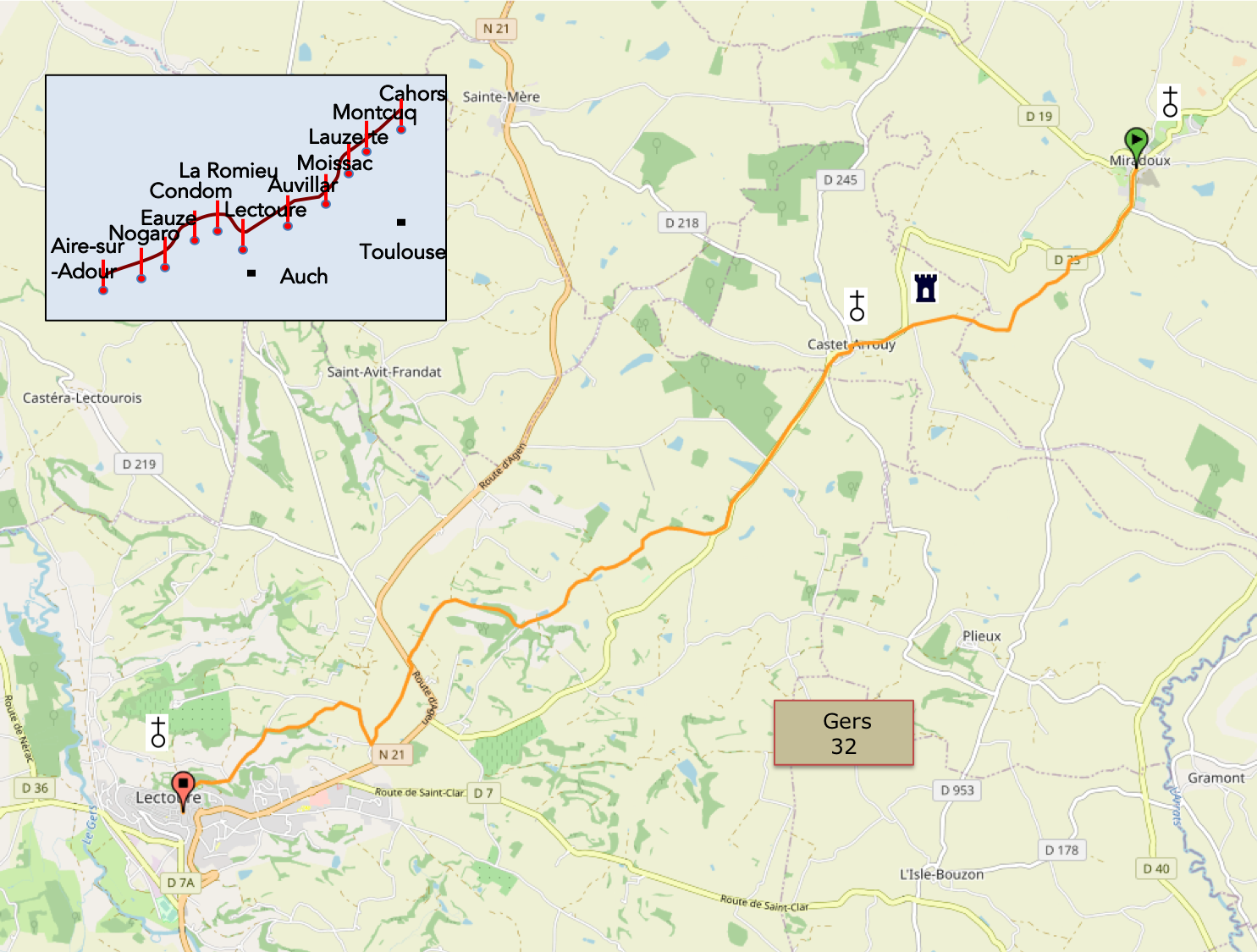
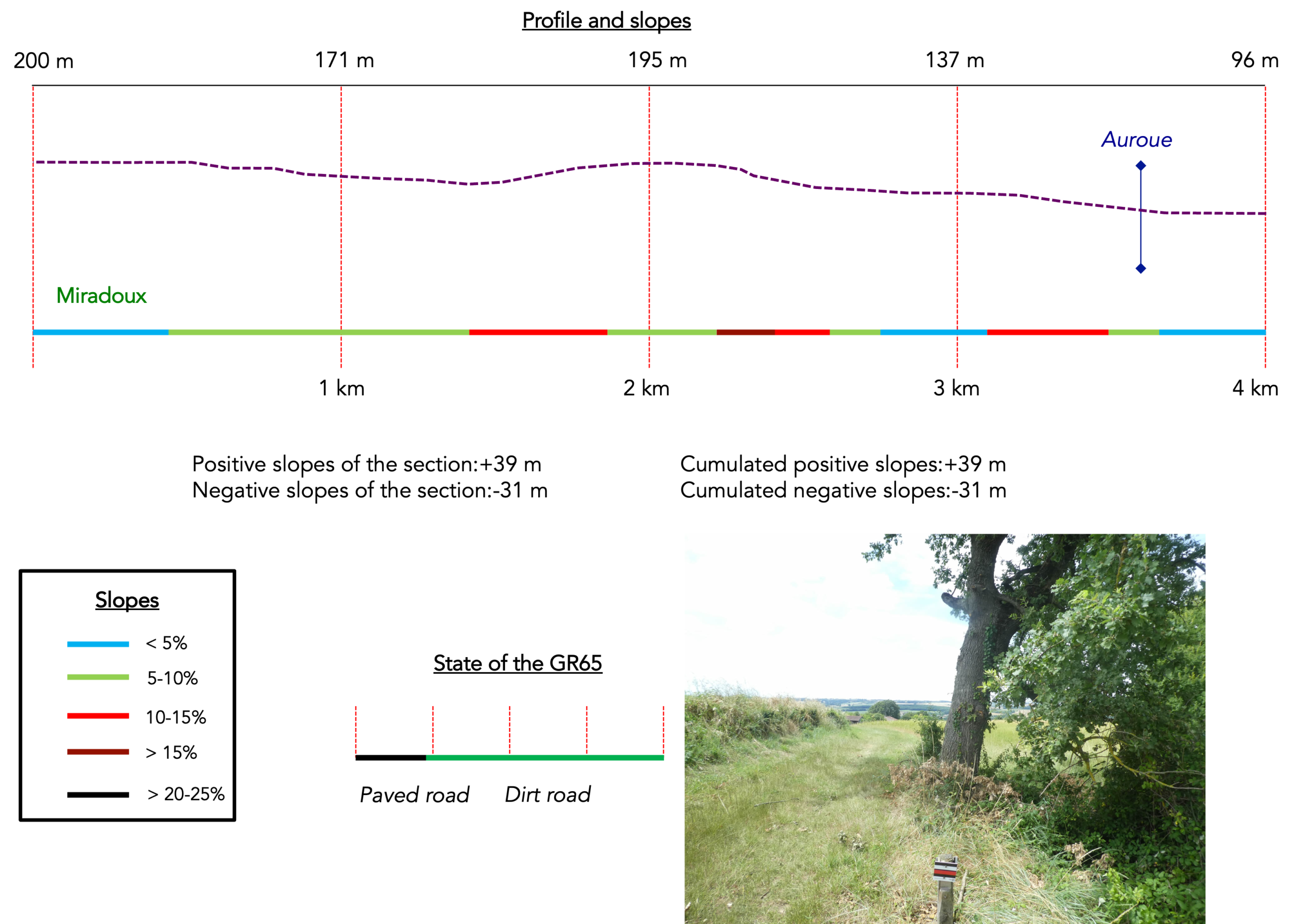
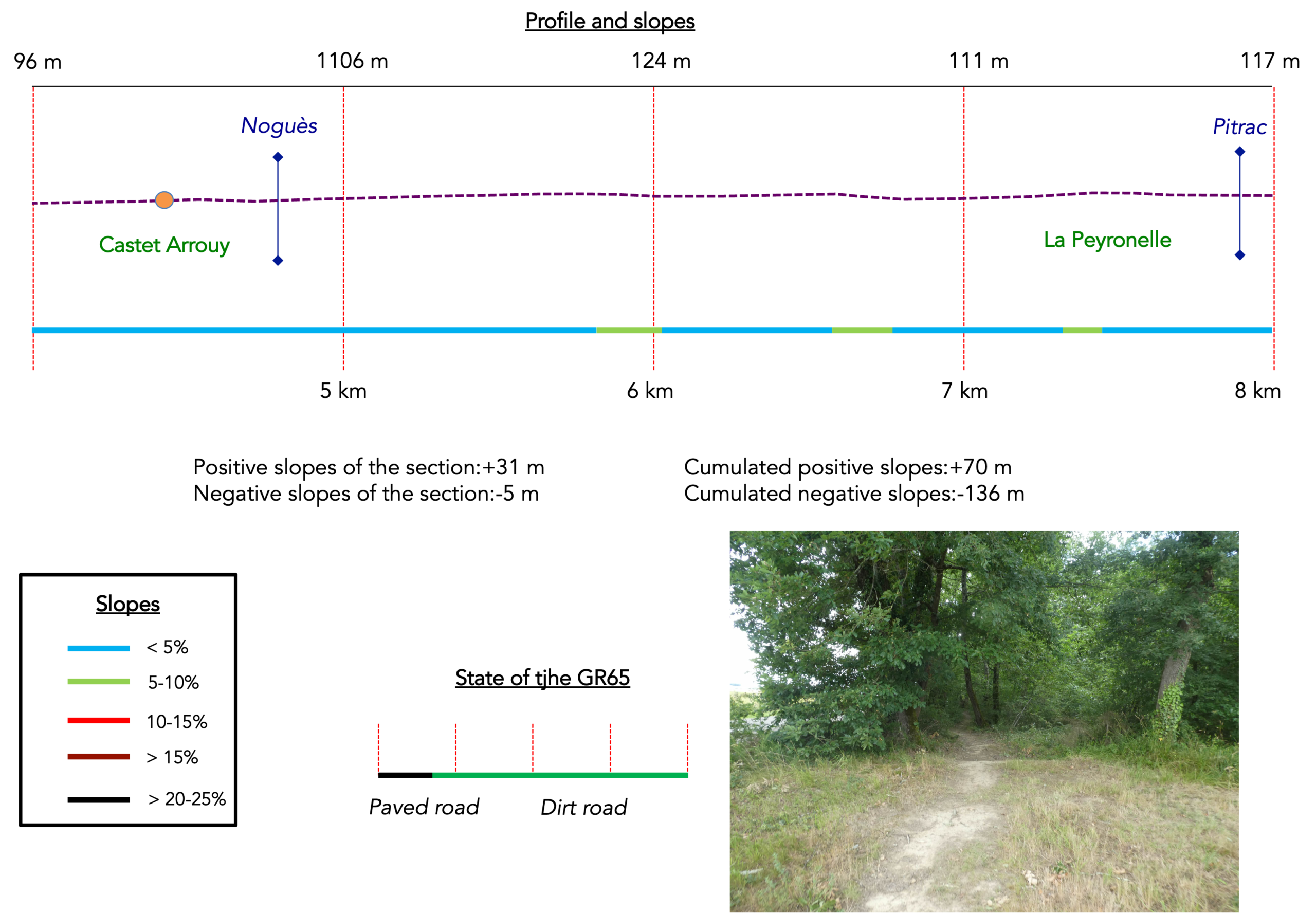
We divided the course into several sections to make it easier to see. For each section, the maps show the course, the slopes found on the course, and the state of the roads. The courses were drawn on the « Wikilocs » platform. Today, it is no longer necessary to walk around with detailed maps in your pocket or bag. If you have a mobile phone or tablet, you can easily follow routes live.
For this stage, here is the link:
https://fr.wikiloc.com/itineraires-randonnee/de-auvillar-a-lectoure-par-le-gr65-30586915
|
Not all pilgrims are necessarily comfortable using GPS devices or navigating with a smartphone, especially since there are still many areas without Internet access. That is why, to make your journey easier, a book dedicated to the Via Podiensis from Cahors to Le-Puy-en-Velay is available on Amazon. Much more than a simple practical guide, this book accompanies you step by step, kilometer after kilometer, providing all the information you need for smooth planning and avoiding unpleasant surprises. Beyond its practical advice, it immerses you in the enchanting atmosphere of the Camino, capturing the beauty of the landscapes, the majesty of the trees, and the very essence of this spiritual adventure. Only the pictures are missing, everything else is there to transport you.
In addition, we have also published a second book which, with slightly fewer details but all the essential information, covers the entire route from Le Puy-en-Velay to Saint-Jean-Pied-de-Port. The choice of your journey is yours.
|
 |
 |
If you only want to consult lodging of the stage, go directly to the bottom of the page.
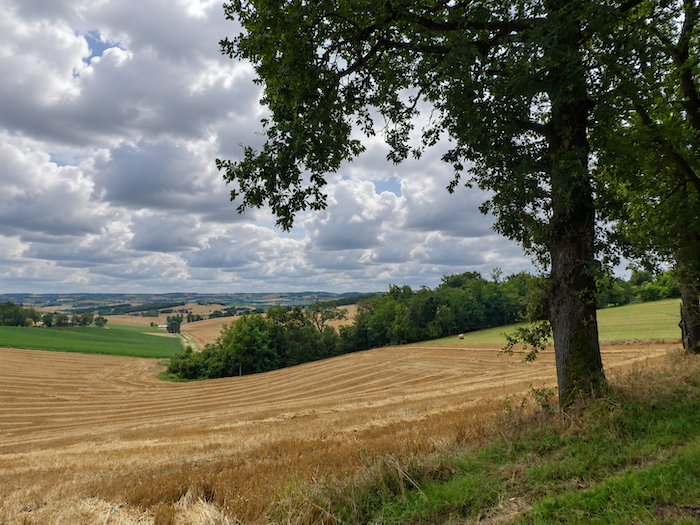
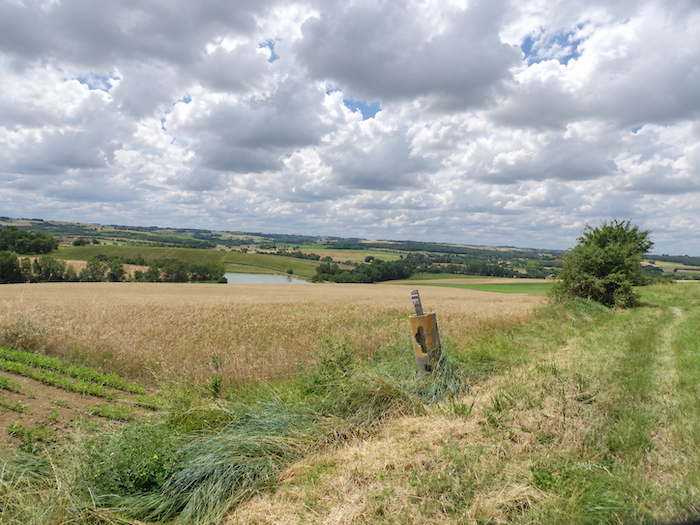
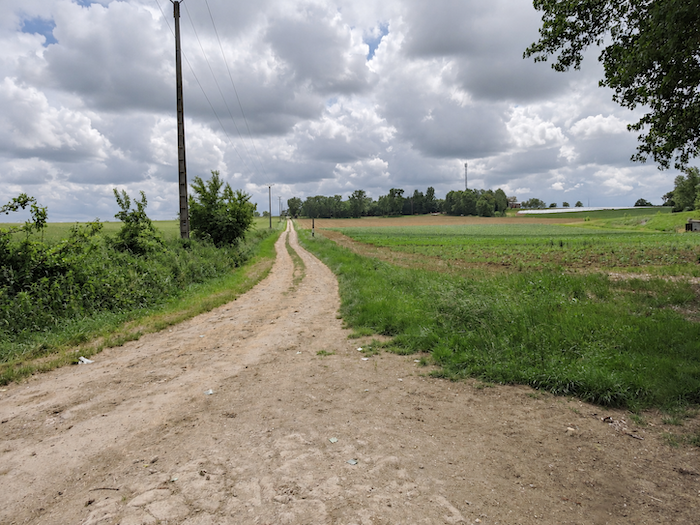
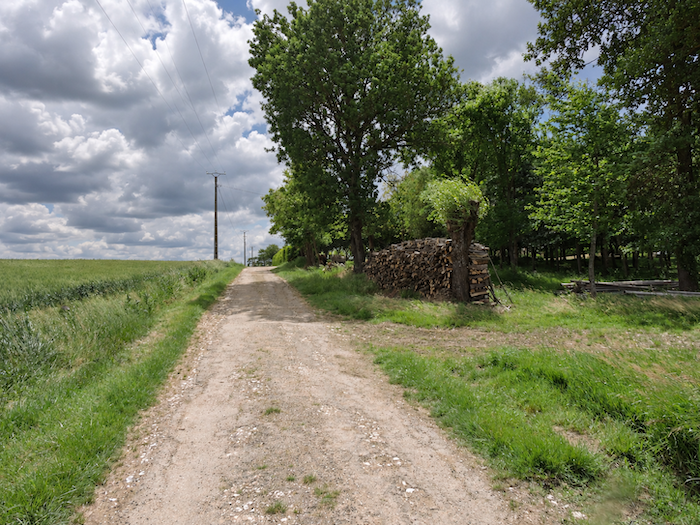
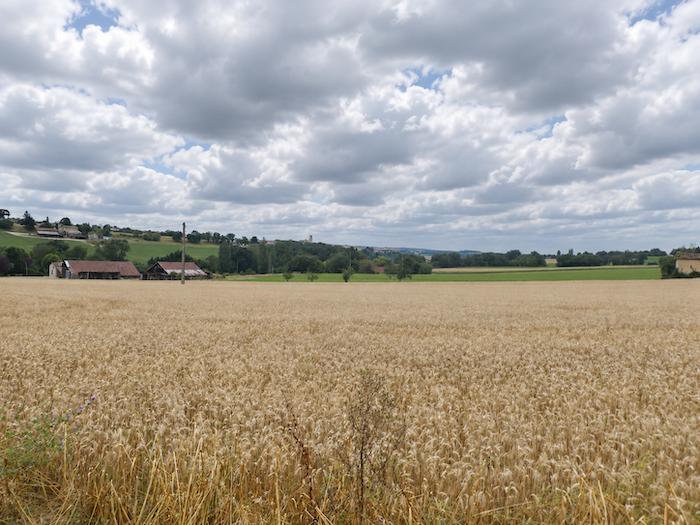
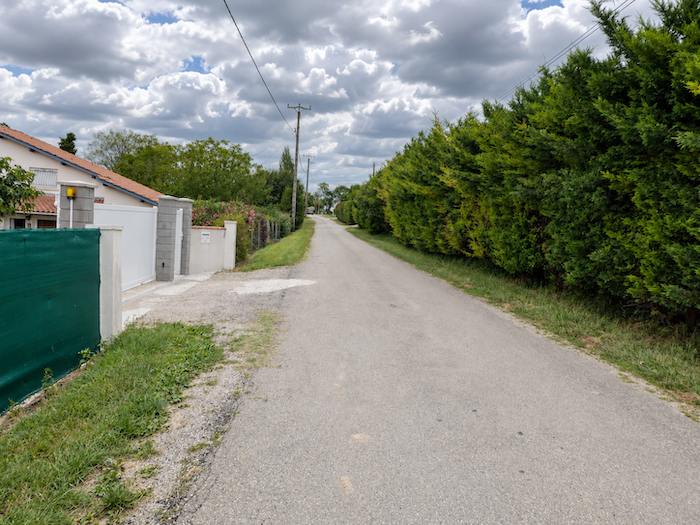
Today, you will cross a large part of the Gers region of Lomagne, the northernmost territory of the Gers department. Lomagne is characterized by broad valleys carved into an extensive limestone bedrock, together with rolling hills crowned by ridges and small plateaus. The landscape often consists of vast, open expanses, dotted here and there with outcrops of white limestone and scattered groves where oak trees still predominate. The soils of Lomagne are exceptionally fertile, as the limestone has enriched the clay, creating excellent land for growing wheat.
Older buildings are often constructed from rough-hewn stone, usually concealed beneath a layer of lime plaster, leaving only the finely dressed stonework around doors and windows exposed. The bastide towns, such as Lectoure, Flammarens, Miradoux and Auvillar, seem frozen in time. With their distinctly medieval appearance, they stand on strategically positioned hilltops. Towers, ramparts, moats and patrol walkways, all the features of their fortified past are still there. Yet these towns and villages have suffered considerably from the rural exodus and are now largely deserted. Their historic centers have often deteriorated, with many houses standing empty or falling into ruin. Centred around Lectoure, the historical and cultural capital of Lomagne, the Lectourois area offers a remarkable concentration of the region’s characteristic landscapes.
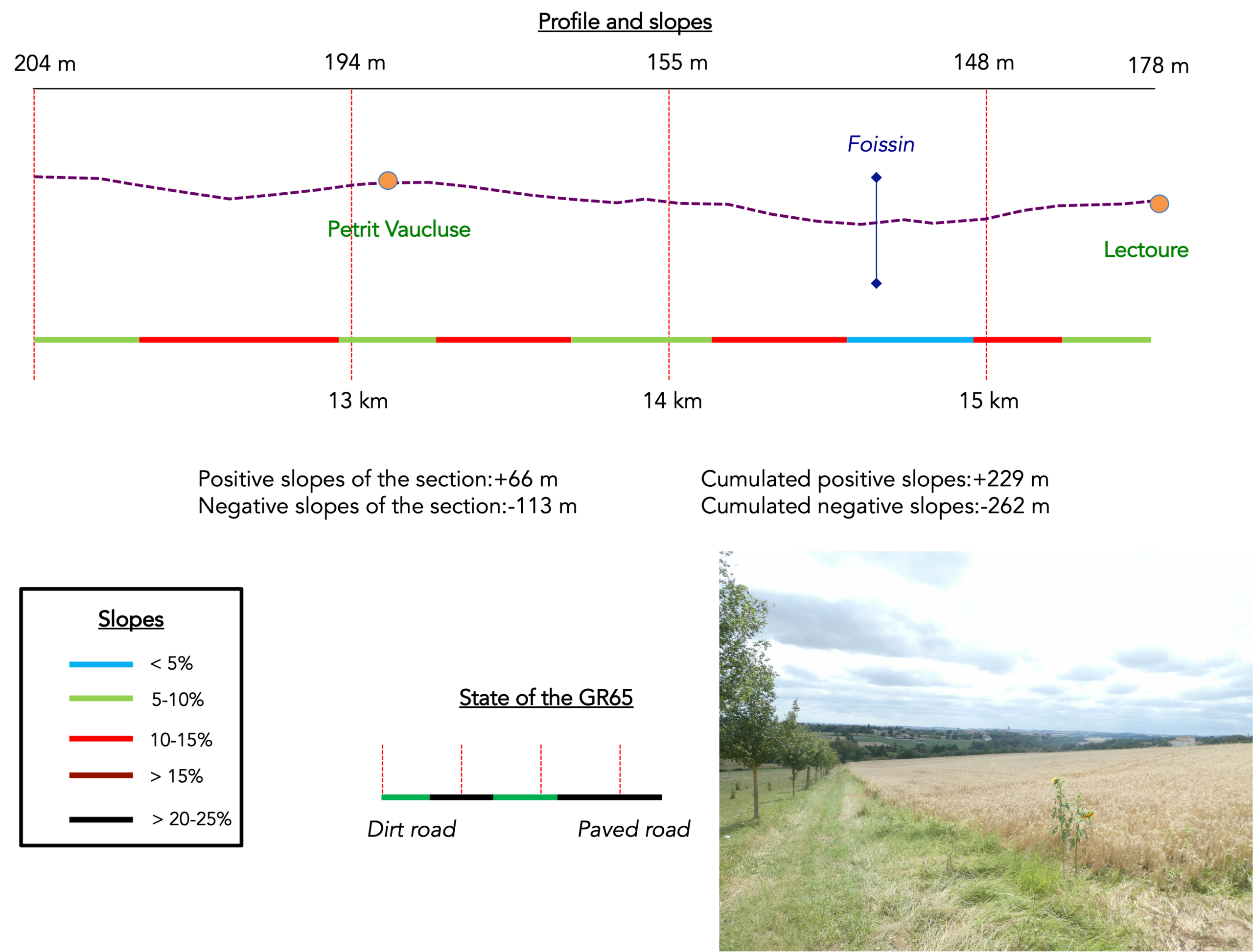
Difficulty level: Today’s elevation changes (+229 meters / -262 meters) are once again very modest, especially since we have chosen to divide the long stage between Auvillar and Lectoure that some pilgrims complete in a single day. In Lectoure, people say that pilgrims arrive on their knees, exhausted by the length of the stage and the final climb into town. Today’s stage presents no major difficulties along the route. You will rarely rise above 200 meters in altitude, and only a few gentle climbs and descents punctuate the journey. No pilgrim would claim that this is the most beautiful stage of the Way of St James.
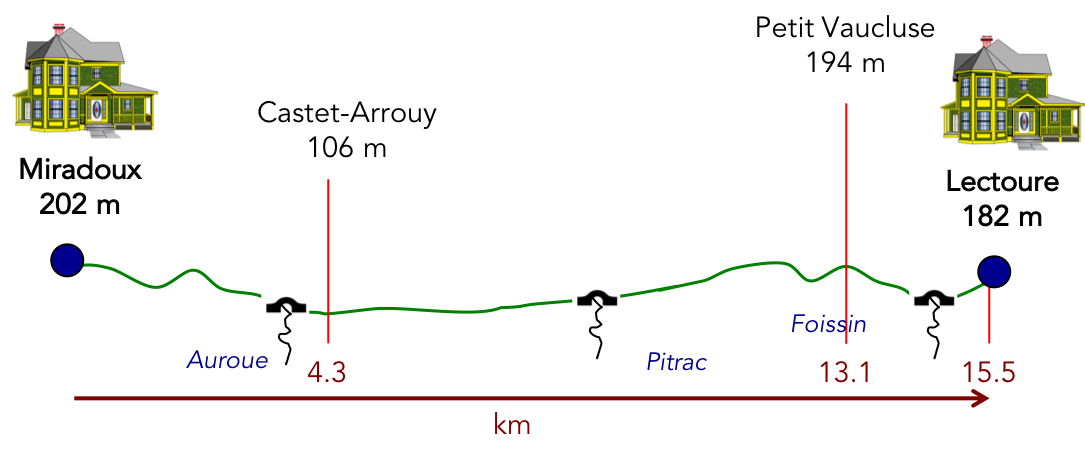
State of the GR65: Today’s route consists predominantly of paths, although some simply run alongside roads:
- Paved roads: 3.8 km
- Dirt roads: 11.7 km
Sometimes, for reasons of logistics or housing possibilities, these stages mix routes operated on different days, having passed several times on Via Podiensis. From then on, the skies, the rain, or the seasons can vary. But, generally this is not the case, and in fact this does not change the description of the course.
It is very difficult to specify with certainty the incline of the slopes, whatever the system you use.
For « real slopes », reread the mileage manual on the home page.

Section 1: In the Lomagne countryside
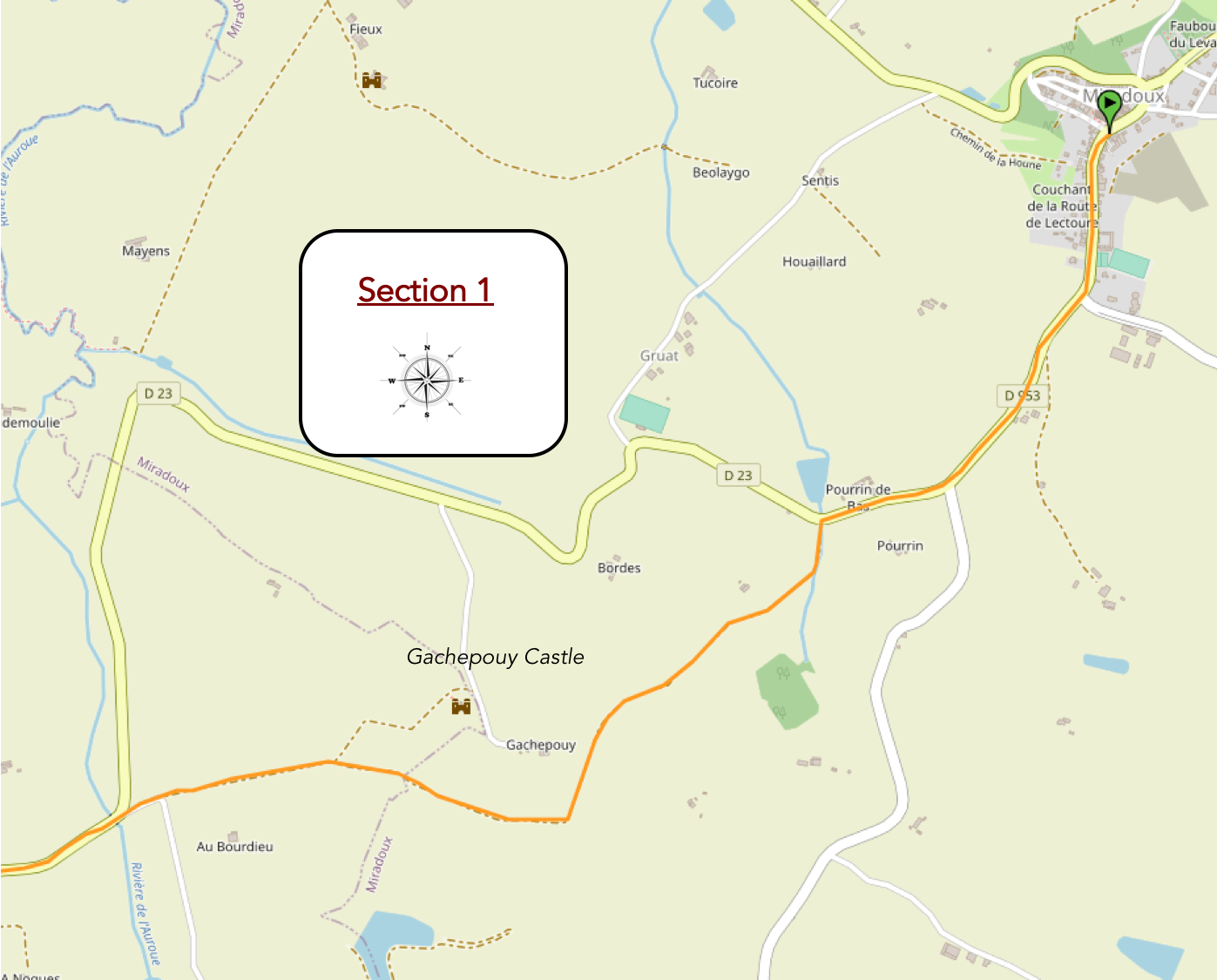
Overview of the route’s challenges : course without major difficulty.
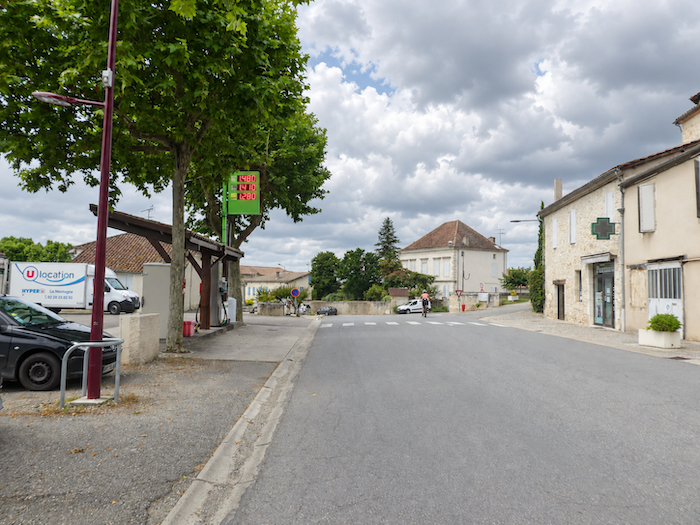
| The GR65 bids farewell to Miradoux from the small shopping square, just a stone’s throw from the church, where the ever-present Virgin Mary, draped in blue and white, has faithfully kept watch for as long as anyone can remember. |
 |
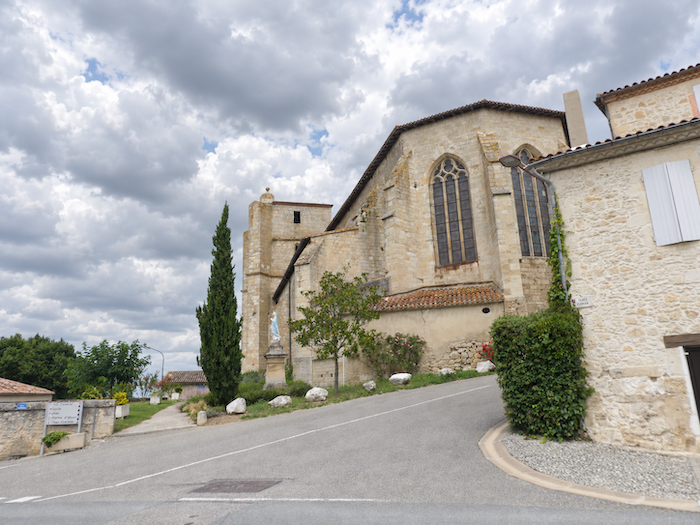 |
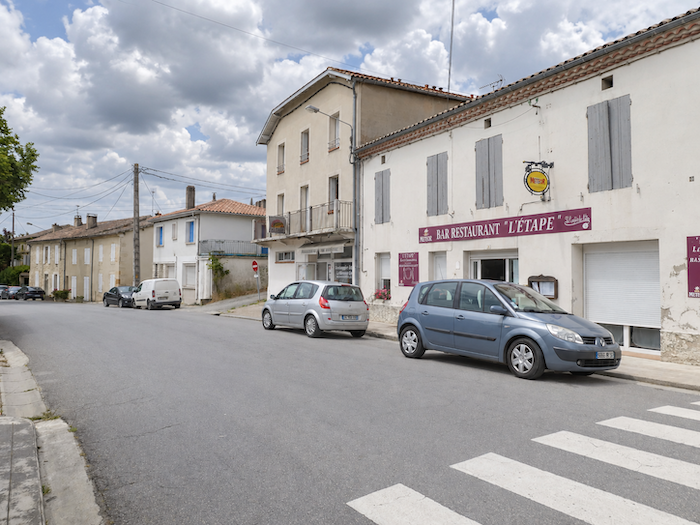
| The passage through the village ends with a descent along the departmental road, gradually leading pilgrims towards the last houses. |
 |
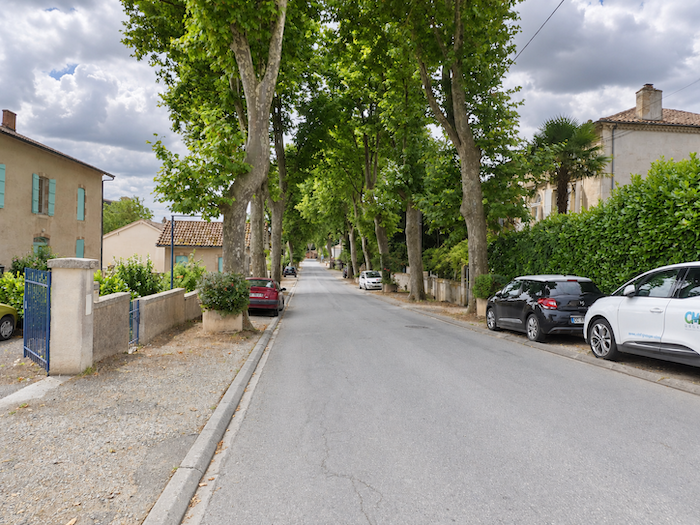 |
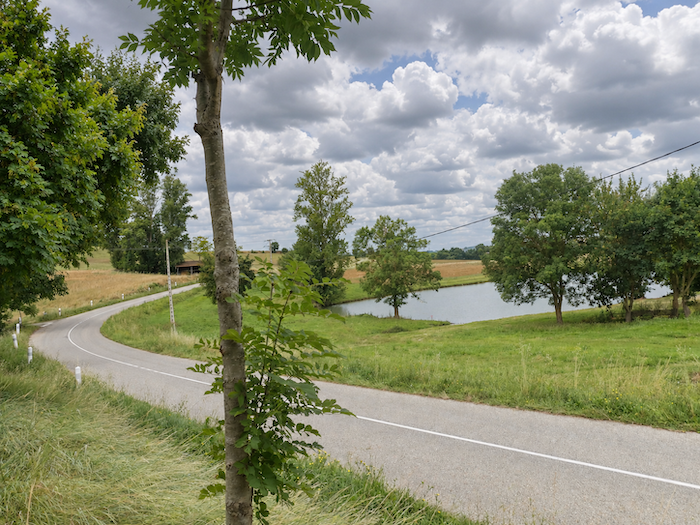
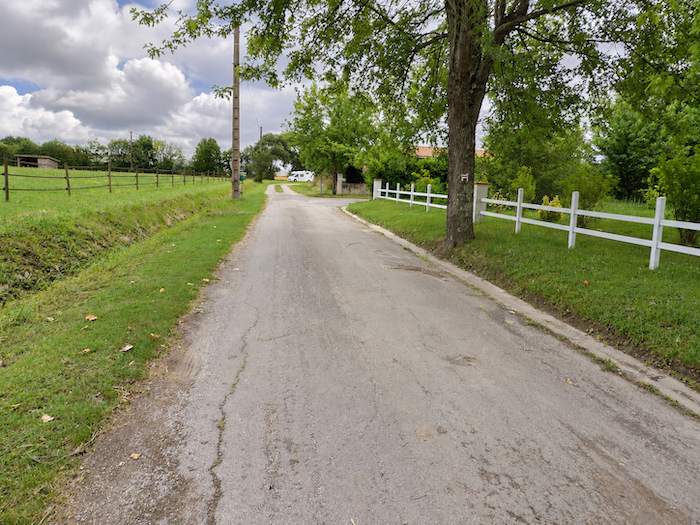
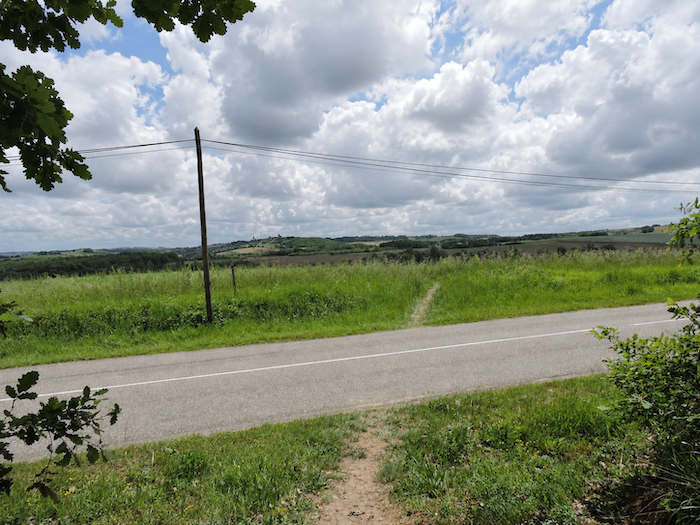
| On leaving Miradoux, the ribbon of asphalt remains close at hand for a little while longer. The route now follows it along a grassy strip, beneath the still tentative shade of young maple trees, planted in large numbers throughout this region. |
 |
 |
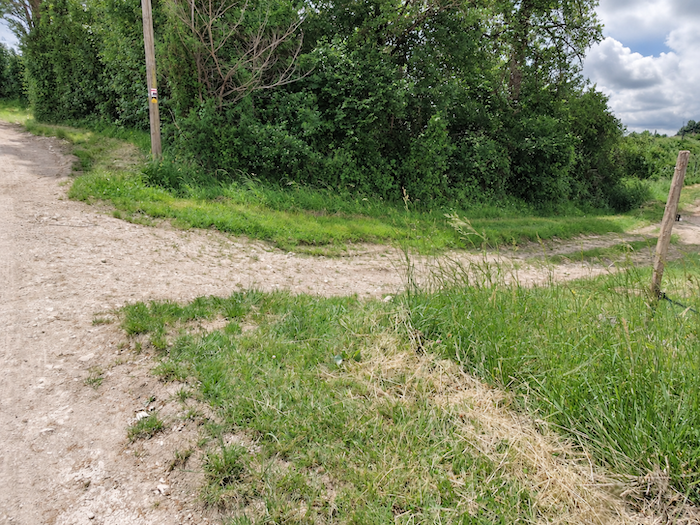
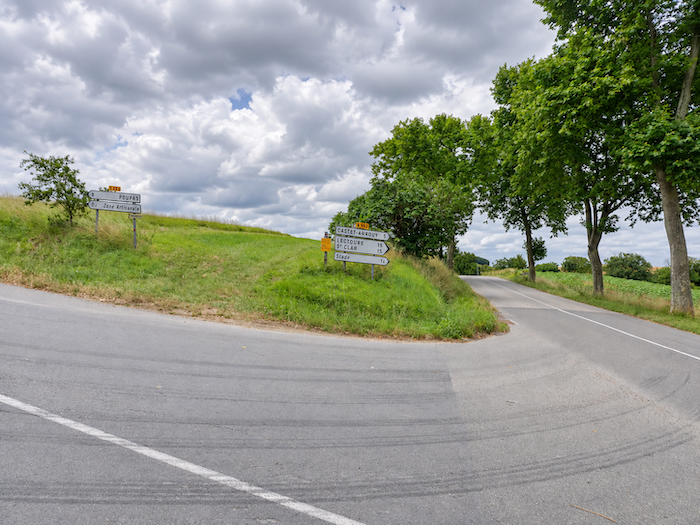
| But beware! Things have changed around here. Once a faithful companion of the departmental road, the GR65 now turns its back on it and follows a narrow road towards the hamlet of Caouze. This change in the route is worth paying attention to. |
 |
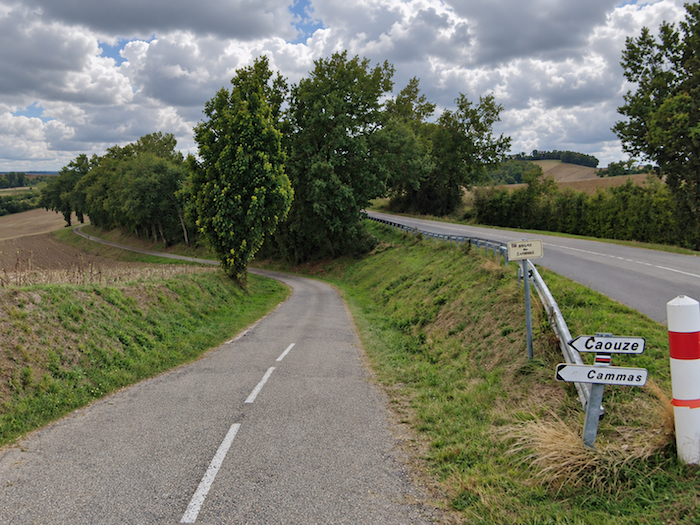 |
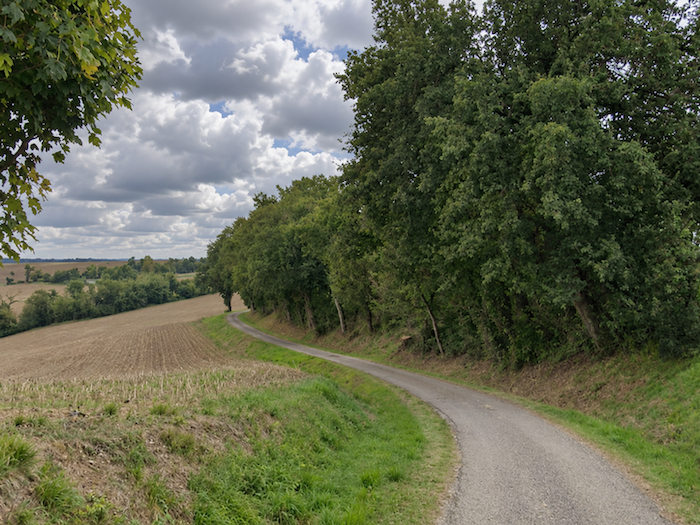
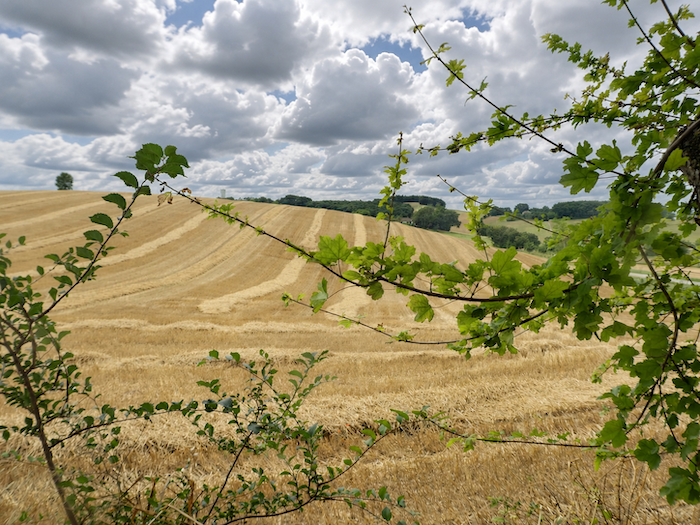
| At least this detour offers the pleasure of rediscovering, in all its vastness, the Gers countryside, which seems to stretch on forever. The hills roll gently, the fields extend as far as the eye can see, and on one of the heights, a windmill presides over the surrounding landscape. Judging by the immense farmland around it, there must once have been plenty of work to keep it busy. |
 |
 |
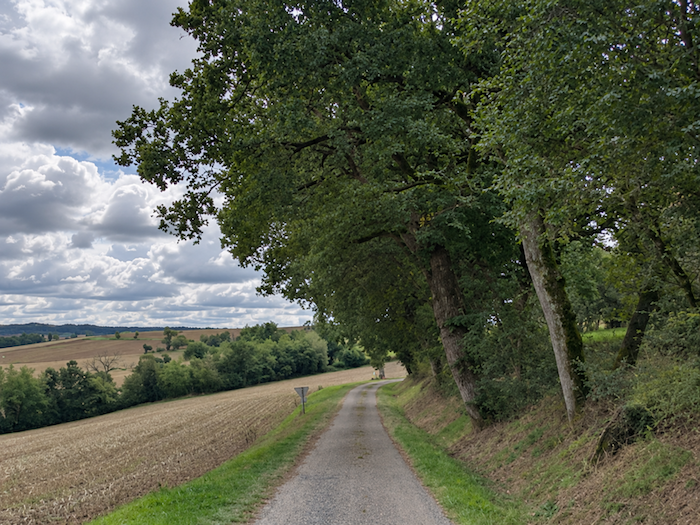
| Be careful, however, not to become too absorbed in the scenery. Beneath the beautiful avenues of oak trees, where the landscape seems to invite you to continue without a second thought, an almost inconspicuous sign on the right calls walkers back to attention. It is precisely in places where everything seems so obvious that one is most likely to lose the way. |
 |
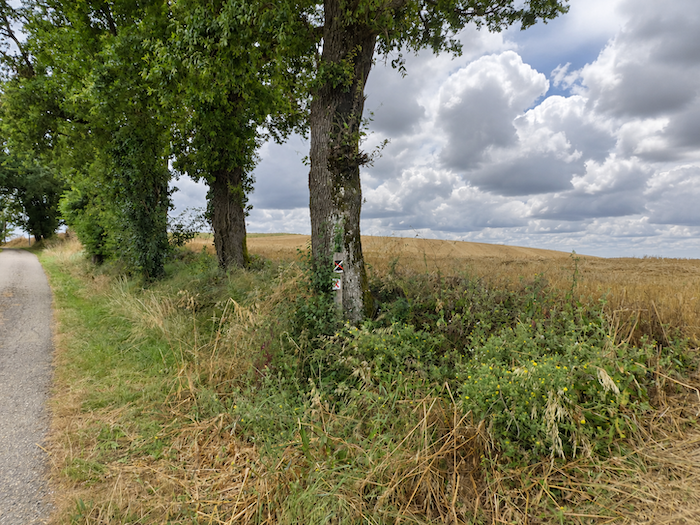 |
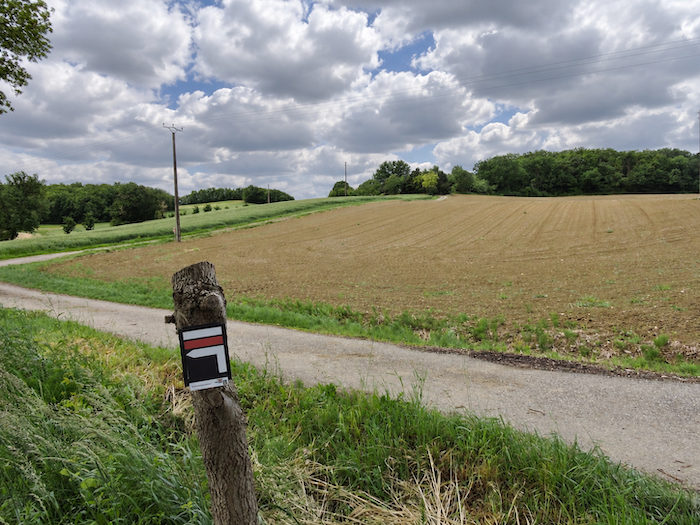
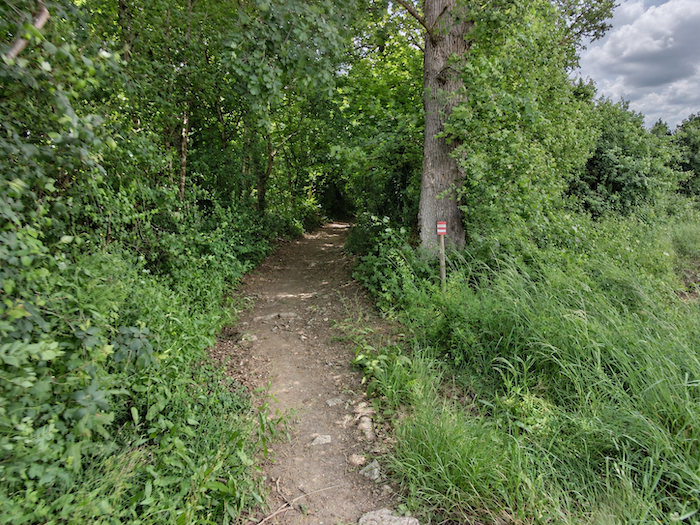
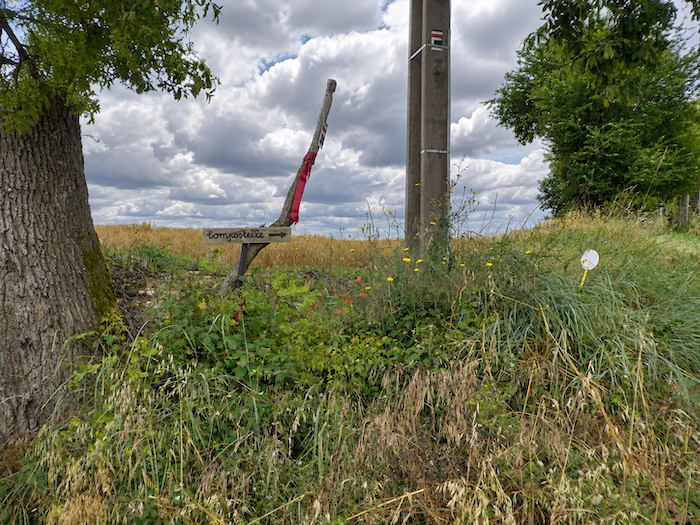
| You need a sharp eye here. Attached to an oak tree, a modest sign indicates the direction to take. The GR65 leaves the narrow road at this point, turning right onto a path that disappears into the fields. |
 |
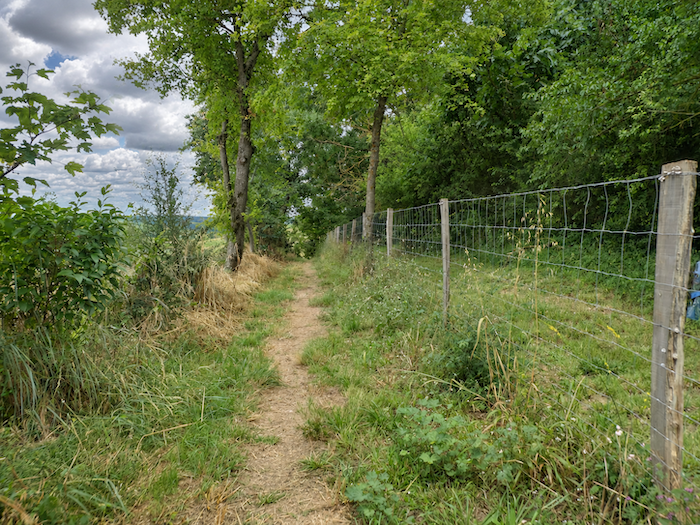 |
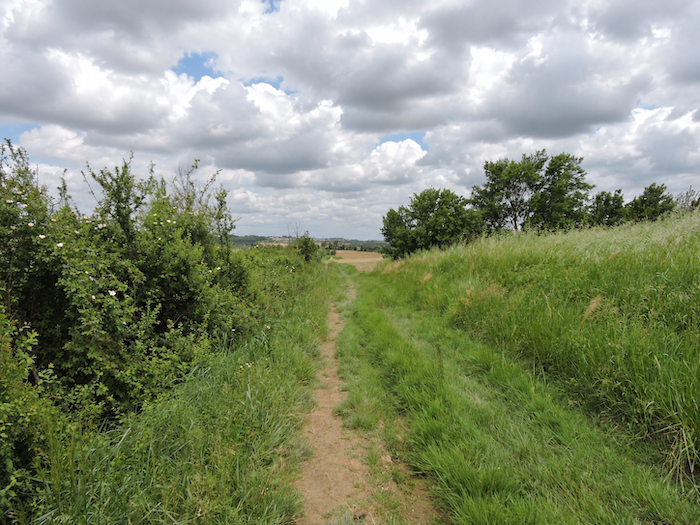
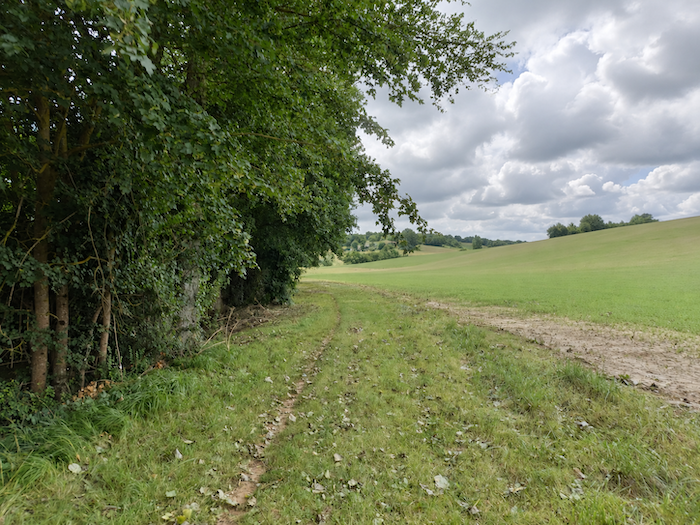
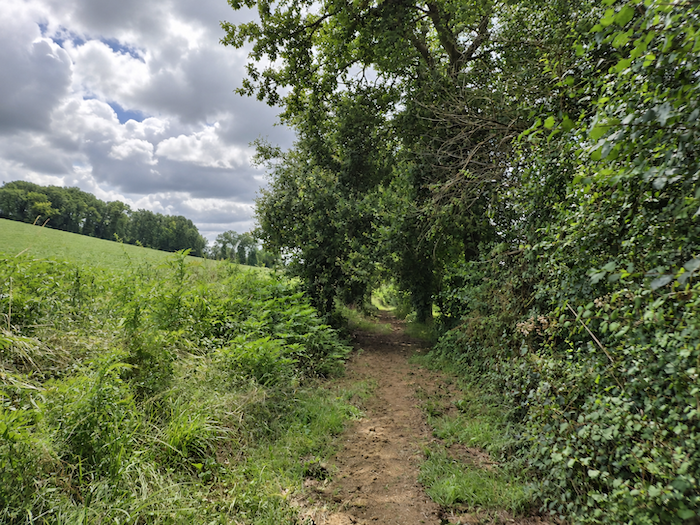
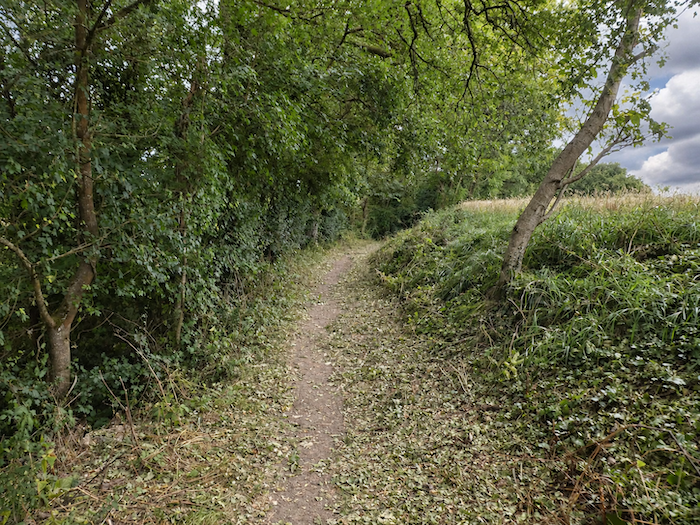
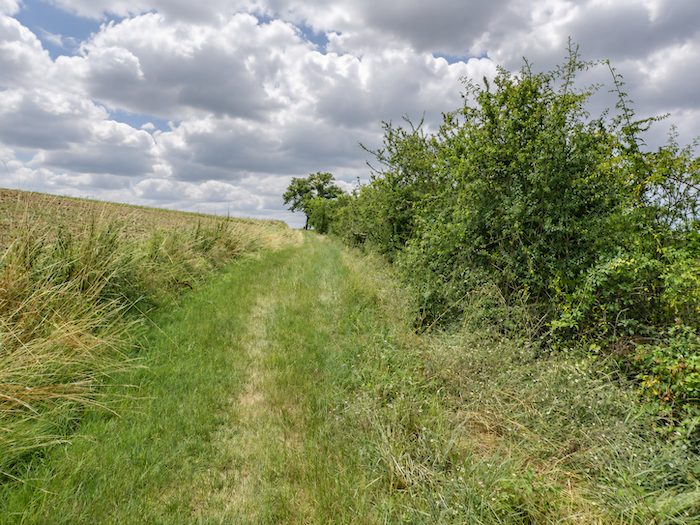
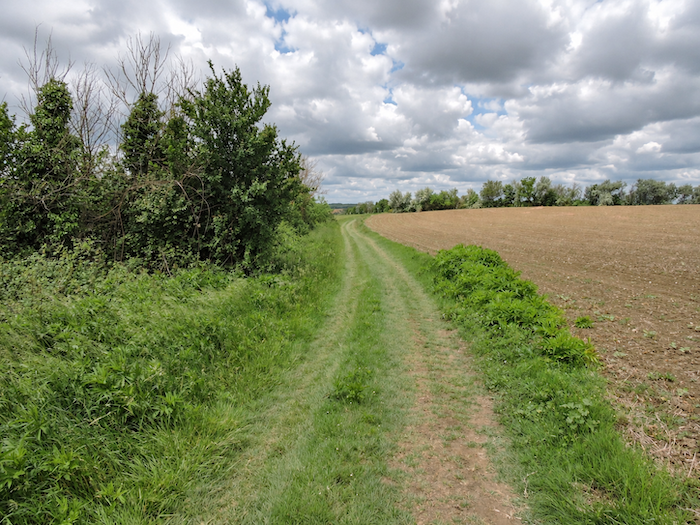
| A pleasant stretch now begins along the edges of the wheat fields, accompanied by a hedgerow where oaks, maples, walnut trees and wild blackthorns mingle. Yet this delightful interlude in the countryside eventually brings walkers back to the departmental road. All that for this! But you know the familiar refrain: those responsible for the Way of St James seem to harbor a stubborn aversion to departmental roads, even if it means sending pilgrims on a few unnecessary detours. |
 |
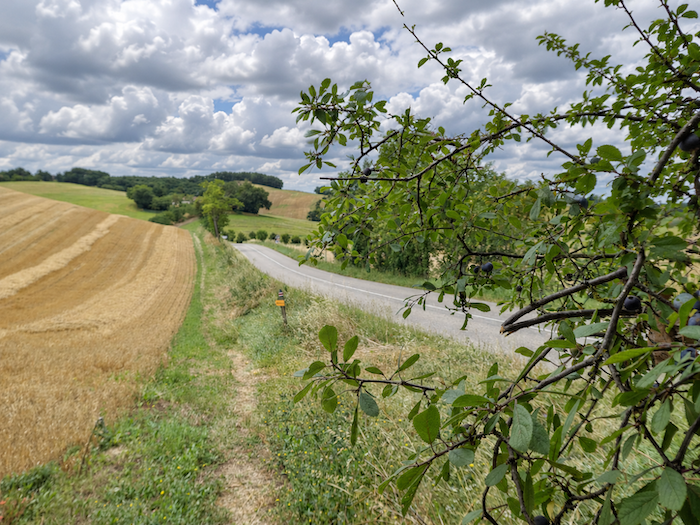 |
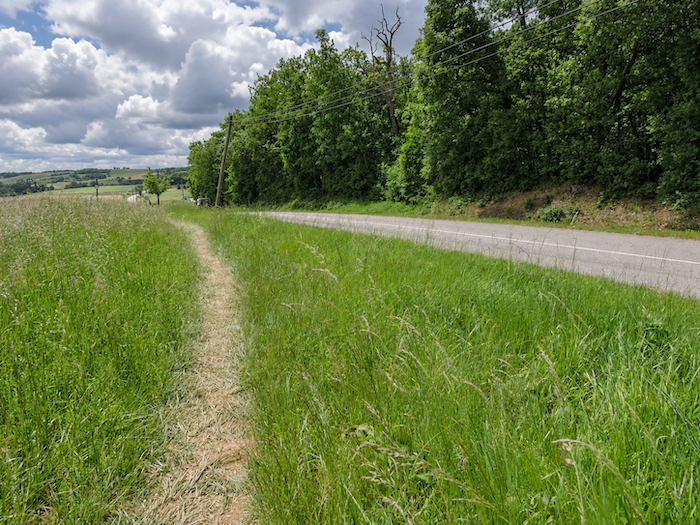
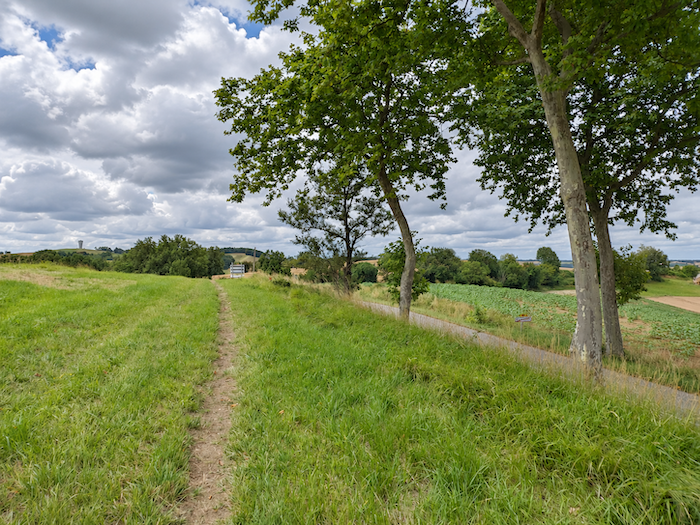
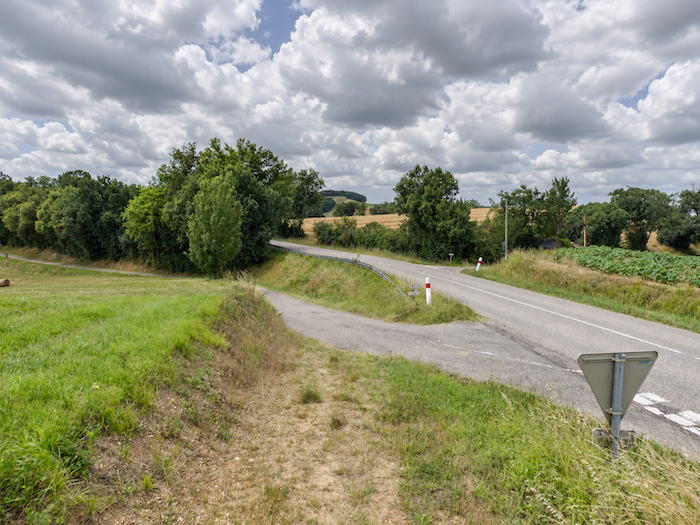
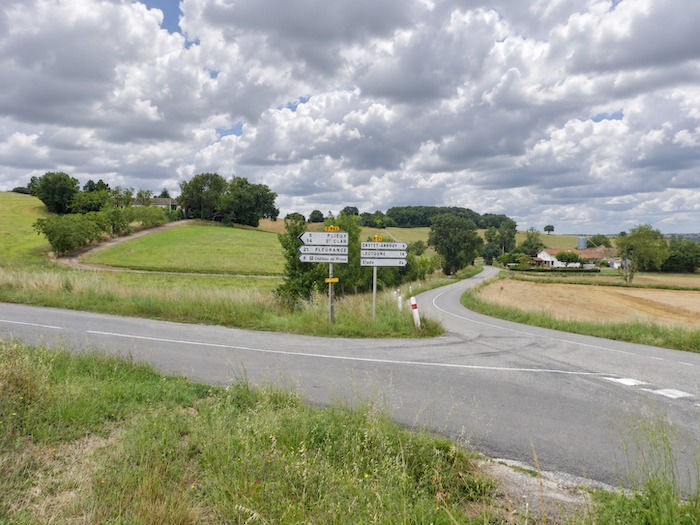
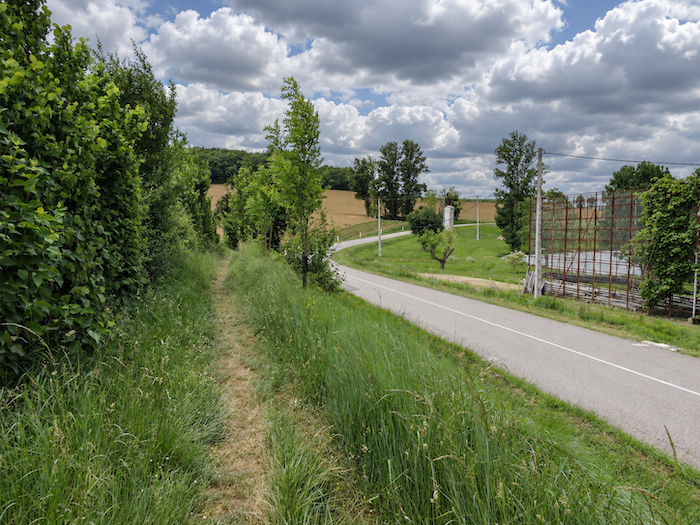
| The reunion with the road, however, is brief in distance but prolonged in time. A narrow grassy passage initially follows its course as far as a crossroads, then continues alongside it towards Castet-Arrouy. Slightly raised on its little grassy embankment, the GR65 keeps a respectful distance from the carriageway, without ever quite losing sight of it. |
 |
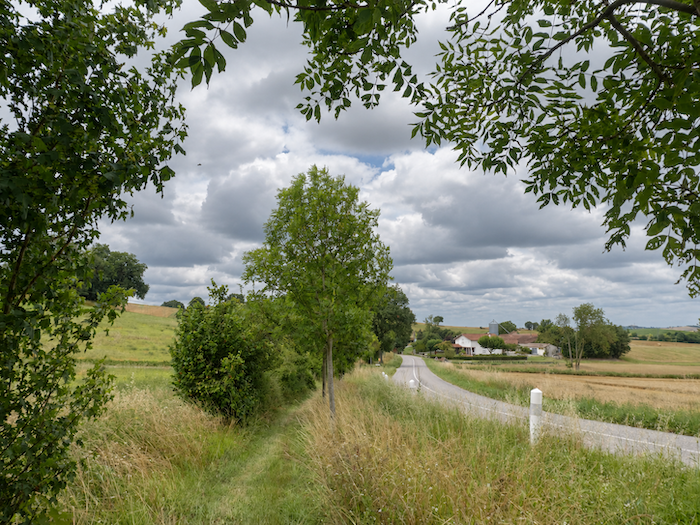 |
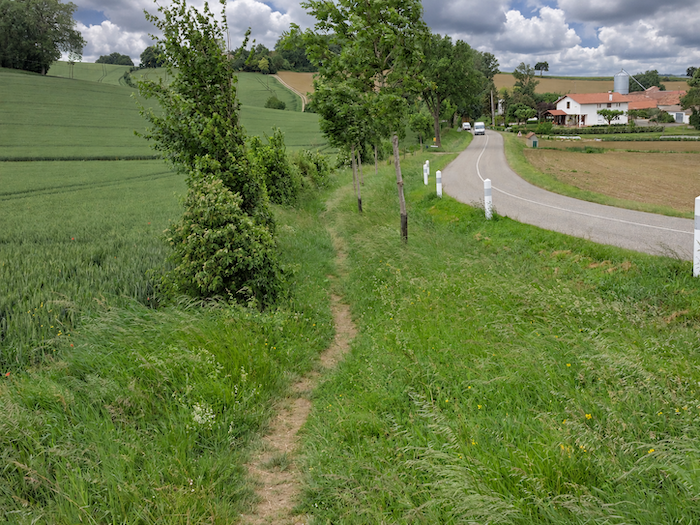
| This walk along the edge of the asphalt continues beneath the kindly presence of ash and maple trees, until it reaches a farm nestled beside a small reservoir. Here, at last, the GR65 seems to grow weary of its roadside companion and strikes out decisively across the fields. |
 |
 |
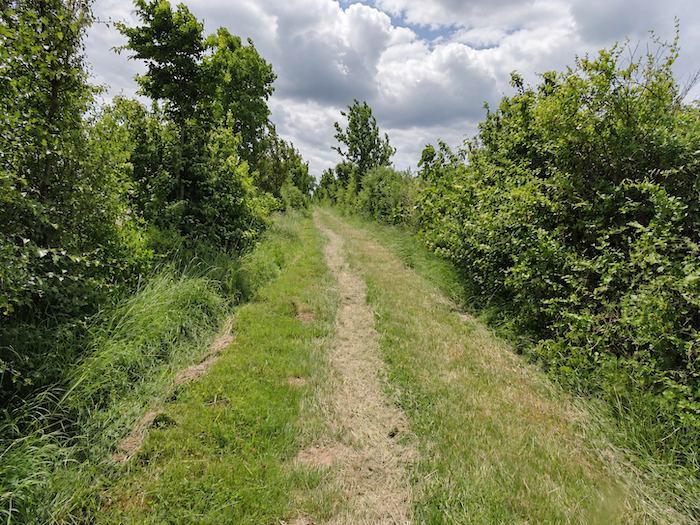
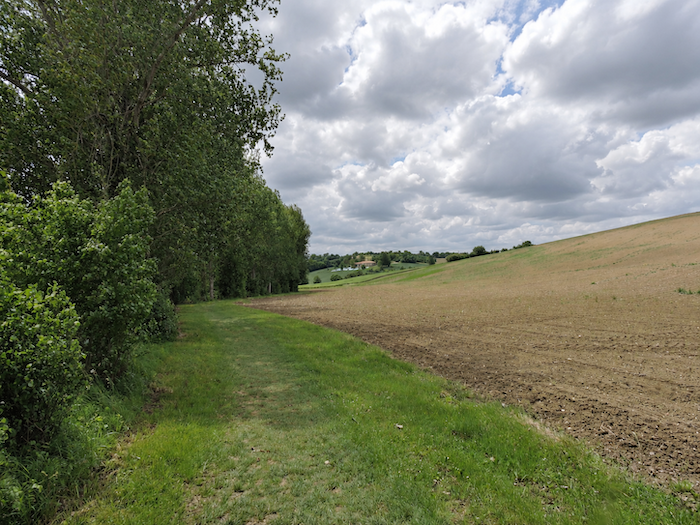
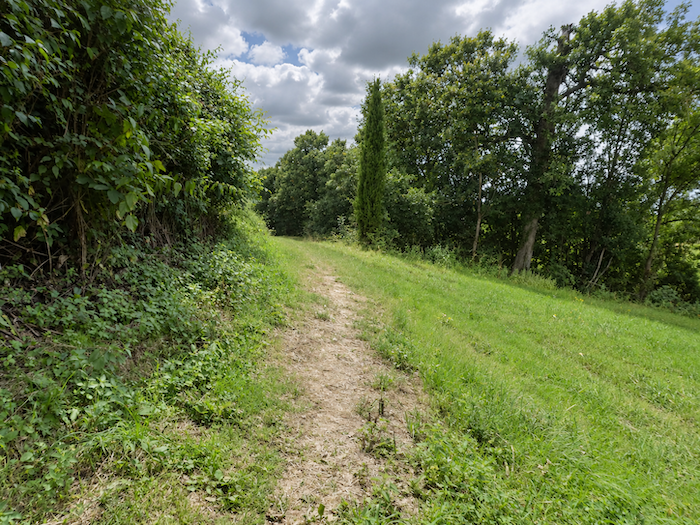
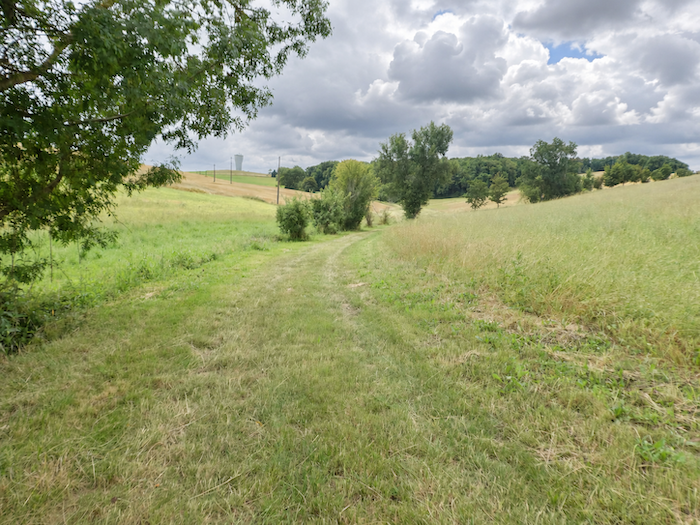
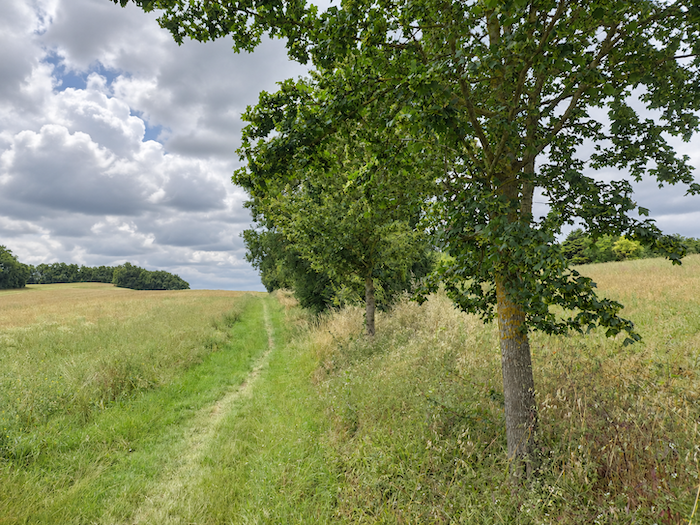
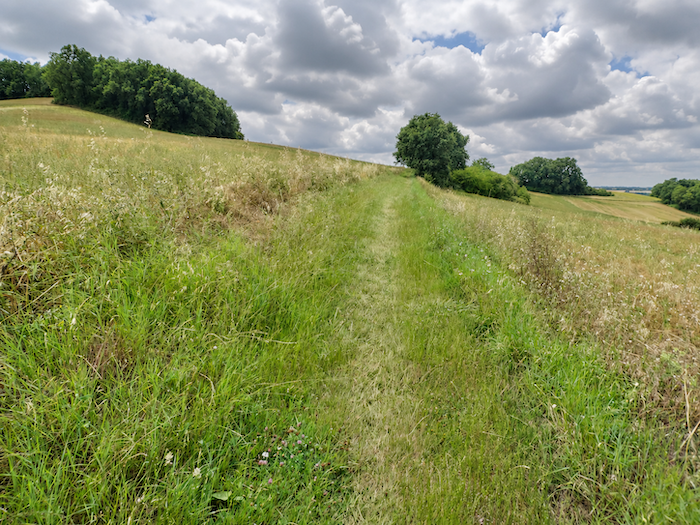
| A broad grassy path now begins climbing the hill along the edge of the cereal fields, with a water tower standing on the heights as its landmark. The slope gives the calves little respite. Young field maples accompany the ascent, planted there, no doubt, to provide this route with a little shade in the years to come and ensure it a long and pleasant future. |
 |
 |
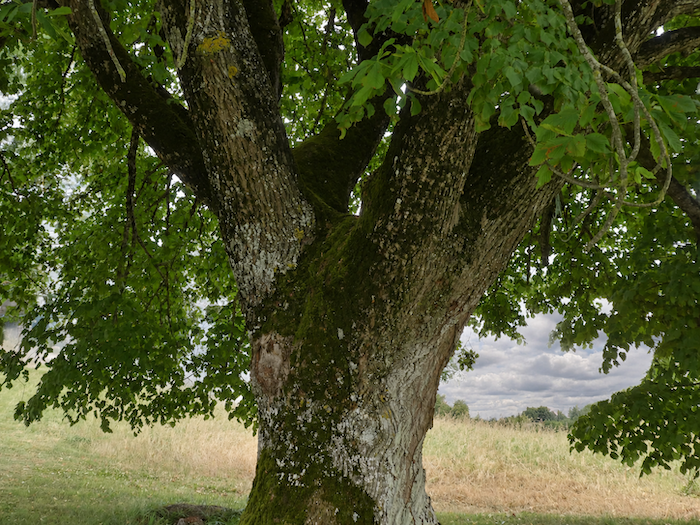
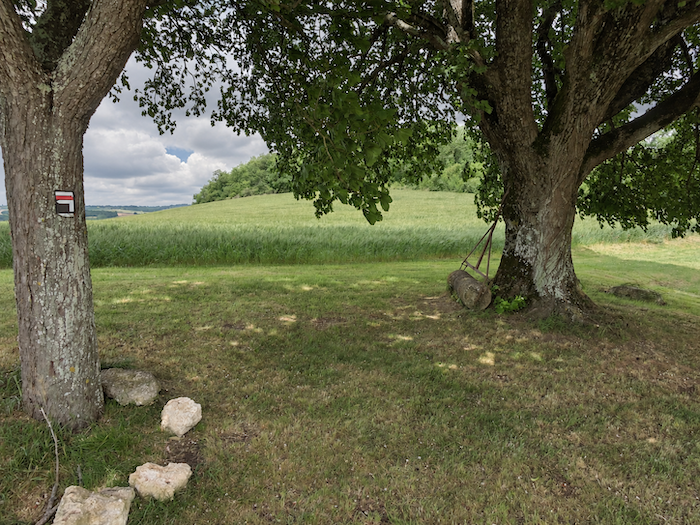
| Halfway up the slope, a few venerable lime trees offer a welcome resting place beneath their generous branches. Who could possibly tell their age? These ancient companions of the countryside have watched generations come and go with quiet majesty, and one can never tire of celebrating their beauty. |
 |
 |
| The climb resumes through the tall grasses of fields left fallow. But the agricultural landscape is never entirely fixed. Another year, wheat may reclaim these slopes, or sunflowers may spread their great yellow heads across them, according to the rhythm of crop rotation. Such is the life of the countryside, changing its appearance with the seasons and the passing years, yet never abandoning its essential role of feeding the land’s inhabitants. |
 |
 |
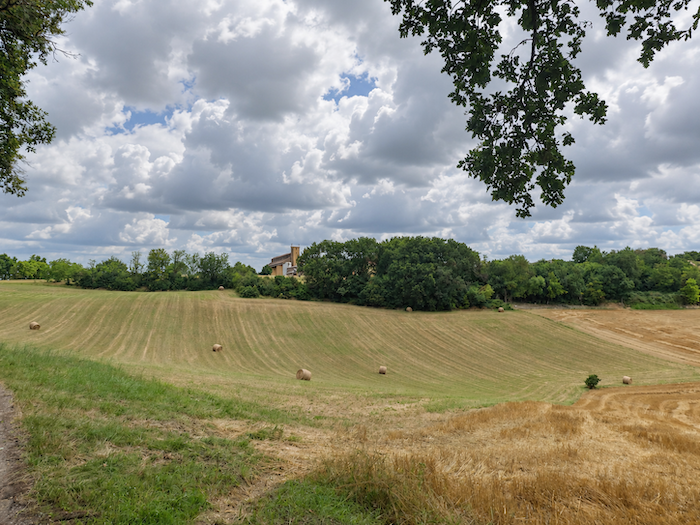
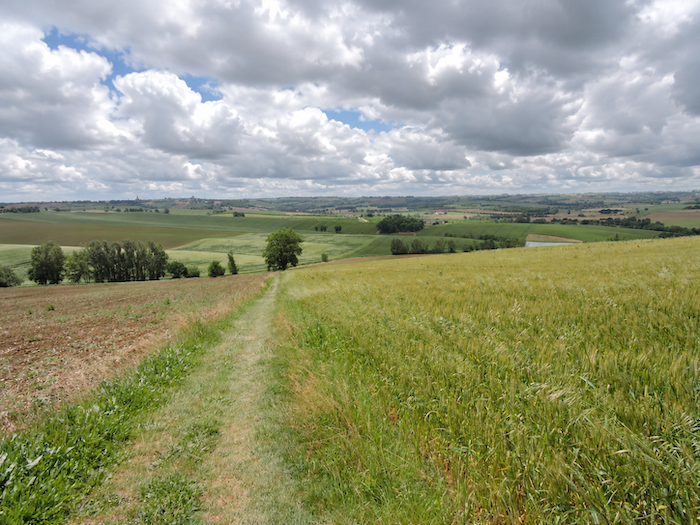
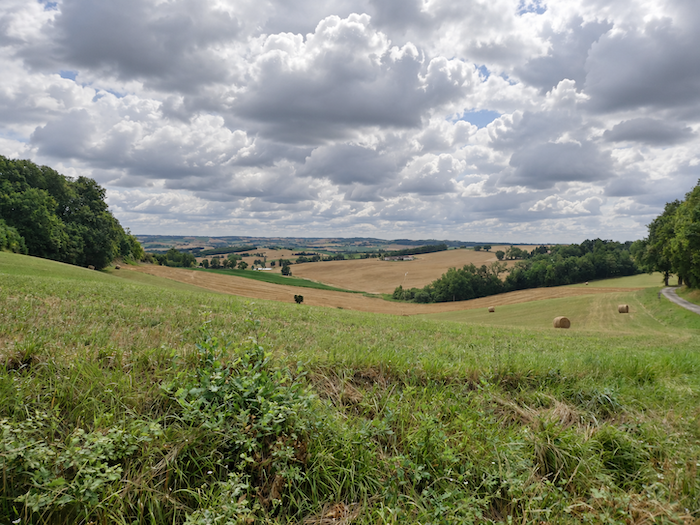
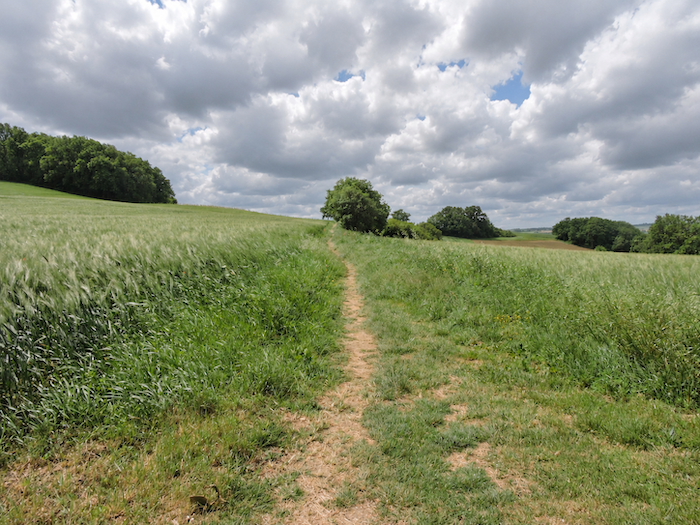
| At the summit, the reward is well worth the effort. Suddenly, the horizon opens up in all its immensity, revealing the Gers countryside, where hills seem to follow one another endlessly in a vast succession of cultivated fields and barely discernible distant landscapes. |
 |
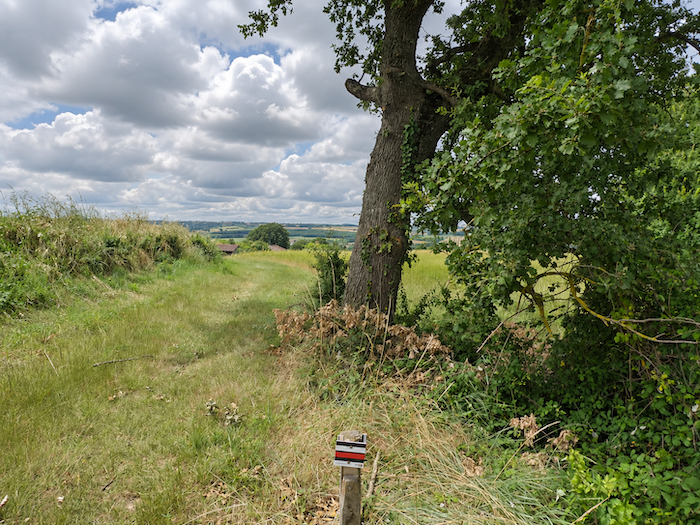 |
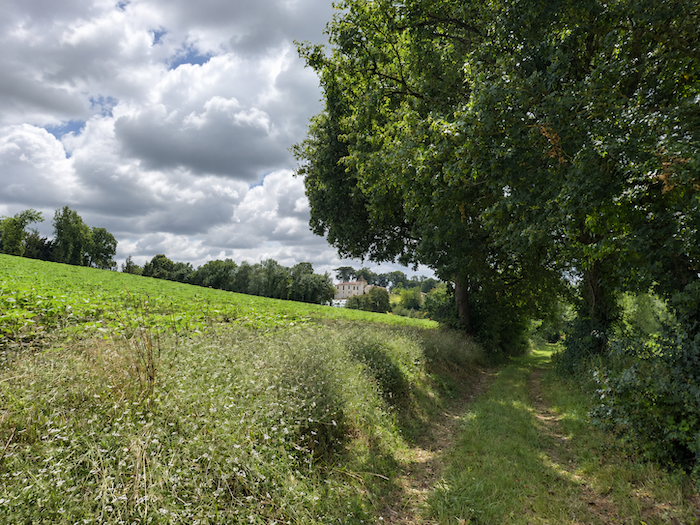
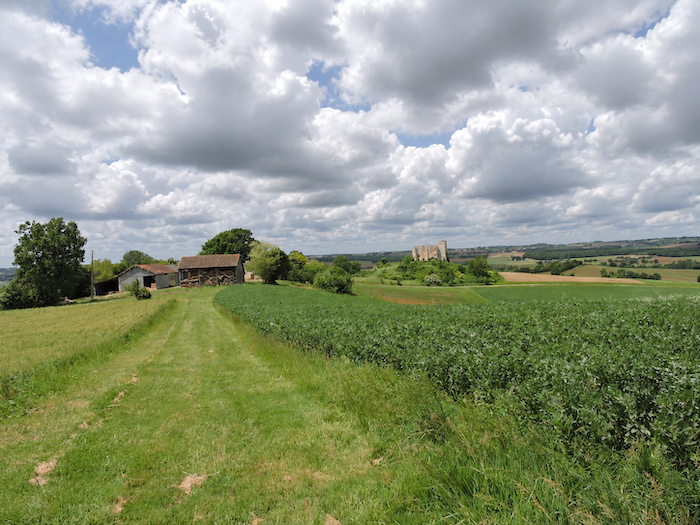
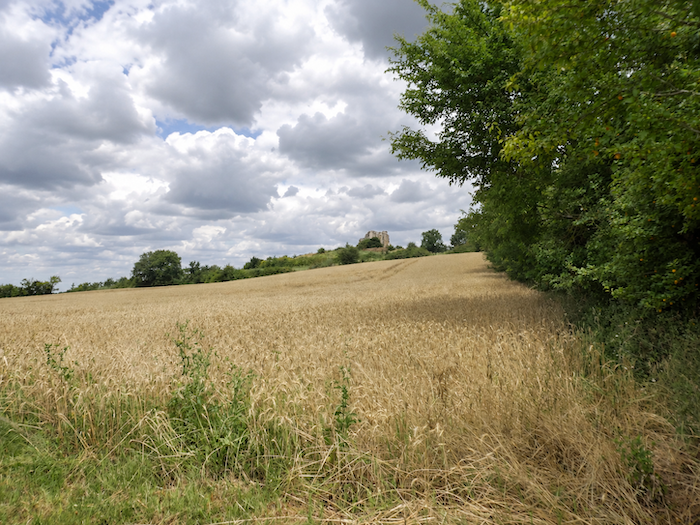
But another silhouette soon catches the eye: that of Gachepouy Castle, whose ruins you will continue to skirt for some time, always keeping your distance. Its name, inherited from the Gascon language, is thought to combine “gachar”, meaning « to watch », and “pouy”, meaning « height », a name perfectly suited to this ancient sentinel of the hills. Apparently built in the 14th century for defensive purposes, the castle passed from one family to another, undergoing changes over the centuries and remaining inhabited until the beginning of the 20th century. The First World War marked the beginning of its abandonment. Since then, time has continued its work, assisted by those who came to carry away stones from its walls. Today, only ruins remain of this long history, the last witnesses to its former grandeur.
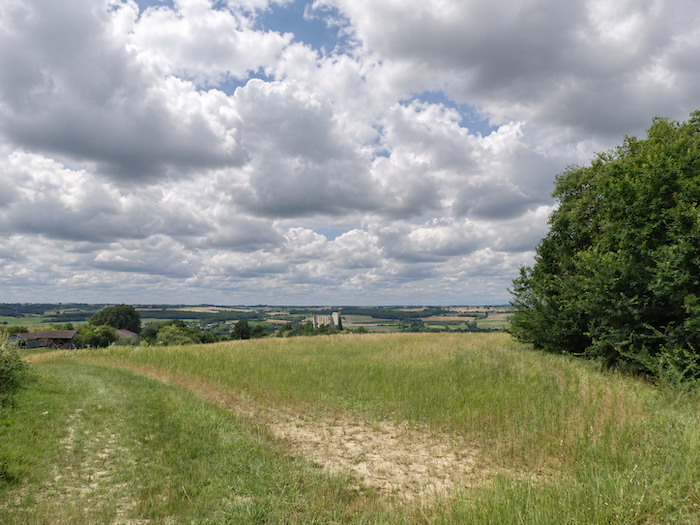
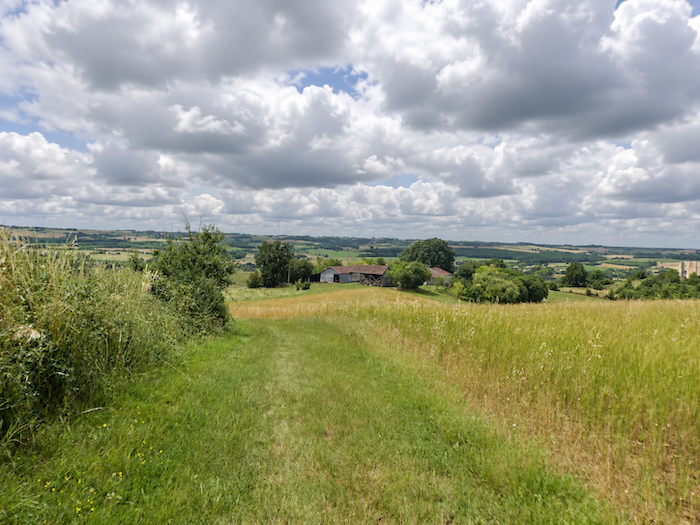
| Across these gently rounded hills, a few farms emerge here and there from the ocean of cereal fields. They seem remarkably isolated in this vast landscape, where houses are so scarce that one could almost count them on the fingers of one hand. Land is certainly not in short supply here. It is said that many farmers cultivate more than 150 hectares, a scale perfectly suited to these immense expanses devoted to arable farming. The Miradoux area is, in fact, among the least populated and most agricultural parts of the Gers. Yet, as you turn a corner in a village street, do not be surprised to hear the language of Shakespeare. Attracted by the gentle pace of life and property prices that remained affordable for many years, British retirees have settled in this corner of Gascony, as they have in many other rural areas of southwestern France. Their unexpected presence sometimes lends these deeply Gascon villages a faint air of England. |
 |
 |
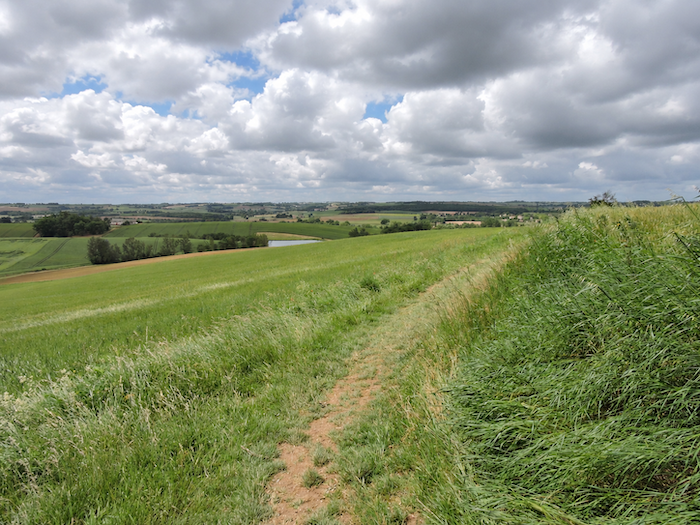
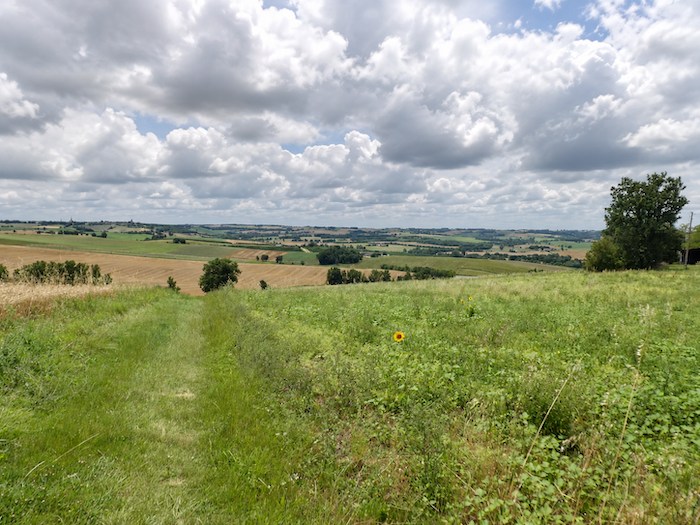
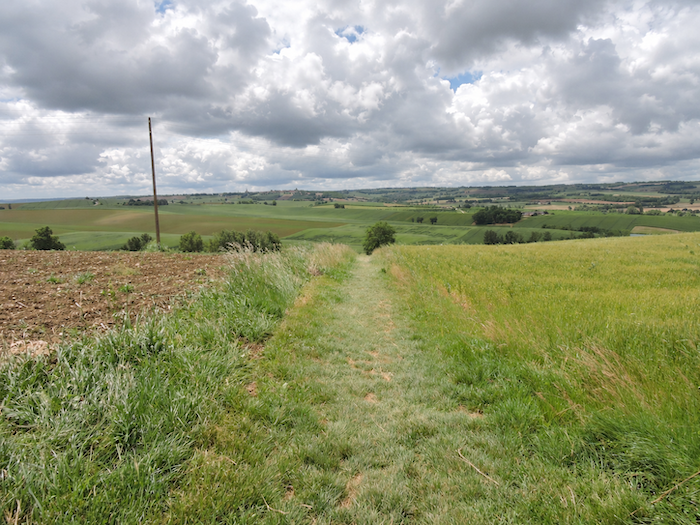
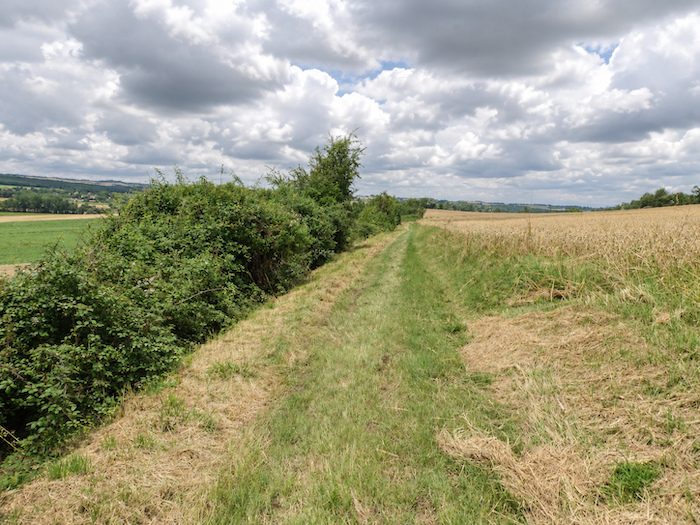
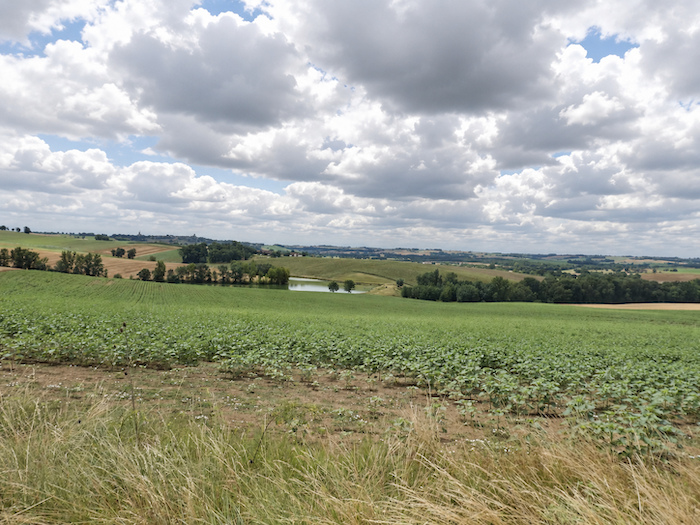
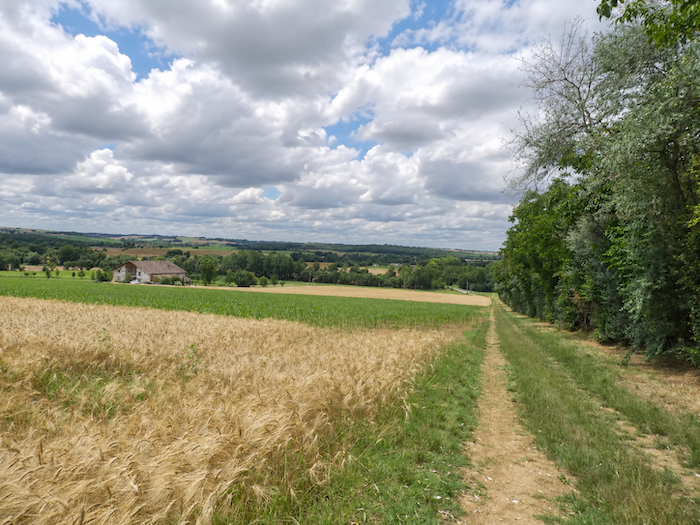
| A broad path begins its descent between cereal fields and fallow land. Down below, a reservoir breaks the uniformity of this countryside, which seems endlessly to unfold its cultivated fields. The farmland follows the gentle contours of the terrain, flowing across the hills like waves. There is nothing spectacular here, and yet what quiet beauty lies in these landscapes, where the eyes find as much rest as the mind. |
 |
 |
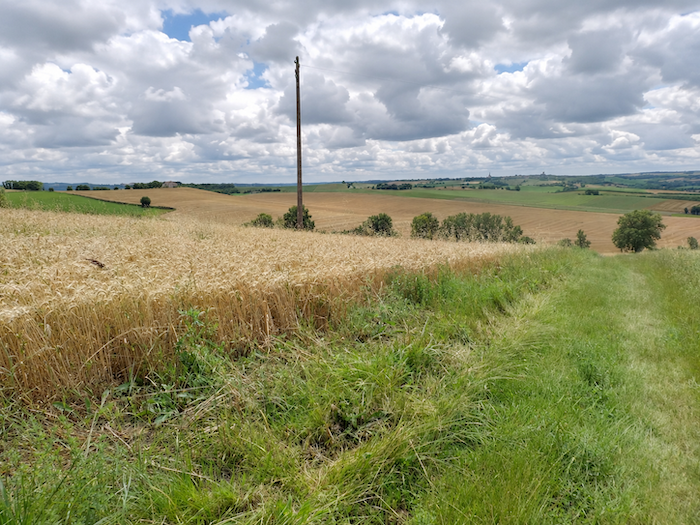
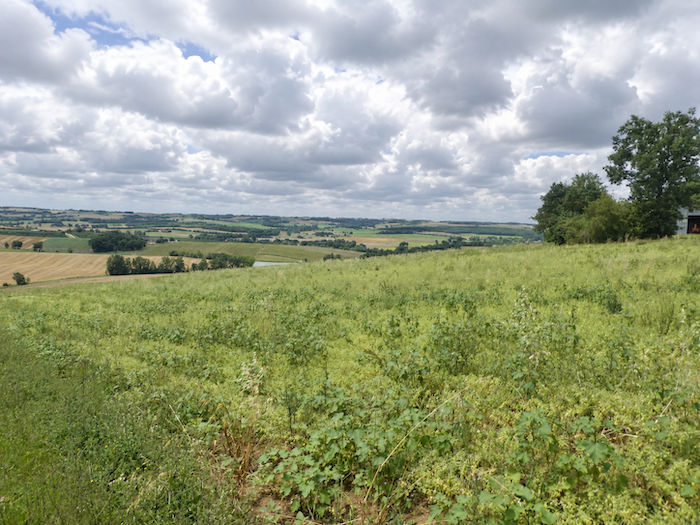
| The descent stretches on along the hillside. After spending so much time walking through this countryside, the eye gradually learns to recognize, even from a distance, the crops that make up this immense agricultural patchwork. The fields follow one another in broad undulations, each with its own colour, texture and particular way of catching the light. |
 |
 |
| As the path sweeps in a long curve through the fields, it skirts Gachepouy Castle, now revealing it from another angle. Up there on its hill, the old residence stands alone, seemingly forgotten in the midst of this immense agricultural landscape. |
 |
 |
| From one hedgerow to another, from sunflowers to wheat fields, the descent gradually becomes gentler. The reservoir draws closer, discreetly nestled in the hollow of the valley. It is easy to imagine how useful such reservoirs must be in a region where large-scale crops sometimes require generous supplies of water. |
 |
 |
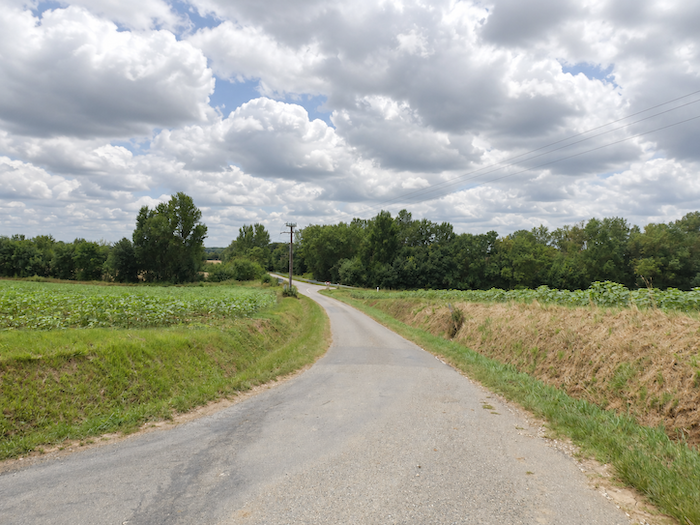
| The long descent finally comes to an end on a narrow paved road, which soon joins the departmental road. |
 |
 |
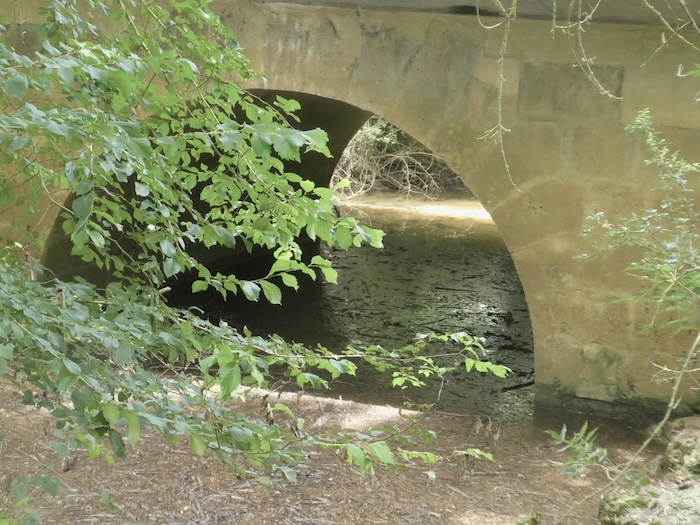
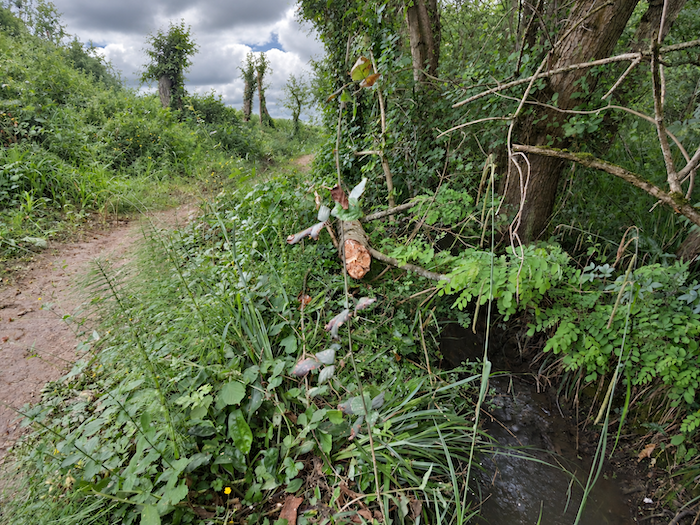
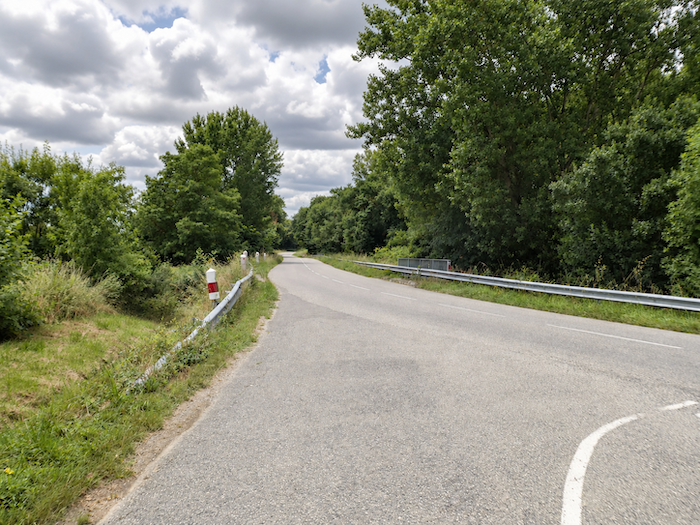
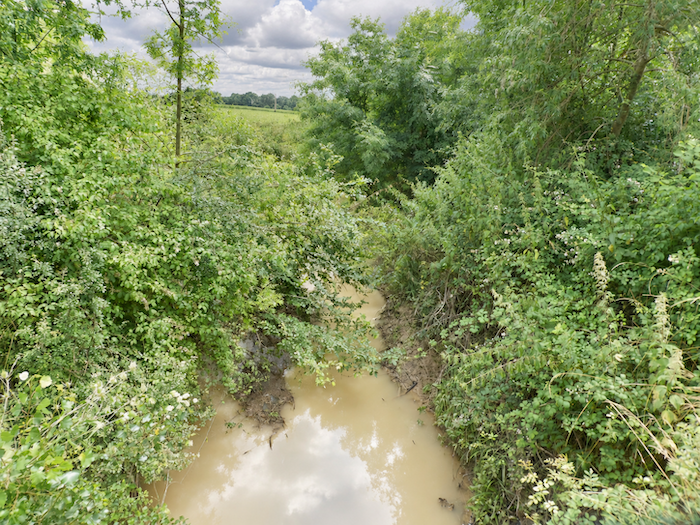
| The GR65 then crosses the Auroue, a modest river with murky waters, almost hidden beneath the luxuriant growth of wild grasses. There is nothing here of the grandeur of mighty rivers. The Auroue quietly continues on its way, as though trying to disappear unnoticed into the greenery. |
 |
 |
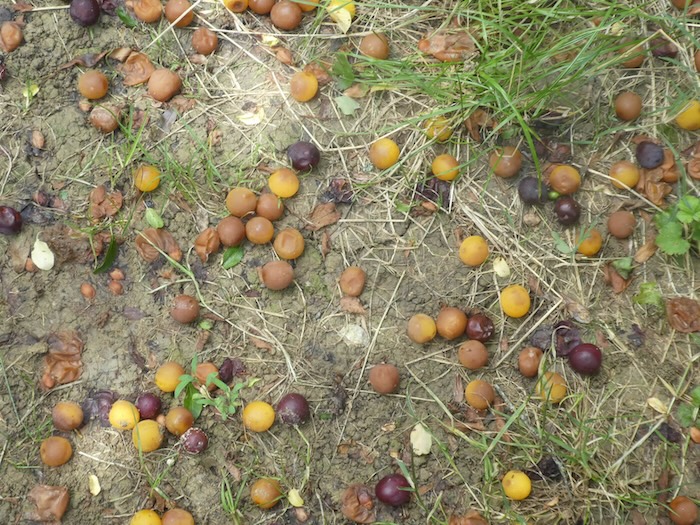
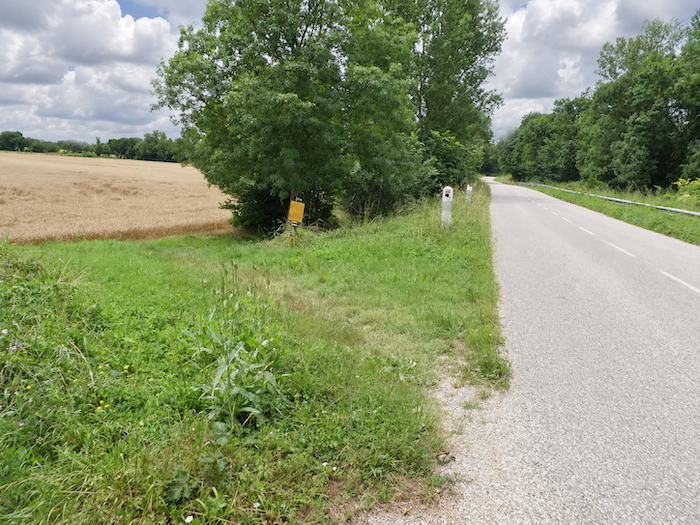
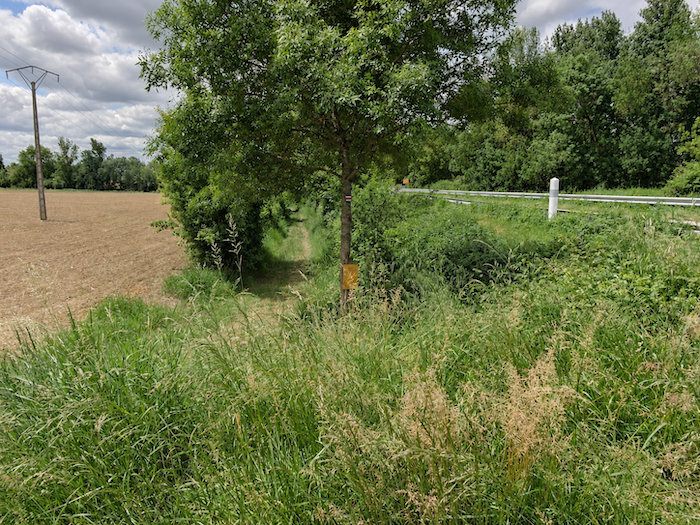
| Barely across the river, a trail slips into the undergrowth, following a narrow passage parallel to the road. From time to time, a gap in the vegetation offers a glimpse of the stream before the foliage closes in once more. And if the season is right, the walk may well turn into a delicious little foraging expedition. Wild plum trees, particularly generous in this region, offer their fruit to anyone willing to slow down and enjoy them. |
 |
 |
Section 2: Long stretches along the departmental road
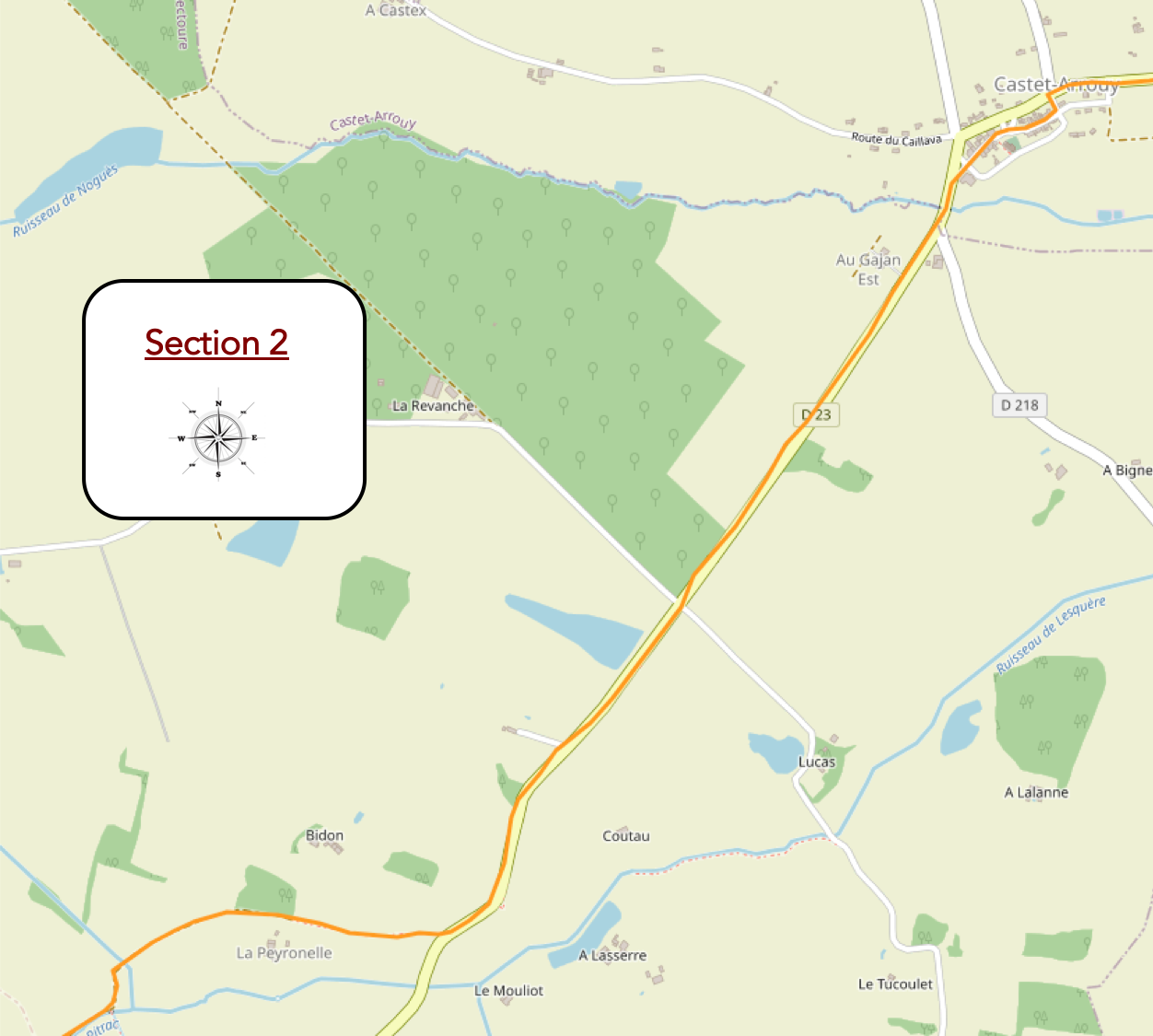
Overview of the route’s challenges: a route with no difficulties whatsoever.
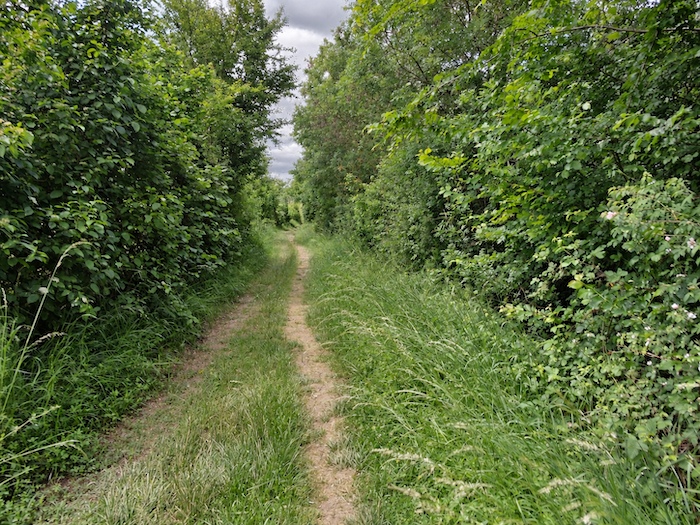
| The trail continues for a while longer, sheltered by hedgerows, faithfully following the road without ever quite joining it. |
 |
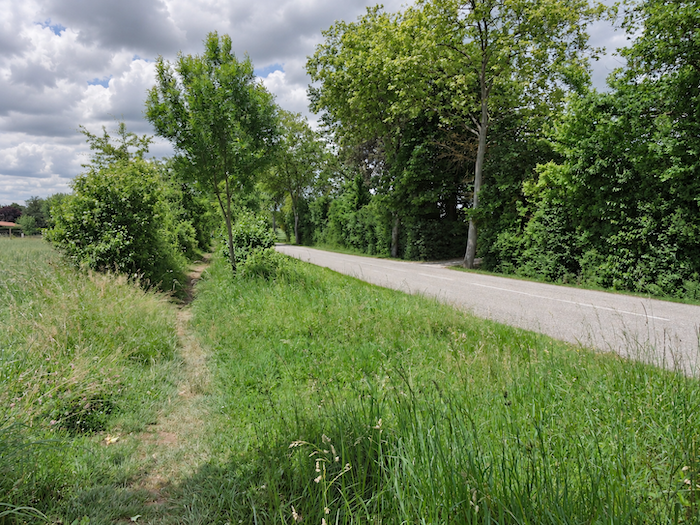 |
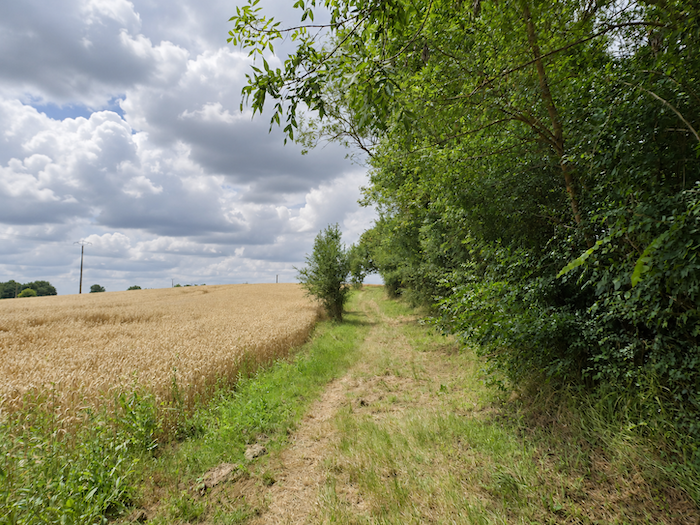
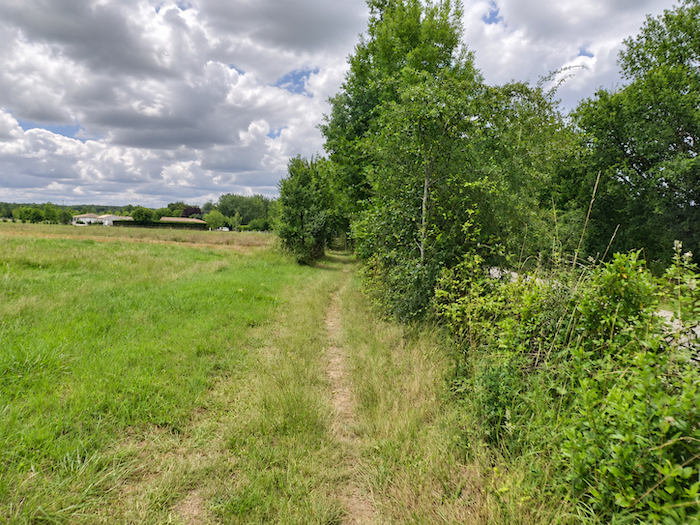
| Then, leaving this green corridor behind, it makes one last excursion through the cereal fields before reaching the meadows that herald the first houses of Castet-Arrouy. |
 |
 |
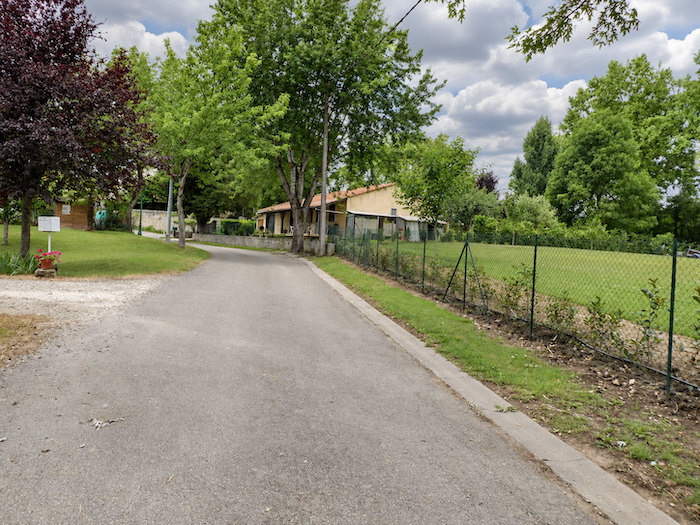
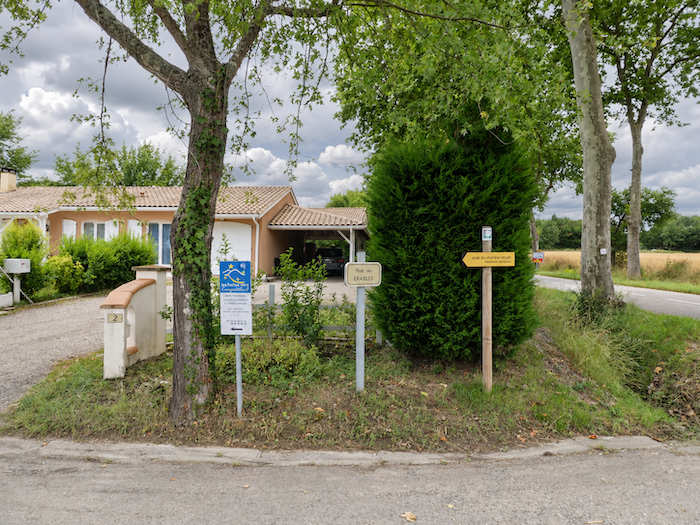
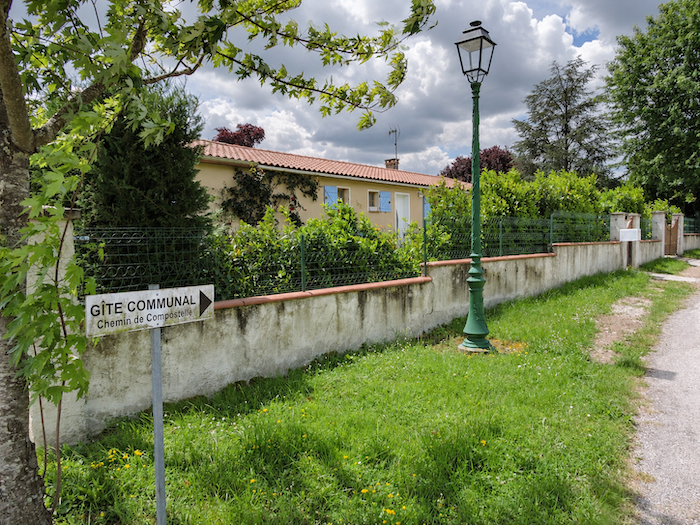
| A narrow road then takes over, winding leisurely through the outskirts of the village, where neat houses and well-tended gardens already set the tone for this peaceful Gascon settlement. |
 |
 |
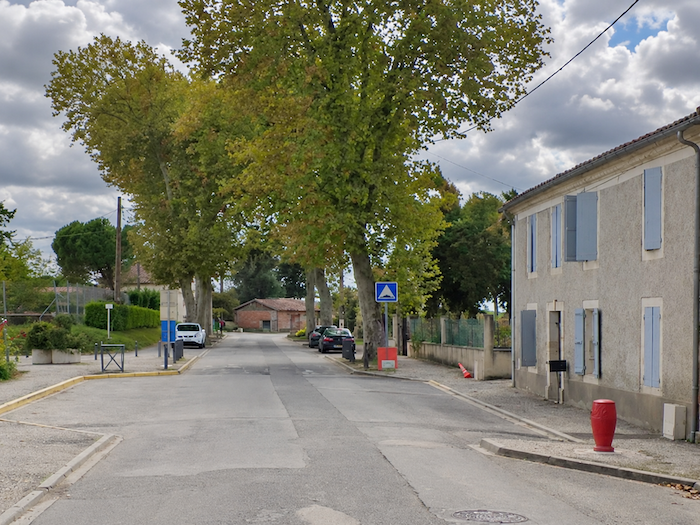
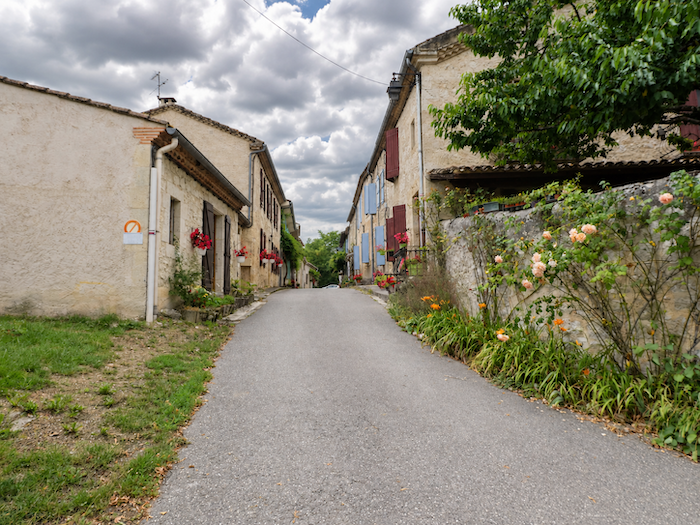
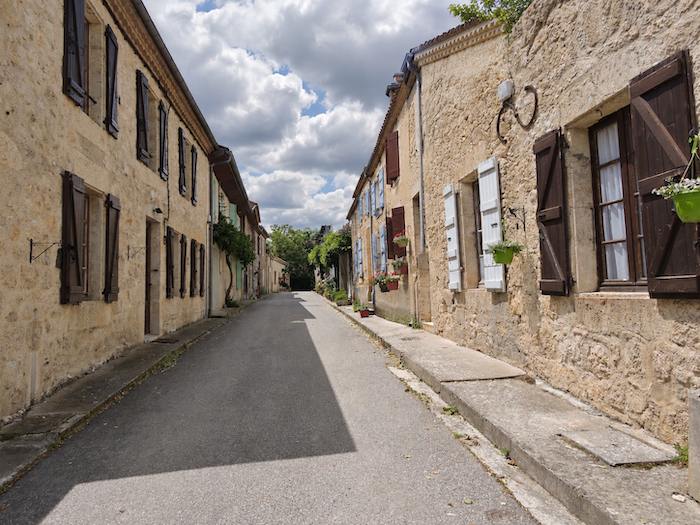
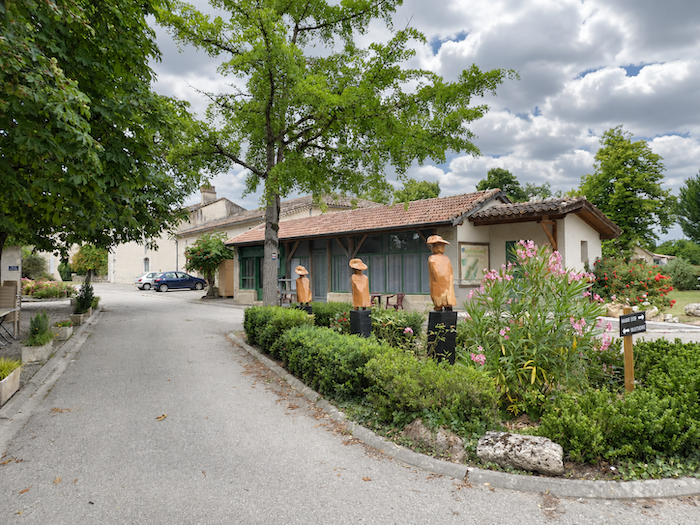
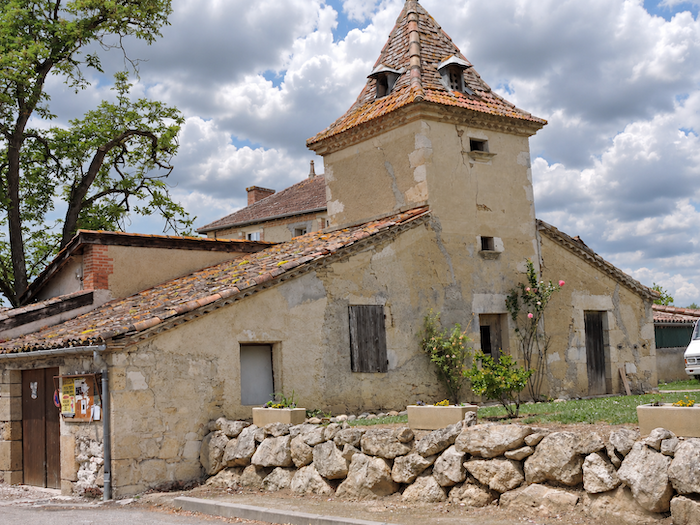
| Soon, you enter Castet-Arrouy, a modest village of some 180 inhabitants, whose charming main street seems to have preserved something of the gentle atmosphere of villages in days gone by. |
 |
 |
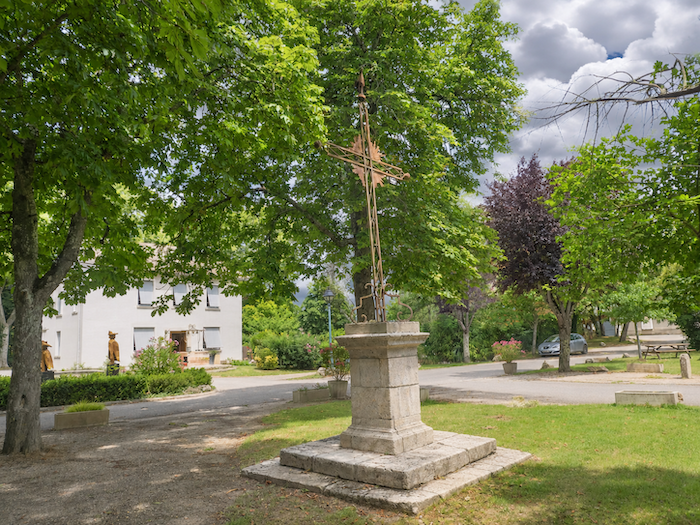
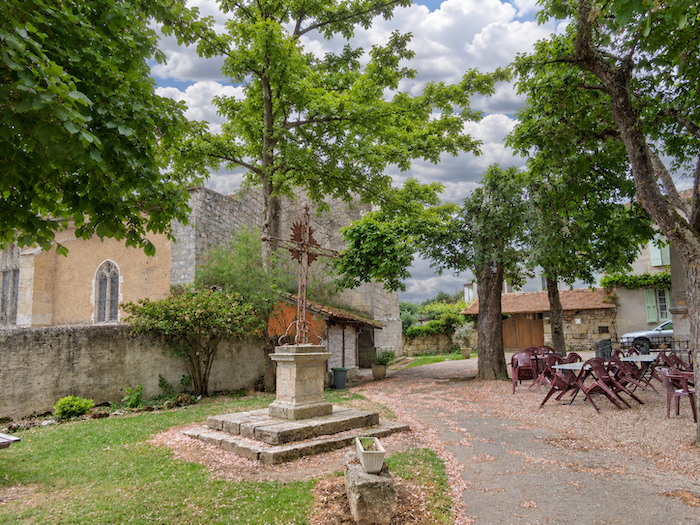
| In the church square, as welcoming as it is picturesque, the restaurant is often packed by the time the pilgrims arrive. These stopping places are true havens of peace along the Way, places where backpacks can finally be set down, weary legs enjoy a well-deserved rest, and conversations flow freely. Pilgrims relive the day’s stage, exchange impressions, recount their little adventures and sometimes meet familiar faces last seen several days earlier. For the Way of St James is as much about the stories told along it as the walking itself. |
 |
 |
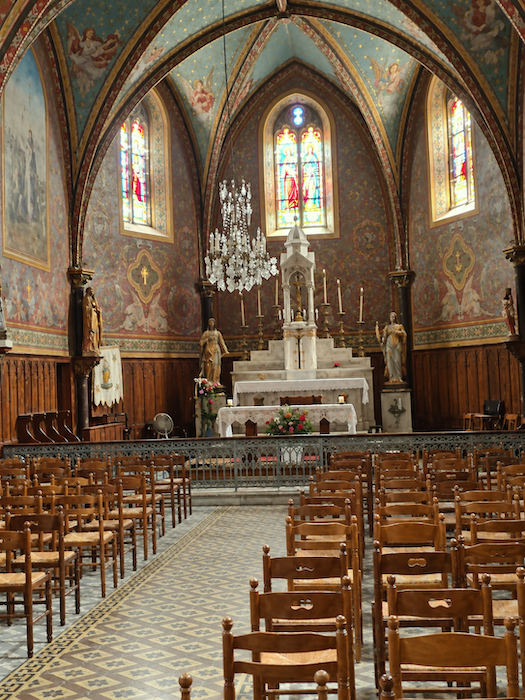
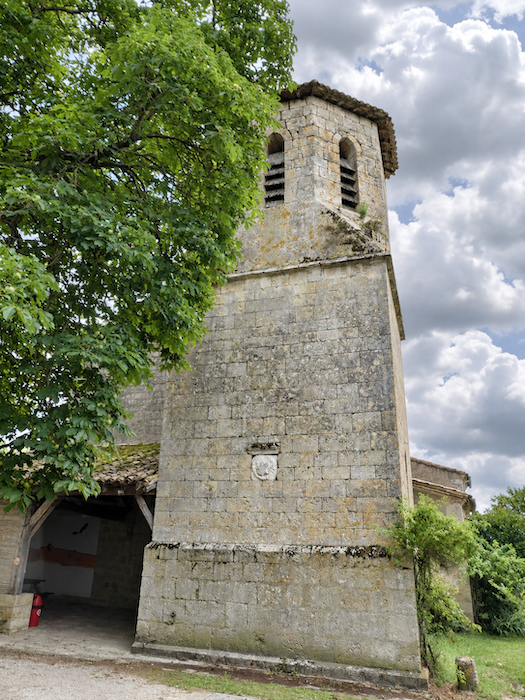
| Castet-Arrouy certainly has no shortage of charm. Its Church of Sainte-Blandine, built in the 16th century and altered over the years, boasts an elegant octagonal bell tower that gives it a proud appearance. Inside, however, the dim light and perhaps rather lavish decoration come as something of a surprise, with ornaments seemingly competing for attention. Yet this abundance is also part of the character of these old country churches, shaped over the centuries by changing tastes and the devotion of successive generations. |
 |
 |
 |
 |
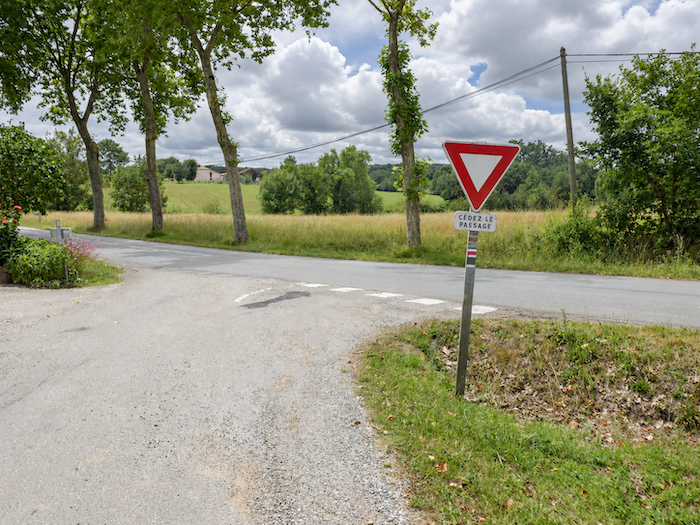
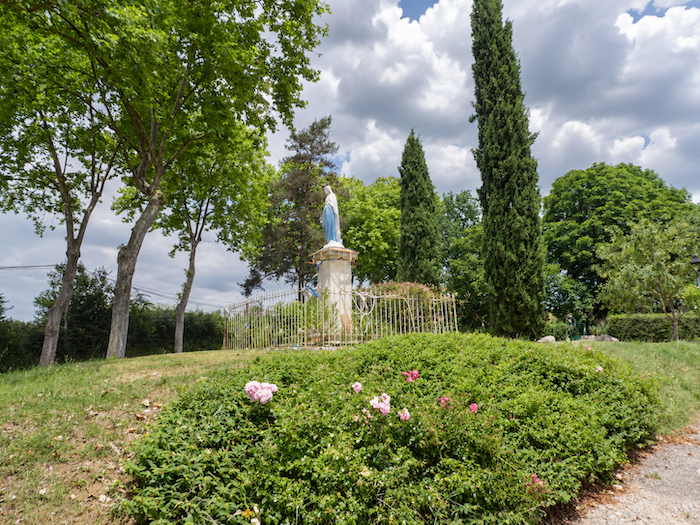
| At the edge of the village, a statue of the Virgin Mary stands guard at a crossroads, watching over the inhabitants and passing travellers alike. These statues really do seem to have come from the same mould! From one village to the next, the same silhouette, the same pose and the same blue and white attire appear again and again, as though a particularly conscientious sculptor had been commissioned to populate the entire countryside with these heavenly sentinels, without ever allowing himself the slightest touch of originality. |
 |
 |
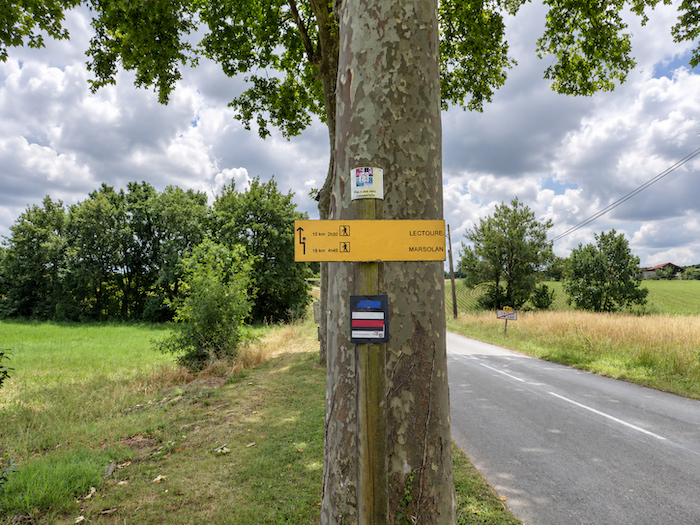
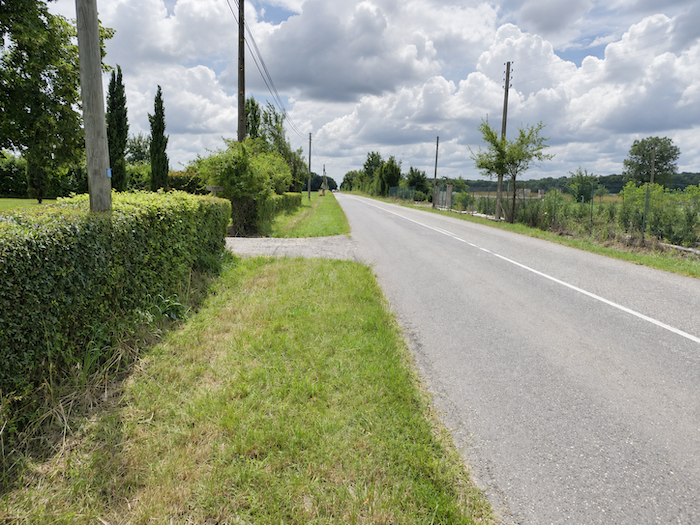
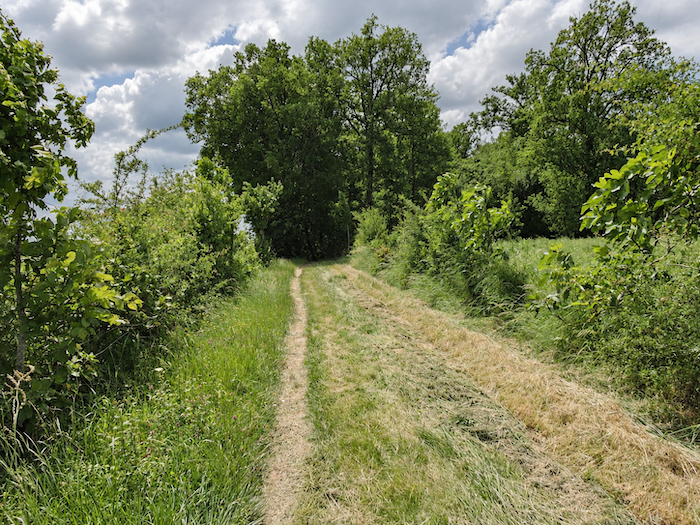
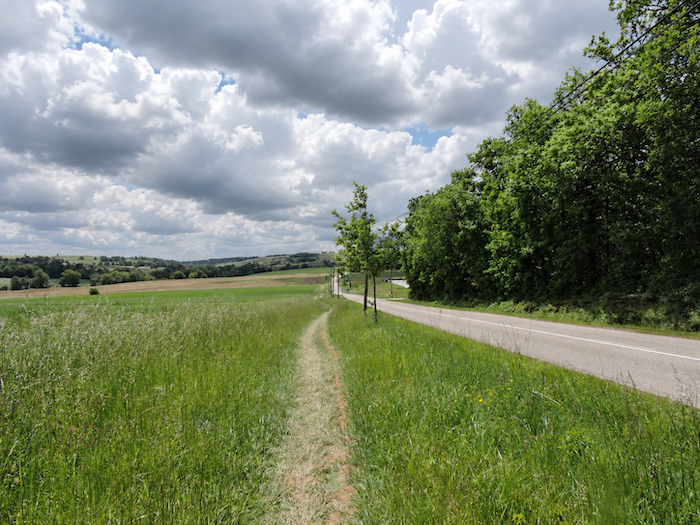
| From here onwards, you might as well be warned: the Way is about to enter a rather lean spell in terms of scenery. Lectoure is now only about ten kilometers away, but a little more patience will be needed before more rewarding landscapes come into view. For the moment, the GR65 simply follows the departmental road for several hundred meters along a narrow grassy strip whose sole purpose seems to be keeping walkers away from the asphalt. |
 |
 |
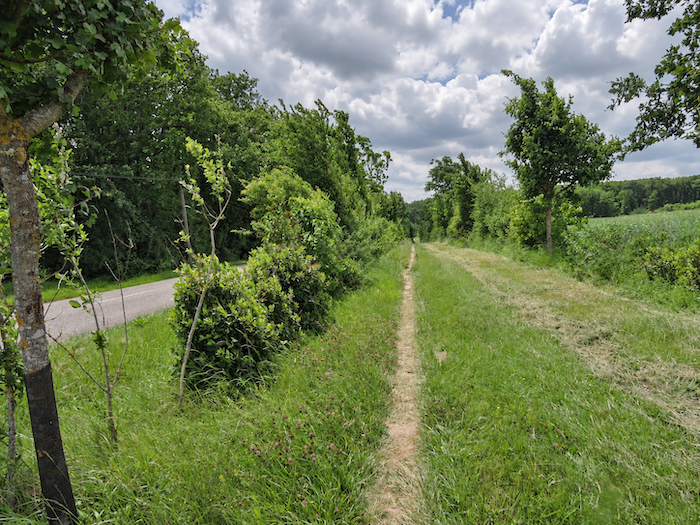
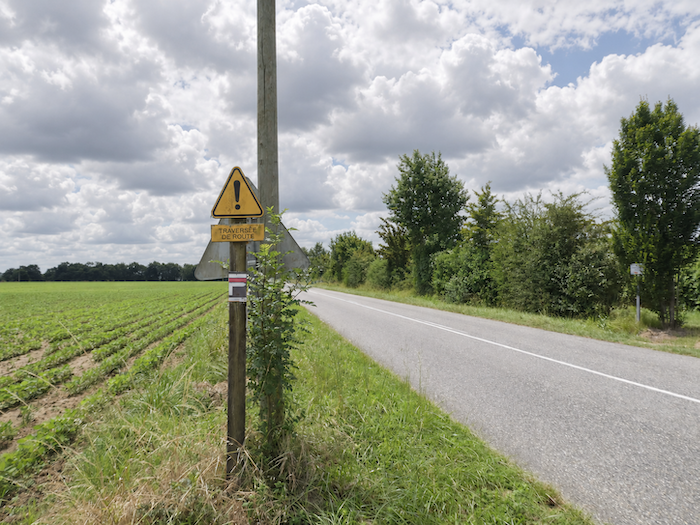
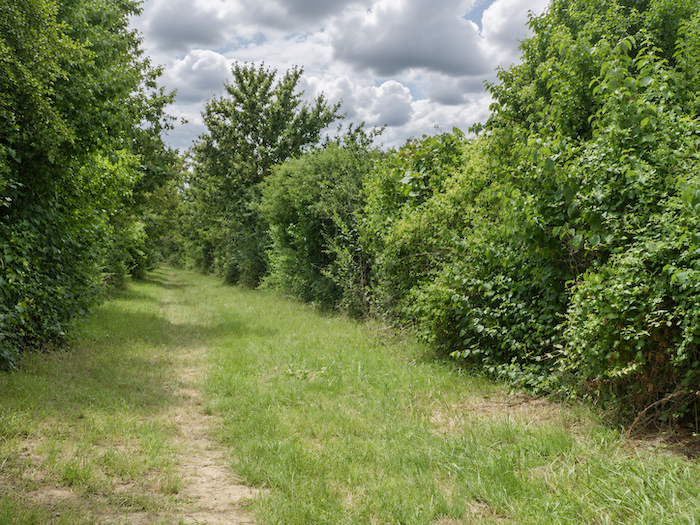
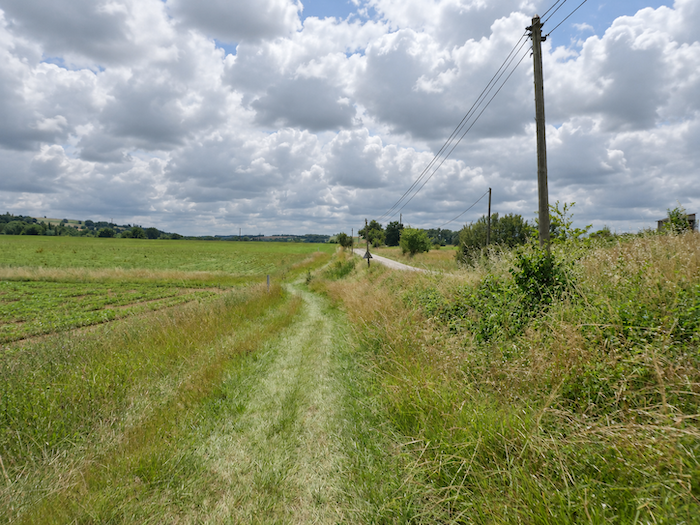
| A curious game of leapfrog with the departmental road now begins. First on the right, then on the left, the route seems to take mischievous pleasure in making pilgrims switch sides. For their safety, no doubt! Although one might wonder whether the traffic really warrants such precautions. With barely one vehicle every fifteen minutes, traffic jams are hardly the scourge of this countryside. But here, at least, comes a welcome diversion: a long grassy track opens through the undergrowth, running parallel to the road and offering, if nothing else, the illusion of having escaped it. |
 |
 |
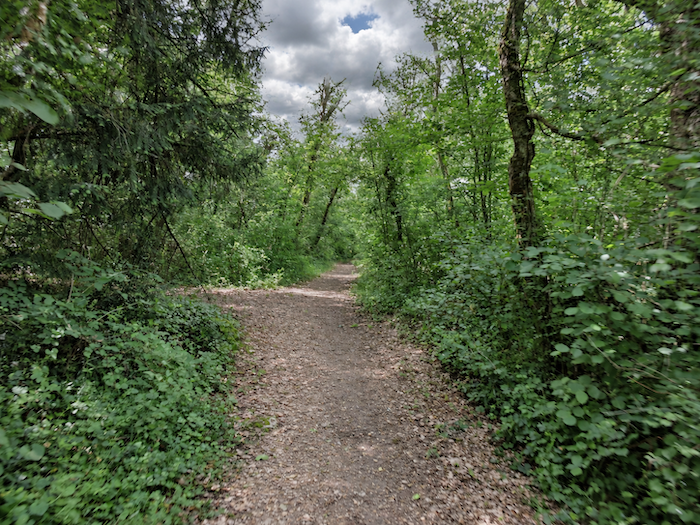
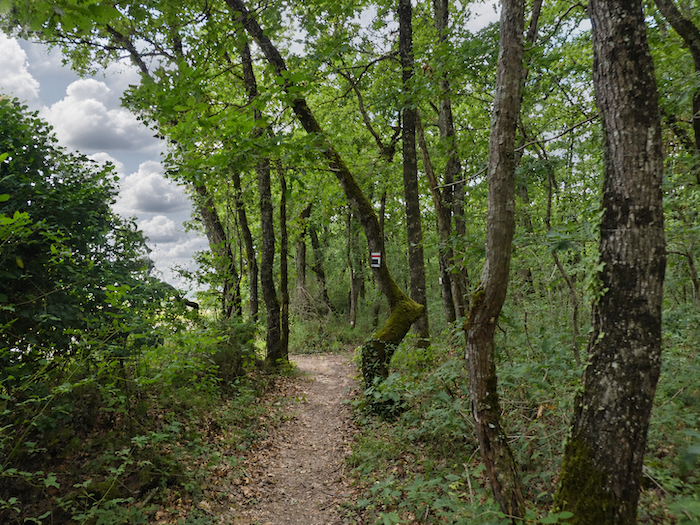
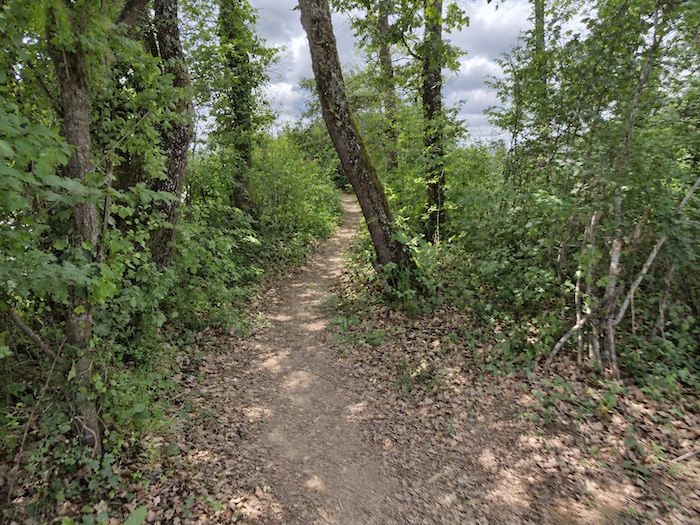
| The walk continues without much happening, unless you suddenly develop a passion for the scrubby vegetation lining the passage. Then, almost unexpectedly, a small wood breaks the monotony. The trail winds through it in a few gentle curves among oaks and maples. At last, a little variety! Enough to raise hopes that the landscape has finally decided to change its tune. |
 |
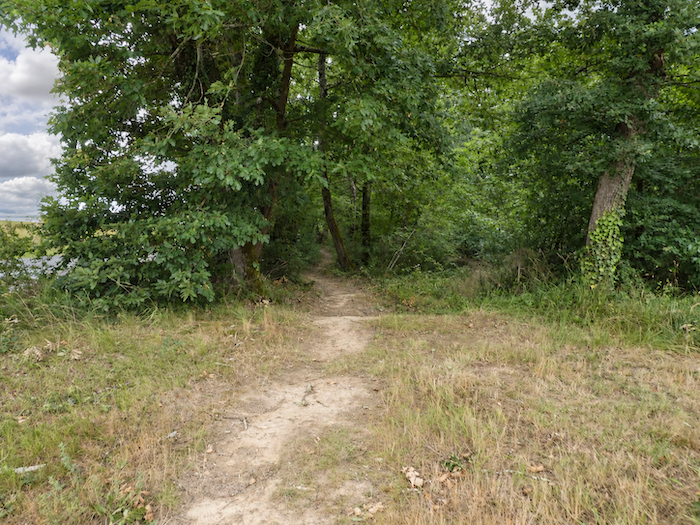 |
| But the hope is short-lived. The woodland proves to be no more than a brief interlude, and already the path is reunited with its old acquaintance, the departmental road. We thought we had given it the slip, but it was simply waiting for us a little farther on. And just to add a little variety, the GR65 now crosses the road once again to continue on the opposite side. If the scenery refuses to change, at least we can change pavements. If only there were a pavement! |
 |
 |
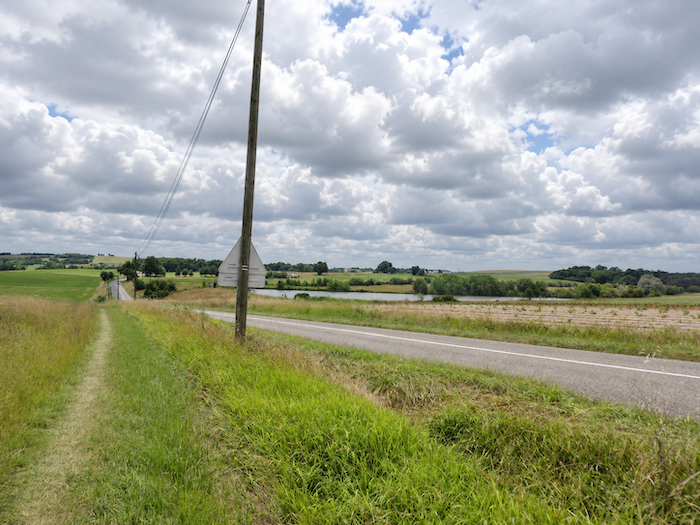
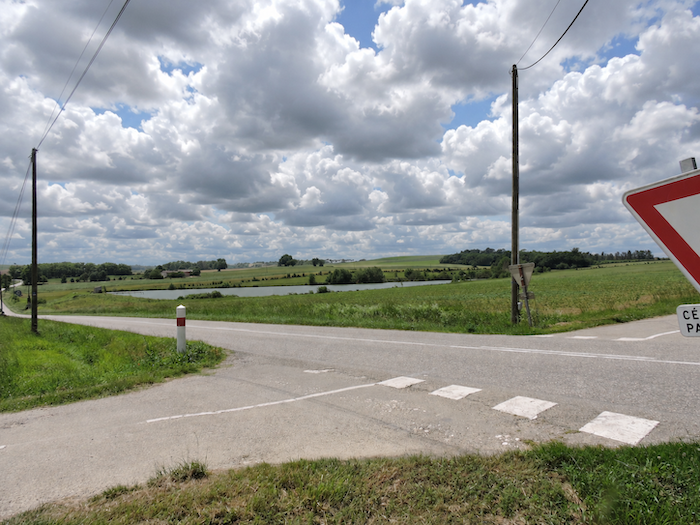
| The grassy trail continues its seemingly endless companionship with the departmental road until it reaches a crossroads near a small lake, at a place known as Sainte-Marie-du-Gajan. Here, the cultivated fields seem to have lost some of their vastness. The plots become more modest, and a few meadows timidly appear between the fields, where the soil, perhaps less fertile, is better suited to grassland than to large-scale arable farming. |
 |
 |
 |
 |
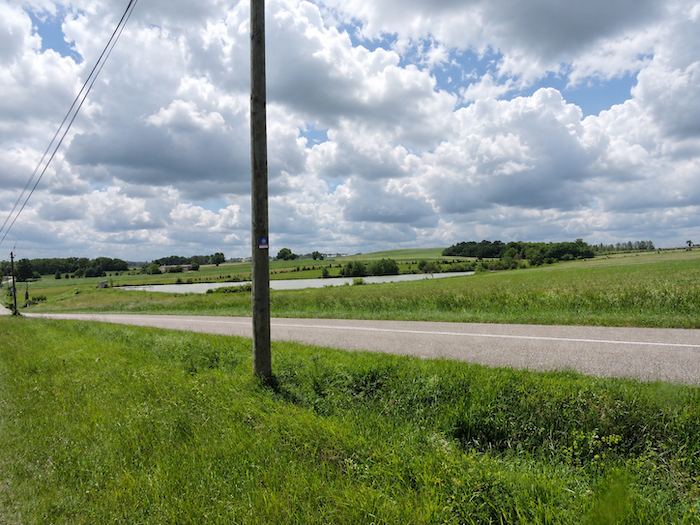
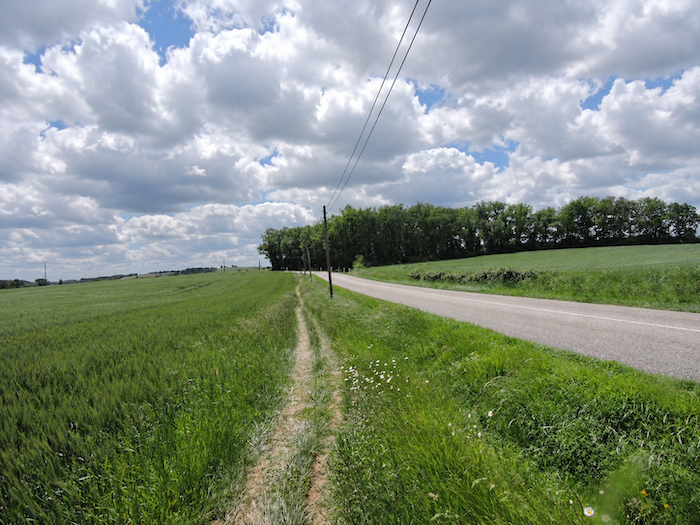
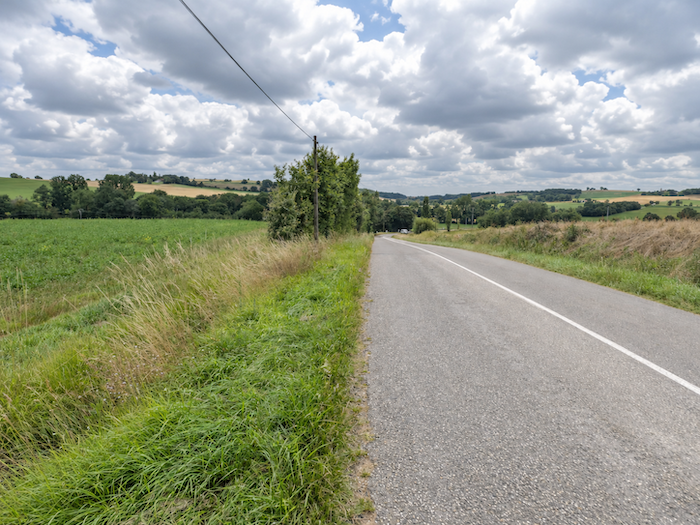
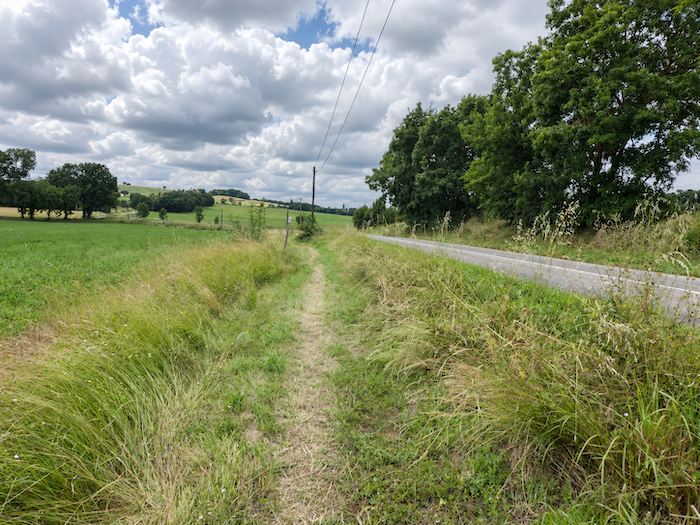
| But the punishment is not over yet! The GR65 stubbornly continues to follow the departmental road, still confined to its narrow grassy strip, with a loyalty one could happily do without. The scenery, meanwhile, makes little effort to entertain the walker. Only the sunflowers have taken over from the scrub, on ground that looks decidedly marshy. The road runs straight through countryside as flat as a pancake, where sunflower fields alternate with fallow land covered in green manure crops. With no hills to enliven the view, at least the colors provide some relief from the long monotony. |
 |
 |
 |
 |
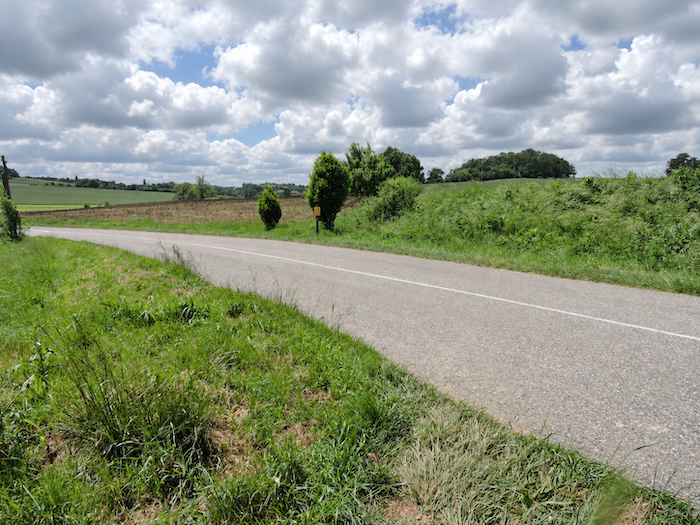
| And then, around a bend, deliverance at last! The departmental road finally loosens its grip, and the route regains a more rural character. Yet we should not be too quick to blame those responsible for laying out the Way. After all, they have to contend with the constraints of the terrain, the roads and the surrounding farmland. This time, geography comes to their rescue. A path leaves the road behind and begins a gentle climb up a hillside. At last, the prospect of horizons offering a few more surprises. |
 |
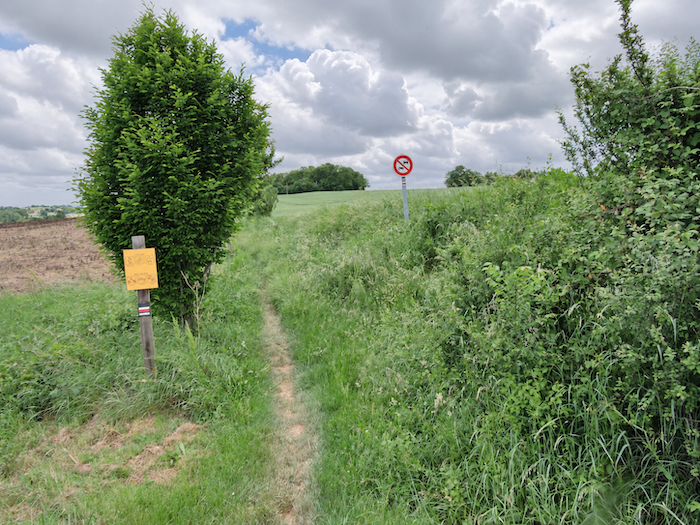 |
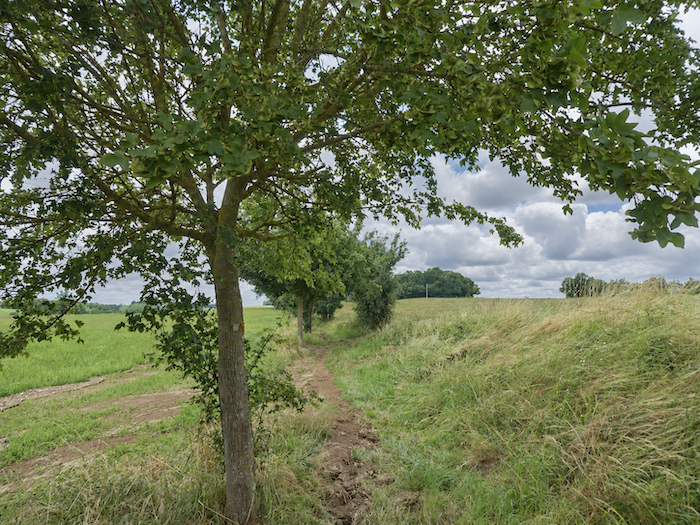
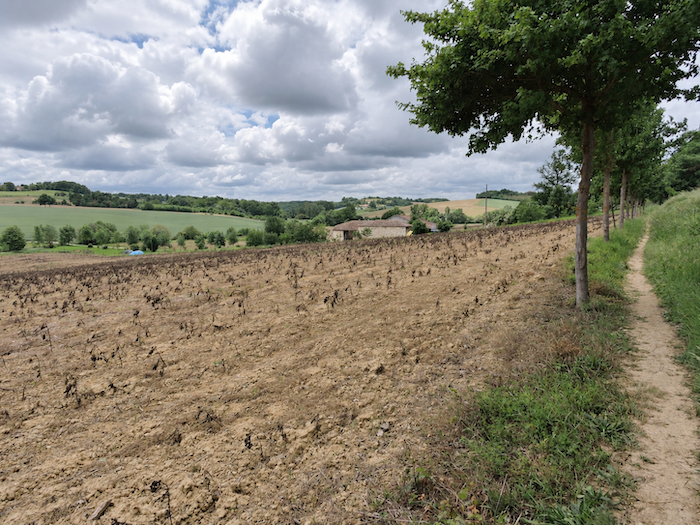
| The GR65 thus resumes its leisurely progress, gradually gaining height in the company of maples and oaks. The climb, which presents no particular difficulty, leads to a place known as La Peyronelle, where the trees seem eager to restore some of the intimacy that the walk had lost beside the road. |
 |
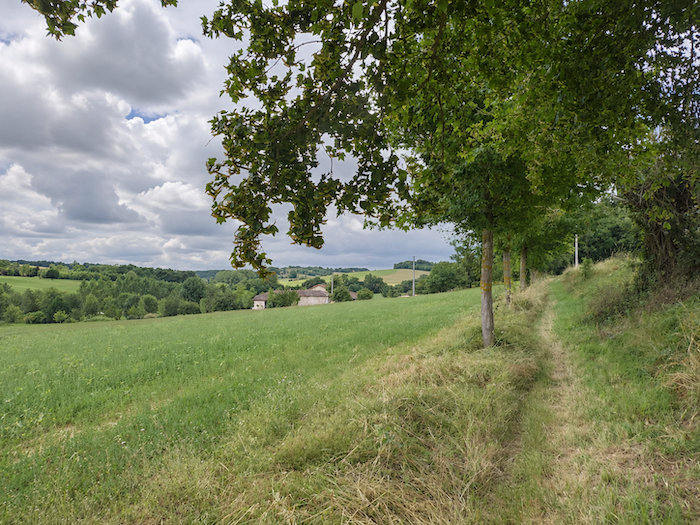 |
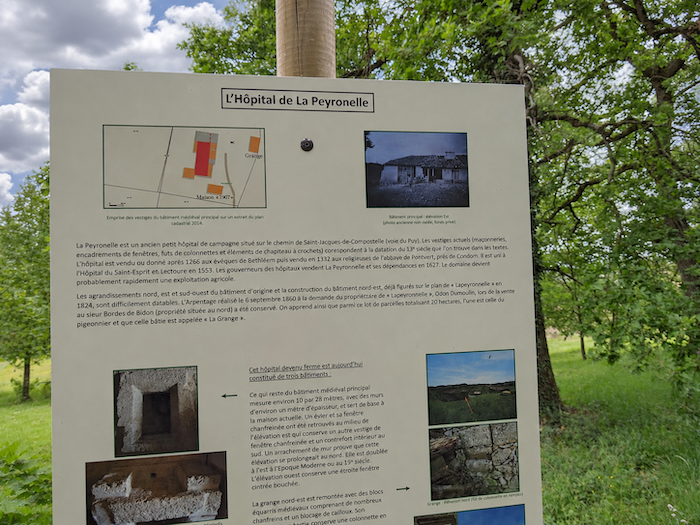
| At the edge of the grove, an information board invites walkers to travel back through the centuries. It recalls that a rural hospital stood here as early as the 12th century, one of those modest establishments that once dotted the roads and offered shelter to pilgrims. Time has swept almost everything away, but a few fragments of masonry and small columns have survived, incorporated into the buildings of a large farm on the hillside. What a curious fate for these ancient stones, which have passed from medieval hospitality to the practical demands of agricultural life without ever quite disappearing. |
 |
 |
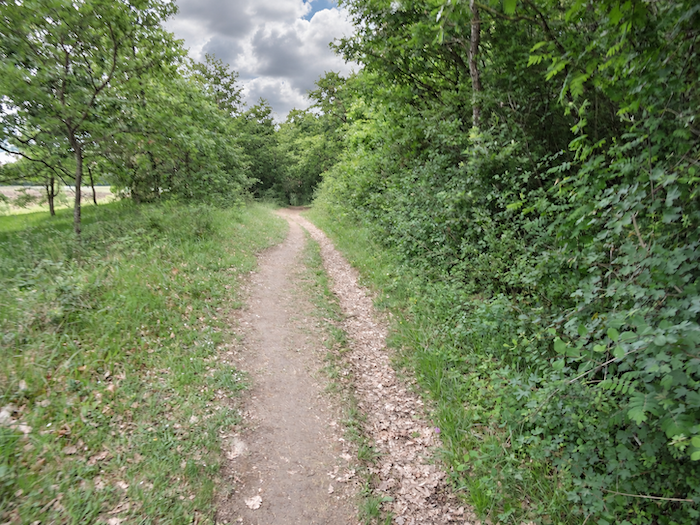
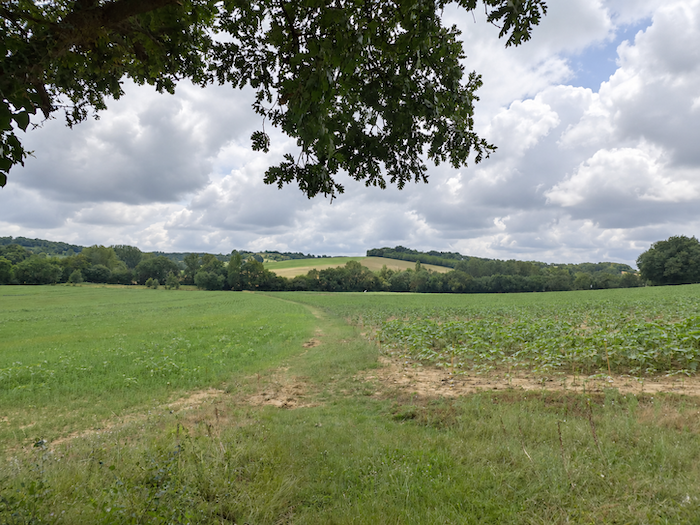
| The path then passes through the woodland before continuing towards the Pitrac stream. Today, sunflowers accompany it along the way. Another year, cereal crops may well have reclaimed these fields. In this countryside governed by crop rotation, the scenery changes with the harvests, and a pilgrim returning a few seasons later might scarcely recognize the fields through which they once walked. |
 |
 |
Section 3: Over hill and dale along the Pitrac stream
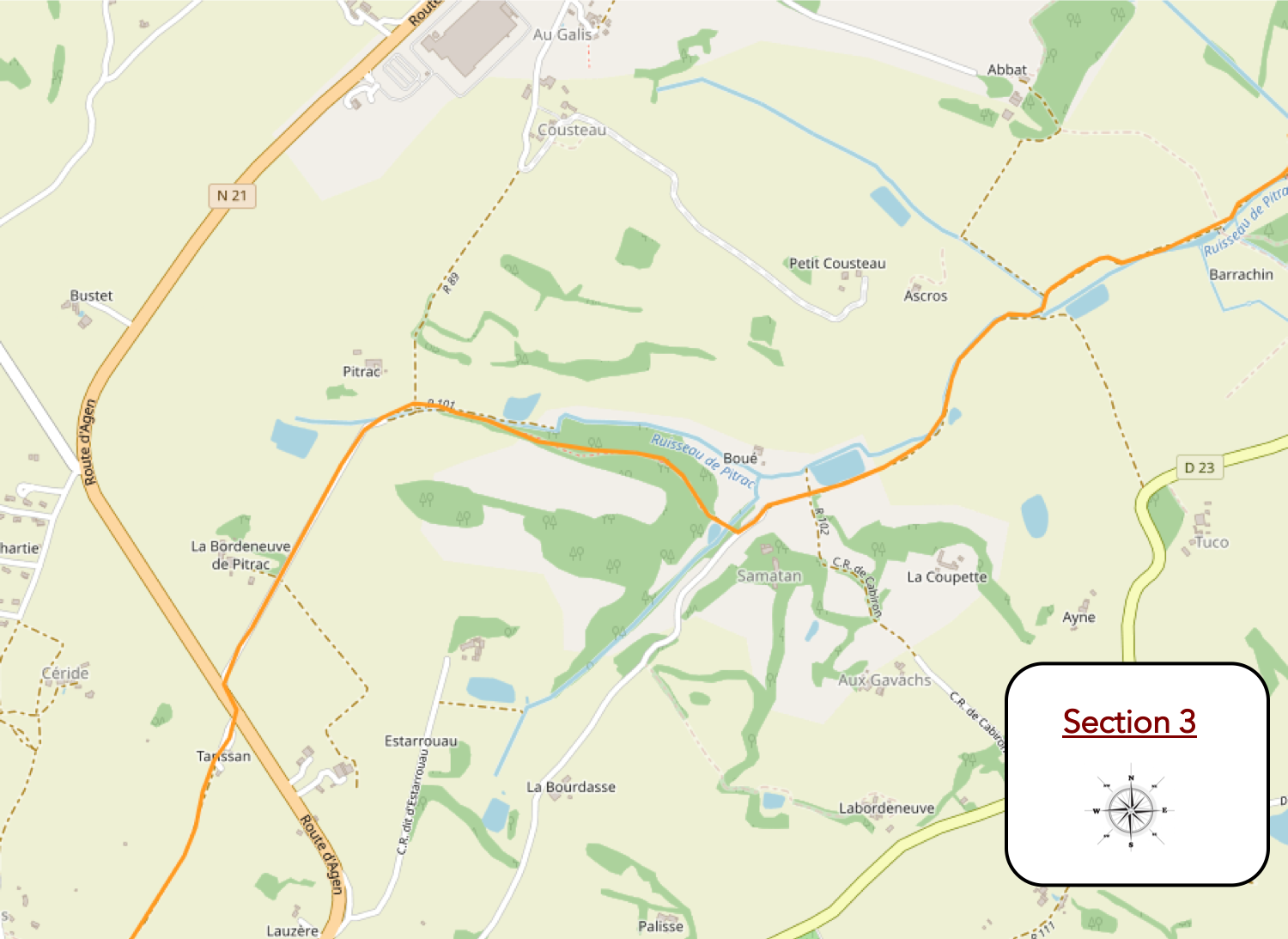
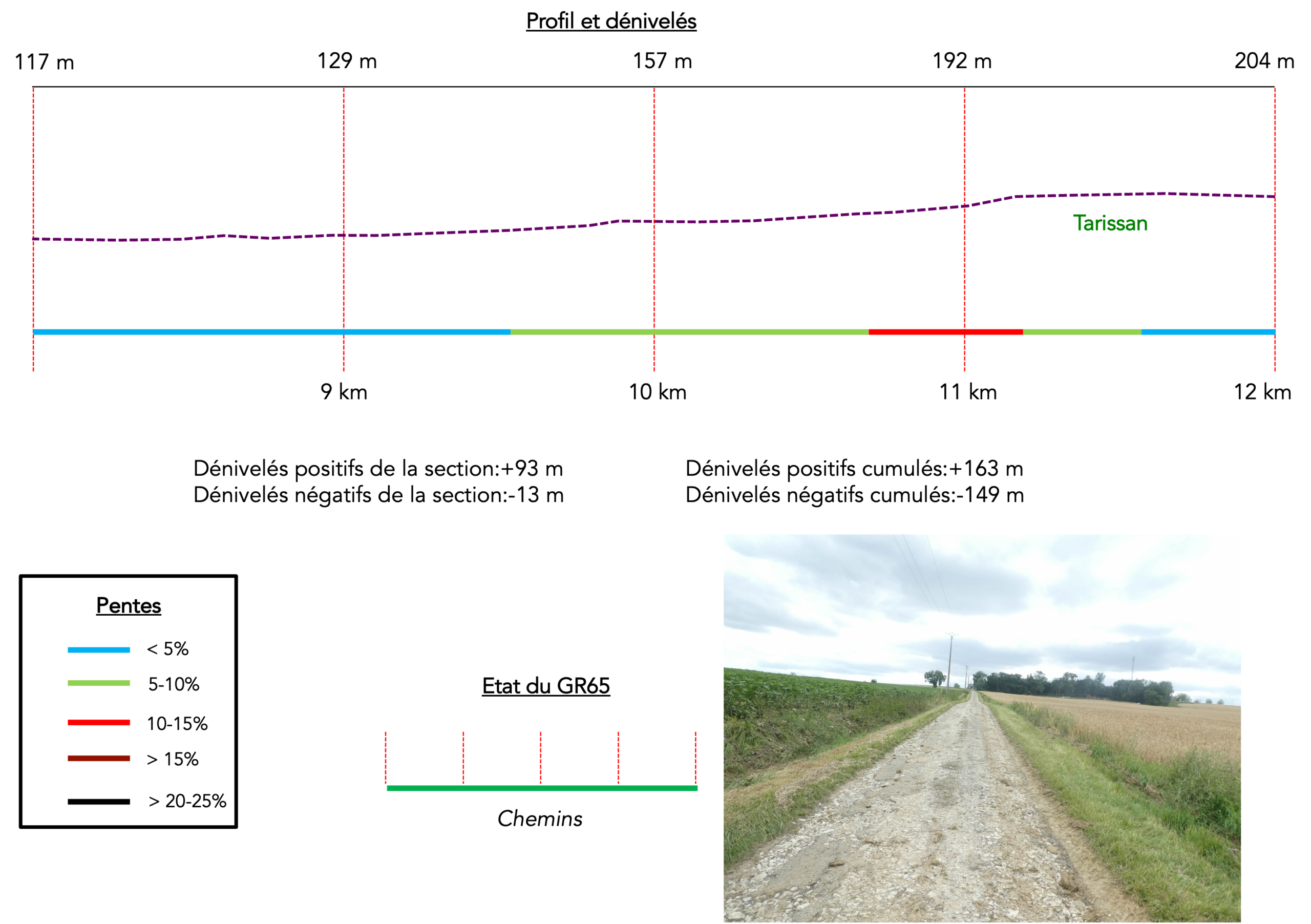
Overview of the route’s challenges: There is a little climbing to do, admittedly, but nothing particularly difficult, at least in fine weather!
| The Ways of St James are not always a bed of roses, far from it! Allow us to recount a little misadventure, if only to illustrate what this peaceful countryside can become when the weather decides to turn nasty. We passed through here one day, just after a violent thunderstorm had thoroughly drenched the region. The soil had been washed away in places, the fields were waterlogged, and the modest Pitrac stream, usually so discreet, had burst its banks at several points. The warning had already been given back in Miradoux: it would be wiser to abandon the trail and reach Lectoure by road. Many pilgrims, sensible and obedient, had followed this advice, resigning themselves to more than eight kilometers along the departmental road. But not everyone, of course! There are always a few walkers for whom the prospect of wading through mud is not sufficient reason to abandon the Way. After all, walking boots are made for walking, and there would always be time to wash them on arrival! But we had little idea what we were getting ourselves into. Not content with overflowing into the fields, the Pitrac had been swollen by runoff water that had washed the loose soil from the slopes and turned the passages into veritable quagmires. The mud admittedly rose little higher than our ankles, but it had that stubborn, almost affectionate consistency that seemed determined to keep our boots for itself. Every step became a little negotiation with the ground, and sometimes we had to pull hard to retrieve a foot that the clay obstinately refused to release. There was no point hoping to find salvation in the neighboring grass. Thoroughly soaked and wonderfully spongy, it offered scarcely firmer footing than the flooded fields. In places, the stream, normally so well behaved that one barely notices it, had spread out into veritable little lakes. These floods did at least have one redeeming quality: they allowed us to rinse some of the mud from our boots. For after accumulating layer upon layer of sticky clay, our footwear had turned into two enormous, shapeless clogs, each weighing a miserable ton with every step. In such circumstances, you also discover the unsuspected usefulness of large stones. On a waterlogged path, they become precious refuges where you can place a foot, regain your balance or attempt to scrape away the mud. But here, there were no such providential rocks! Nothing but earth, grass and water, in a landscape that seemed determined to dissolve entirely into liquid. When we finally arrived, it took us a good quarter of an hour to scrape the mud from our boots and wash them thoroughly with water. They were still not dry the following morning. Such experiences give some idea of what the Way can have in store when it decides to test the patience of pilgrims. Do not misunderstand us: we are hardly in the habit of complaining. The stages we describe generally unfold beneath kindly skies, through landscapes bathed in light. But everyone knows that this cheerful picture does not always reflect the everyday reality of walking the Way. Rain, mud and soaking wet boots are also part of the adventure, and sometimes among its most enduring memories.
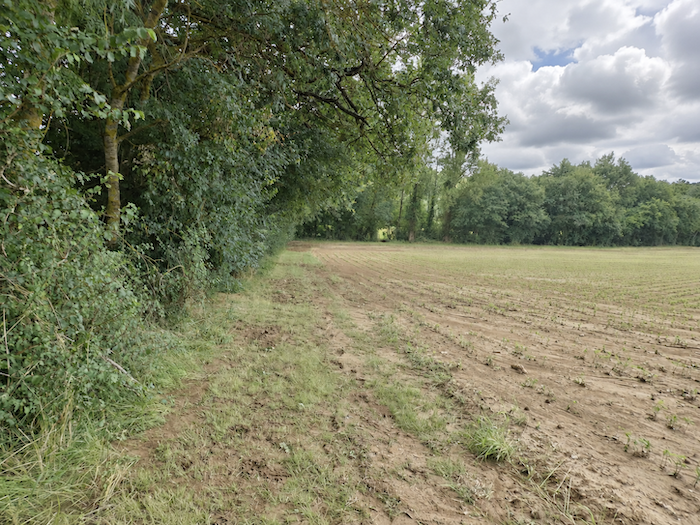
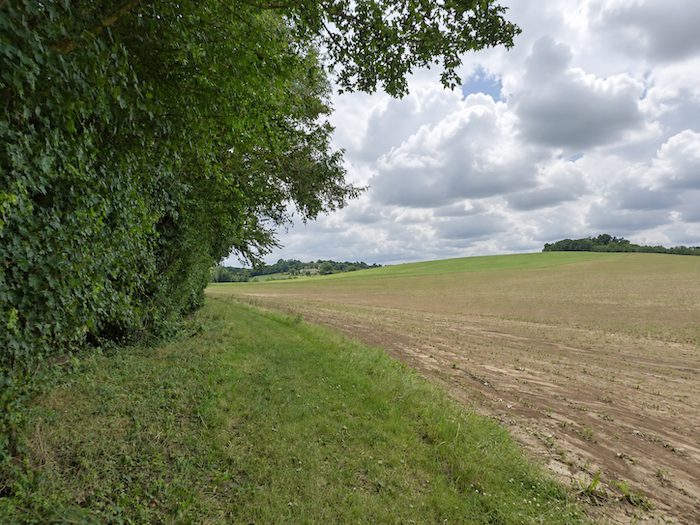
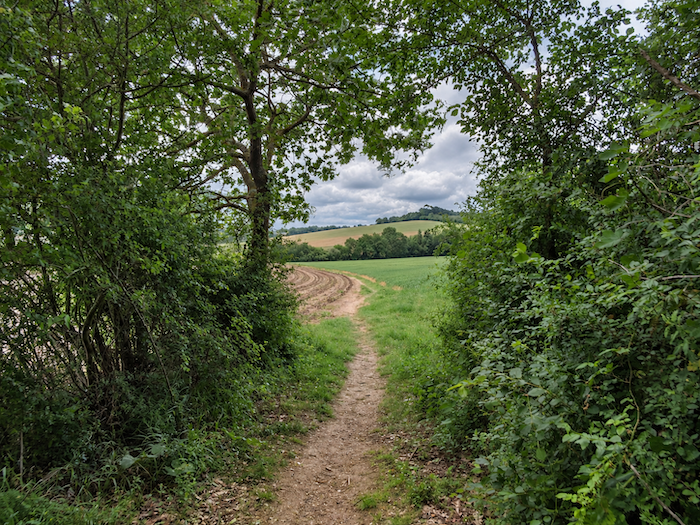
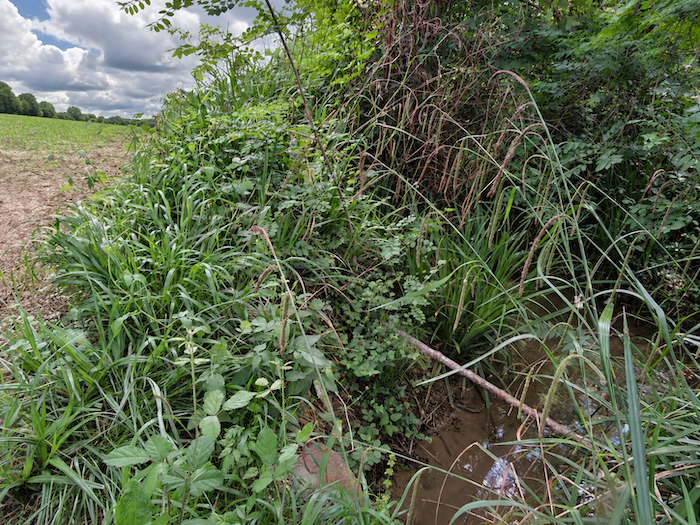
Let us return, then, to our route on a calmer day, though not necessarily a sunny one. The ground here retains an almost permanent dampness, with the Pitrac stream flowing close by. The grass grows thick and lush, the soil is often spongy, and it is easy to imagine how just a few heavy showers could allow the water to reclaim the surrounding land. The boundary between trail and marsh is sometimes remarkably thin. |
 |
 |
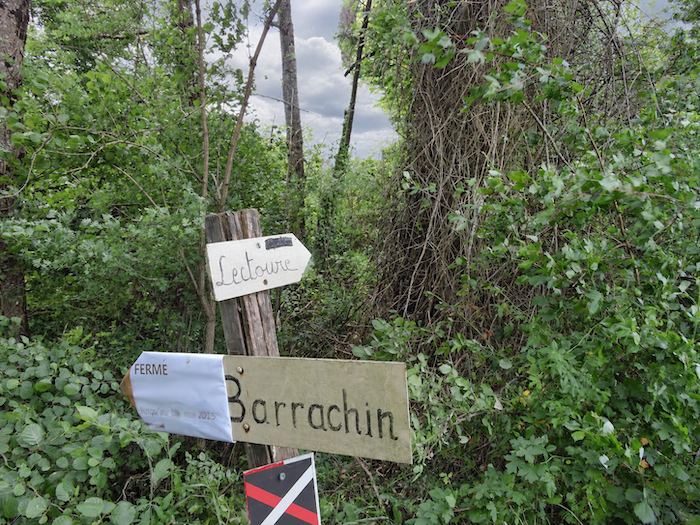
| The path then runs near Barachin Farm, once a well-known address among pilgrims on the Way of St James. The pilgrims’ accommodation closed following the deaths of its owners, but their memory deserves to live on. They had made a considerable contribution to developing the present route, allowing walkers to return to earthen paths where, in earlier days, they had been forced to endure asphalt almost all the way to Lectoure. It was a wonderful contribution to the life of the Way, one from which pilgrims passing through here still benefit today. So let us offer these benefactors of pilgrims a heartfelt thank you, all the way up to Heaven! |
 |
 |
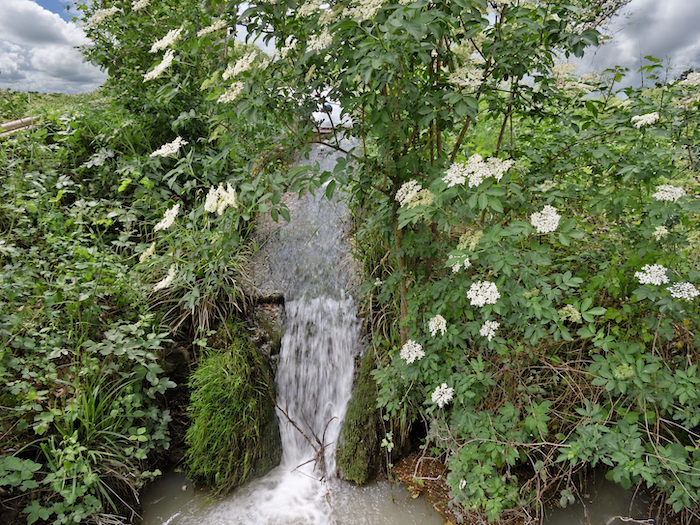
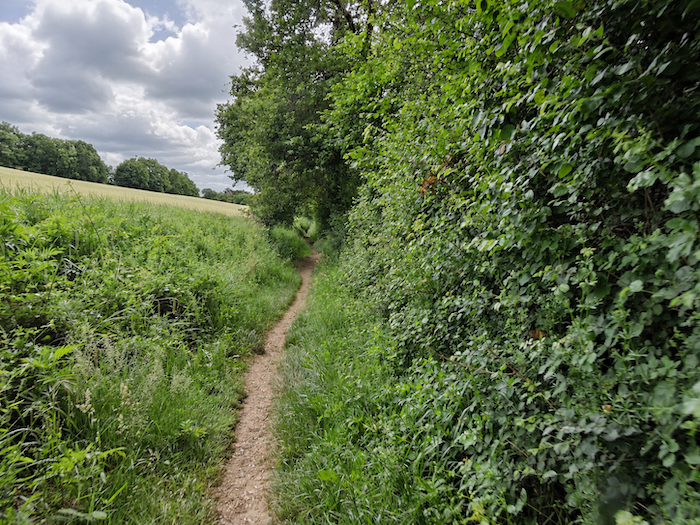
| Here, the path seems to find a new spring in its step, bounding along the edge of the woodland in the company of the Pitrac stream, which indulges in a few playful twists and turns of its own. One winds between the trees, the other slips through the vegetation, while the fields continue to spread their vast expanses all around. A far more enjoyable walk than those endless encounters with the departmental road. |
 |
 |
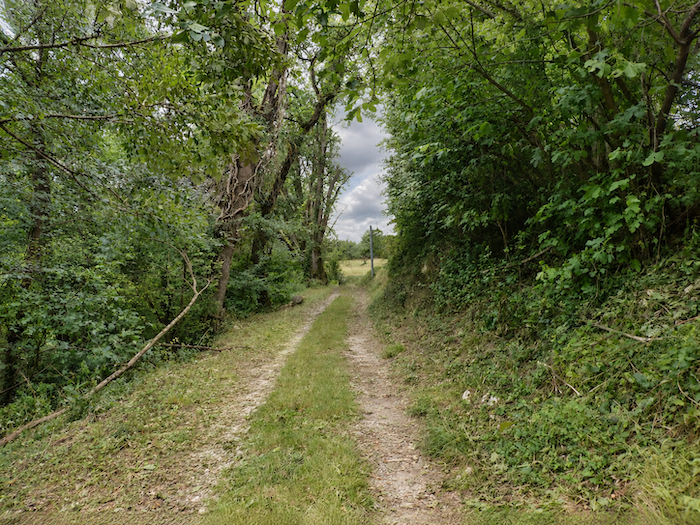
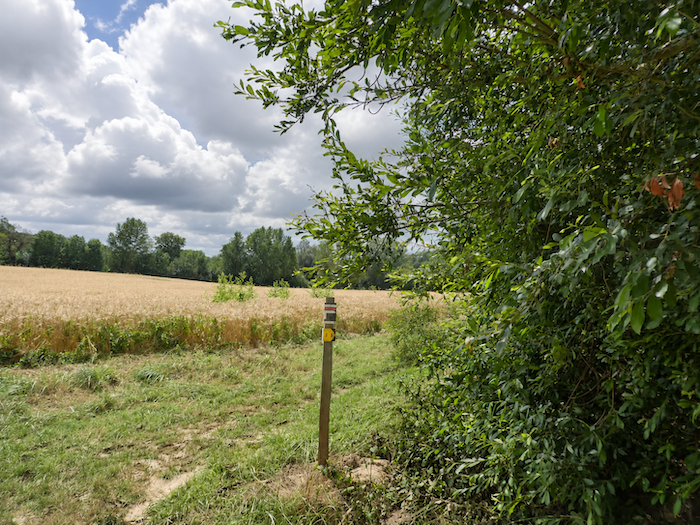
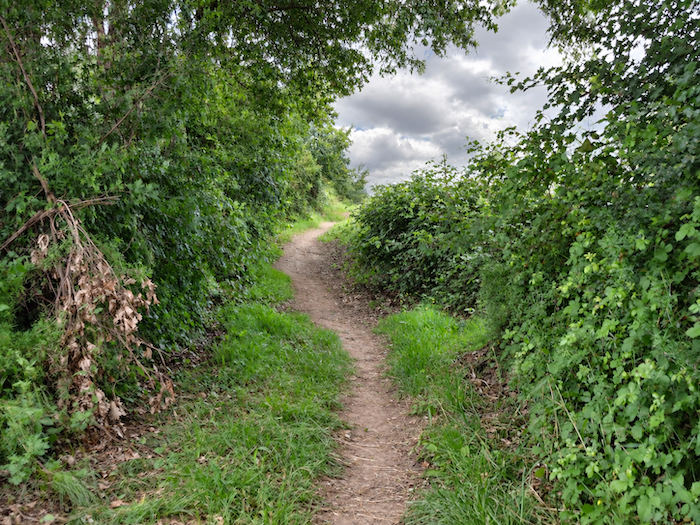
| Farther on, the trail begins to gain height, climbing the hillside along a grassy track that seems to hesitate between the openness of the countryside and the intimacy of the woodland. |
 |
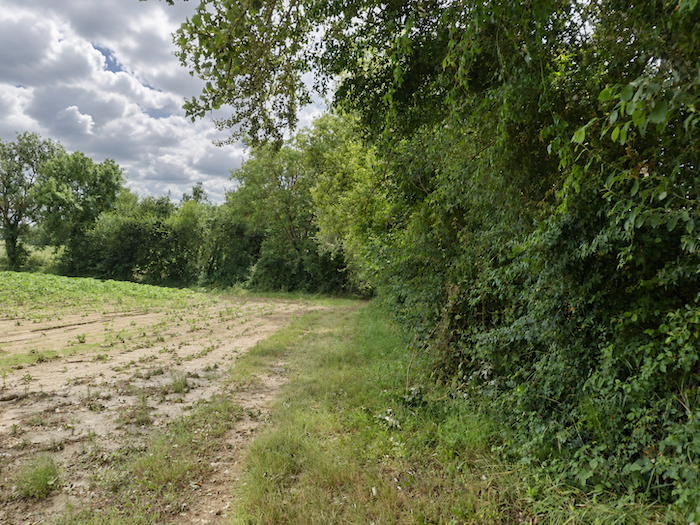 |
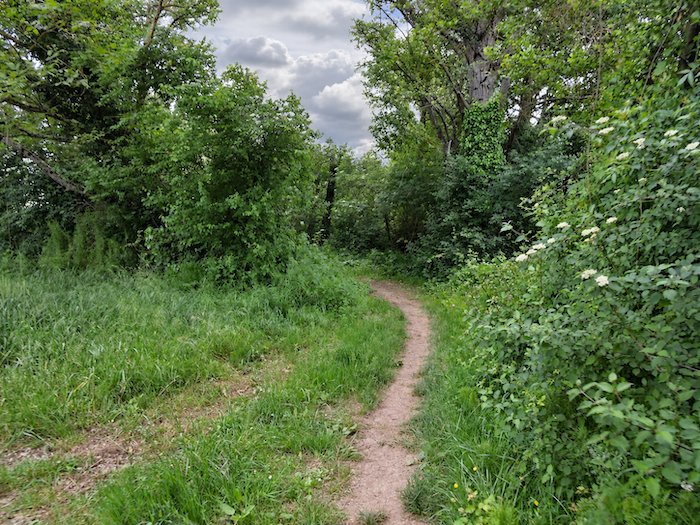
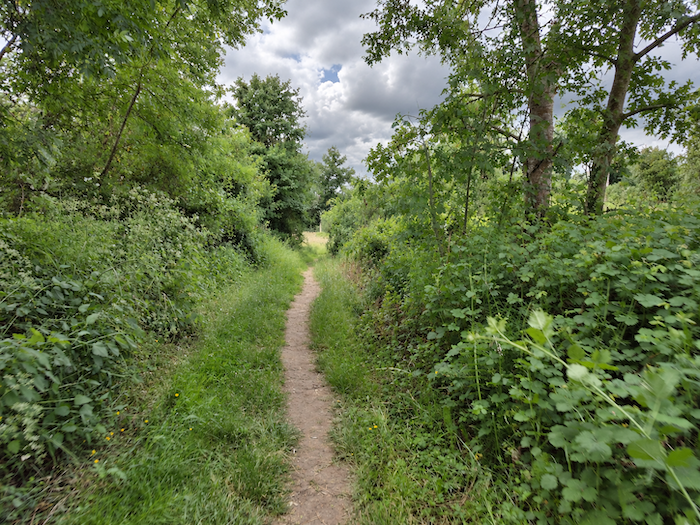
| Nature takes on a more untamed appearance here. There is little that seems truly domesticated in this dense undergrowth, the luxuriant grasses and the vegetation that appears determined to grow entirely as it pleases. The landscape has something wild about it, almost austere in places, as though this little corner of Gascony had insisted on preserving its own character, far from the carefully ordered farmland through which we have just passed. |
 |
 |
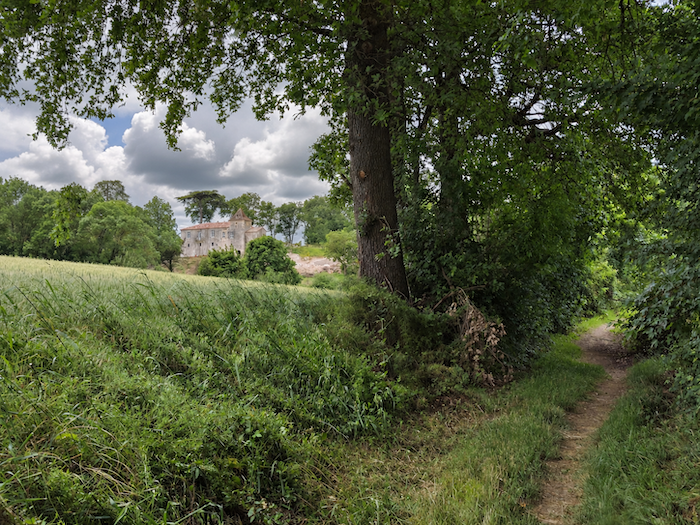
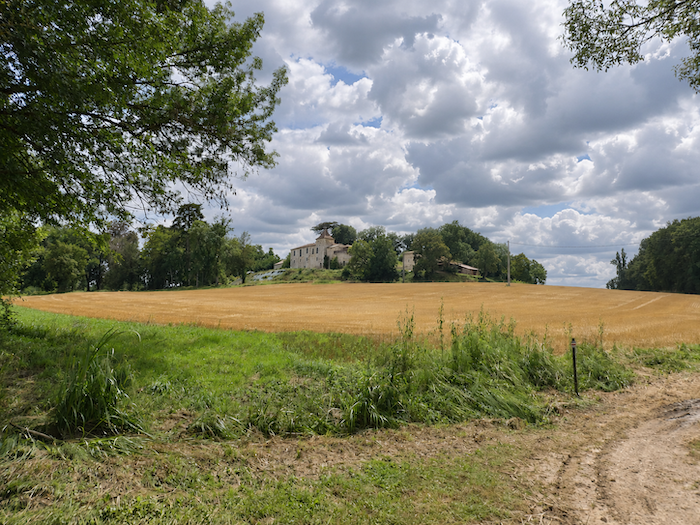
| A little higher up, a magnificent manor house comes into view, perched on the hillside. With its castle-like appearance and commanding position, it seems intent on ruling over the surrounding countryside. |
 |
 |
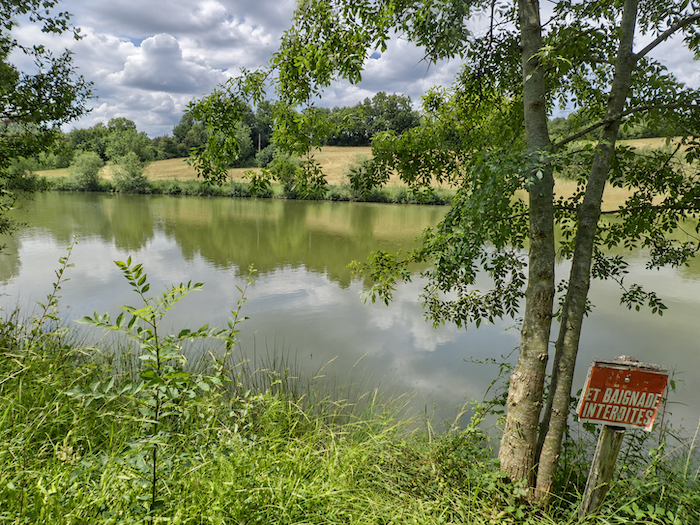
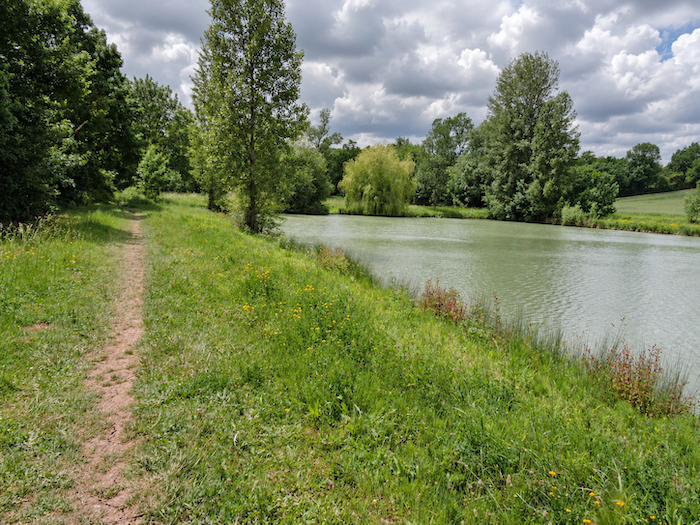
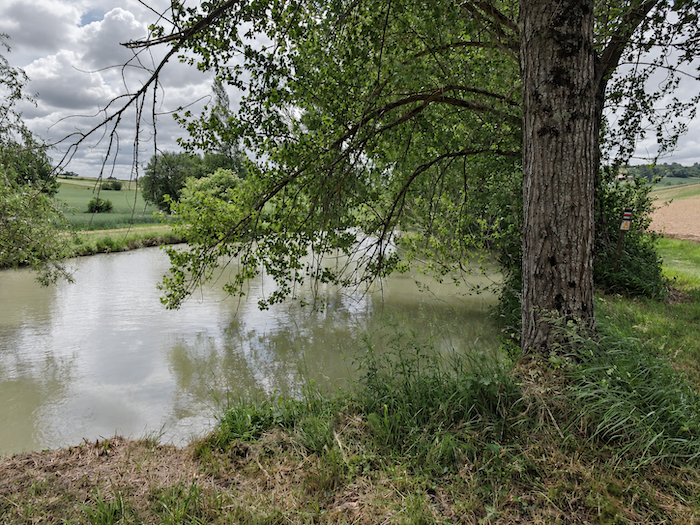
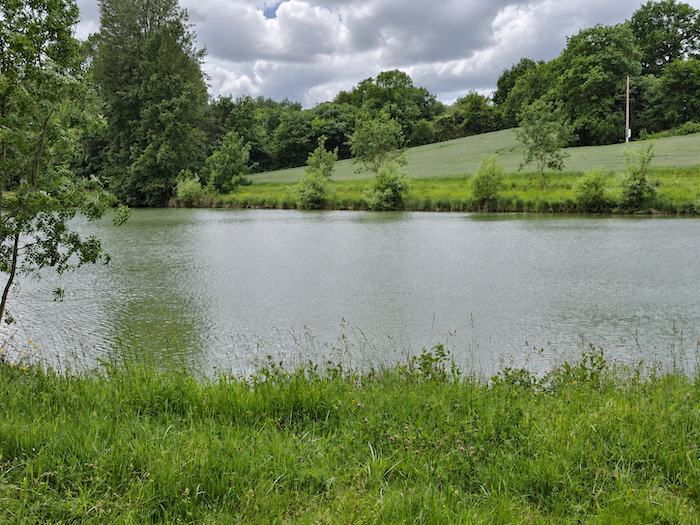
| The route then reaches a delightful little lake, almost hidden away beneath the ash trees, among reeds and tall grasses. The Pitrac stream quietly continues its course here, in a setting where water and vegetation seem to compete for every patch of ground. The place has all the makings of an ideal refuge for a peaceful stop beside the water, but signs remind visitors that fishing and swimming are forbidden. We shall therefore have to content ourselves with admiring the scenery, which, after all, is no small pleasure. |
 |
 |
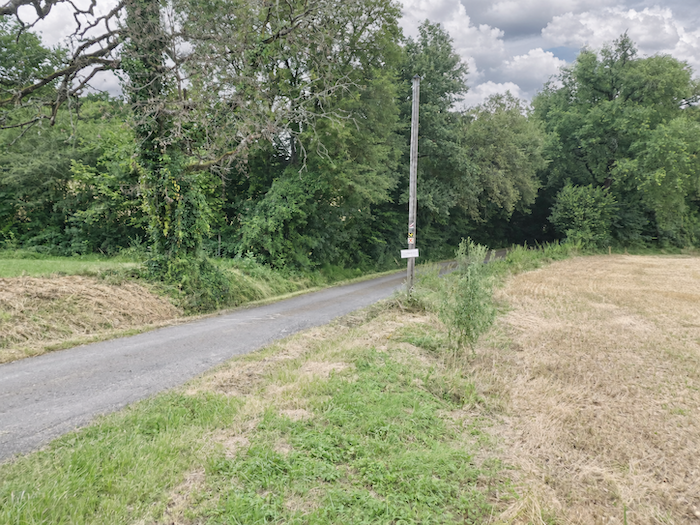
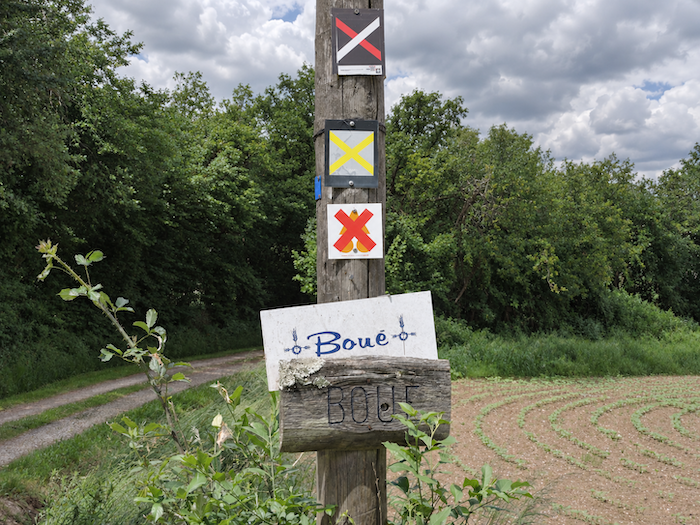
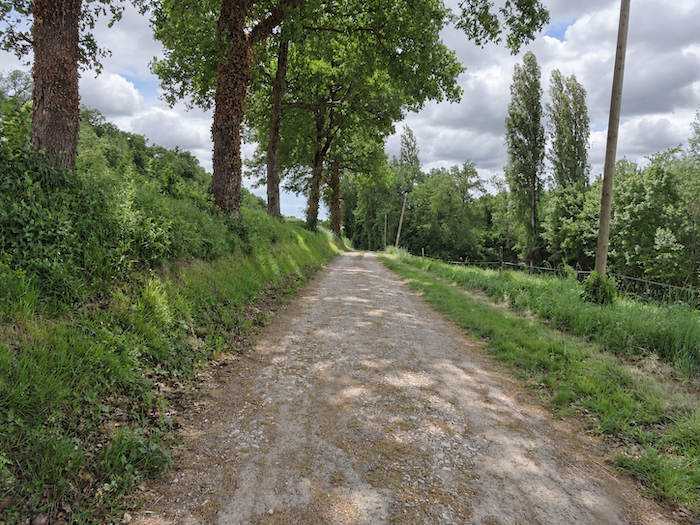
| Shortly afterwards, the GR65 emerges onto a compacted dirt track. A sign points towards Boué, where pilgrims can find accommodation, provided they are willing to make a short detour away from the main route. |
 |
 |
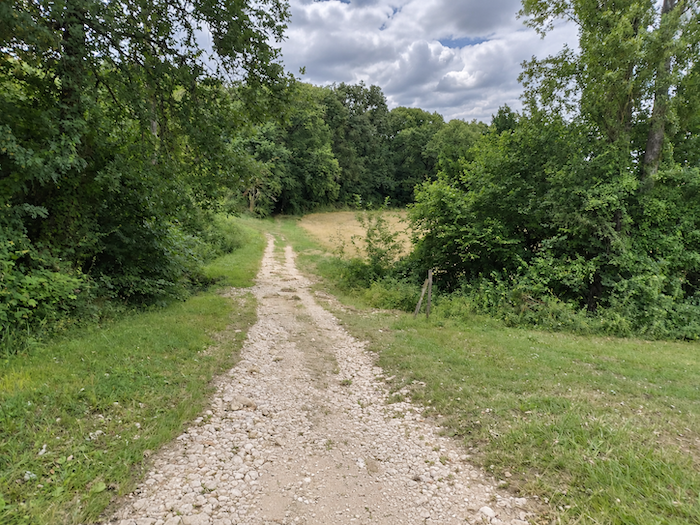
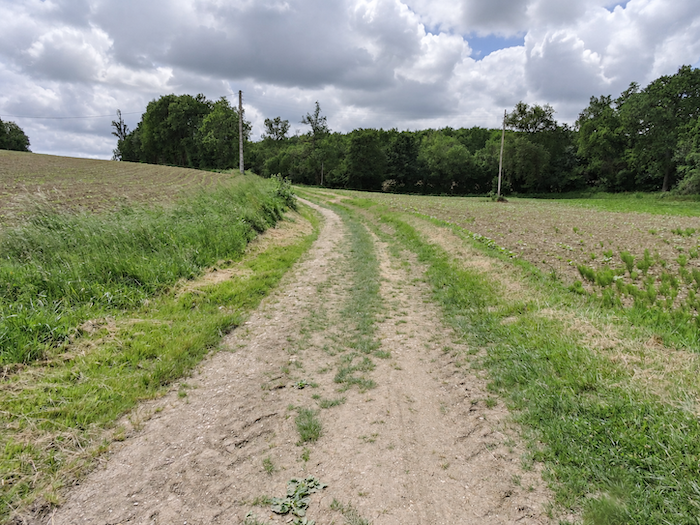
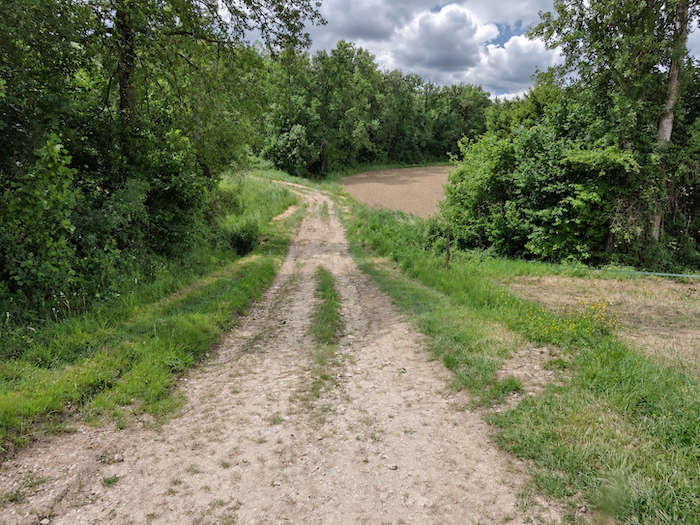
| But the GR65 does not linger long on this road, which in any case eventually comes to a dead end. Almost immediately, a stony path takes over, climbing towards the woodland. Once again, there is the promise of walking away from the asphalt, although the stones beneath your boots already suggest that the ascent will not be entirely effortless. |
 |
 |
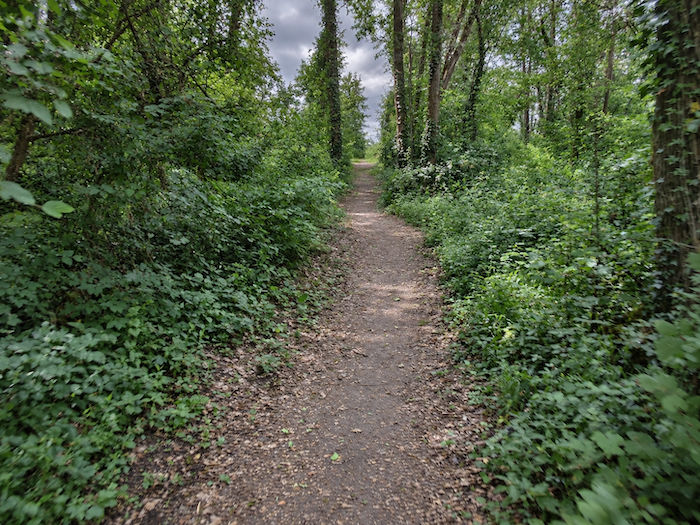
| Soon, the trail disappears beneath the canopy of trees, where the slope becomes a little more demanding. Oaks, chestnuts and hornbeams mingle their foliage overhead, creating a leafy canopy that provides welcome shade. The climb continues in this intimate woodland atmosphere. |
 |
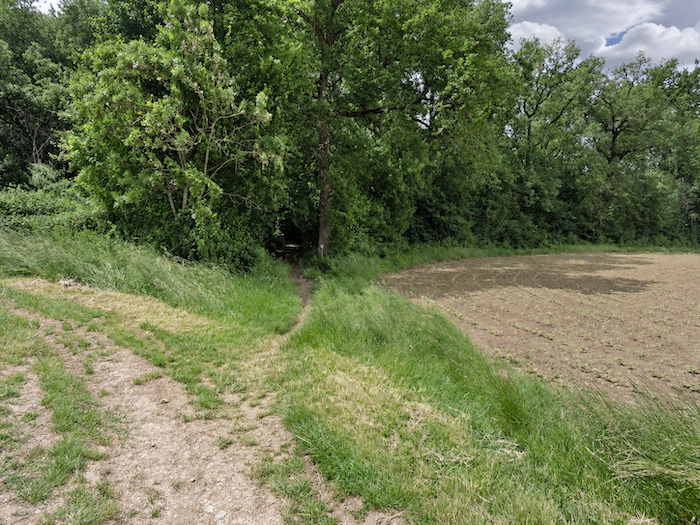 |
| Higher up, the trees eventually give way to hedgerows and cultivated fields. The landscape opens out once more, as though the hill, having kept its secrets hidden behind the foliage for a while, has finally agreed to reveal its horizons. The great expanses of farmland return, together with the gentle undulations of the terrain. |
 |
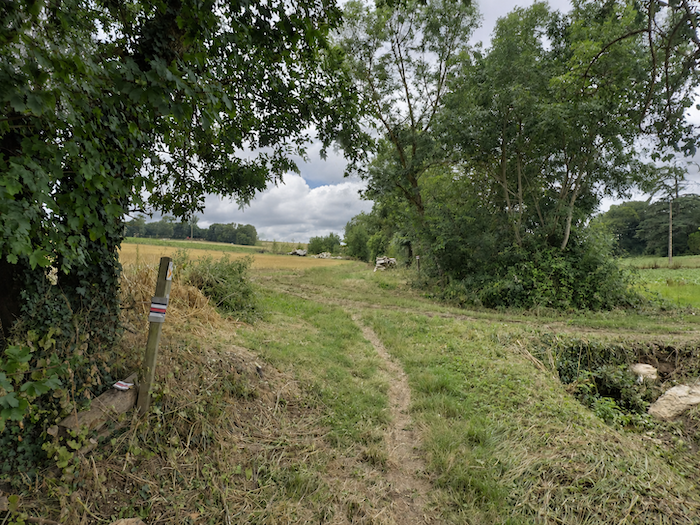 |
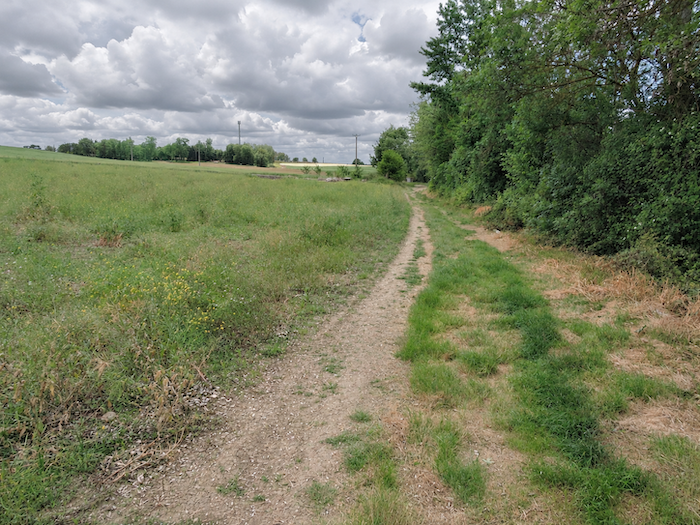
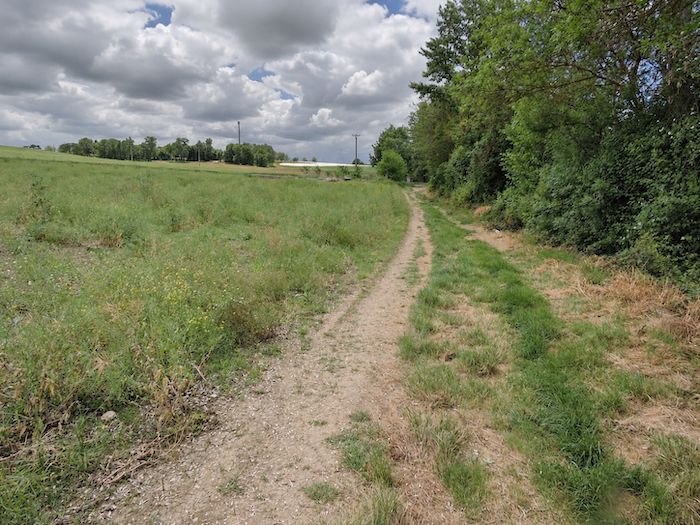
| But there is still height to be gained, and the hill has no intention of surrendering without a struggle. A broad, stony track tackles the slope head-on, with gradients approaching 15% in places. Today, sunflowers and cereal fields frame this demanding climb, at least providing something to occupy the eyes while the calf muscles have rather more pressing concerns. |
 |
 |
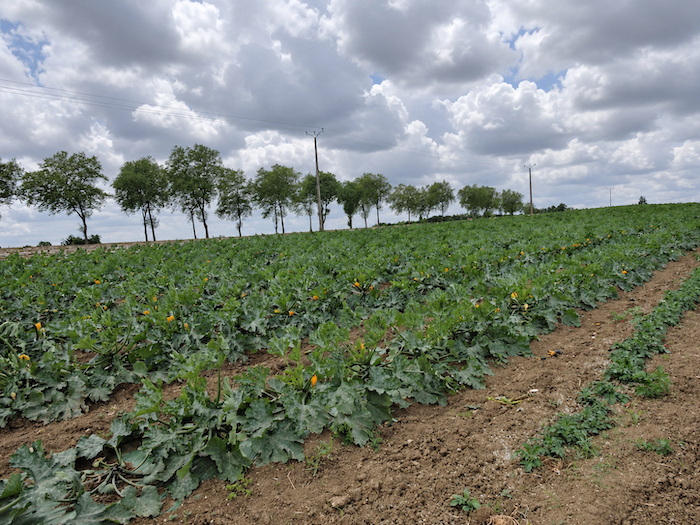
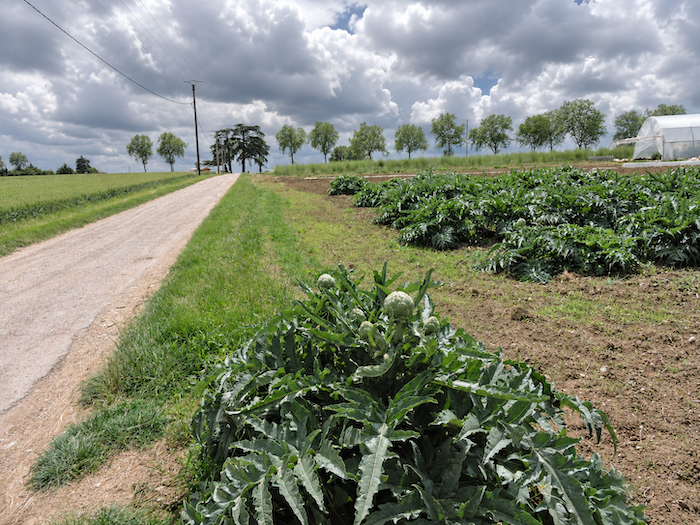
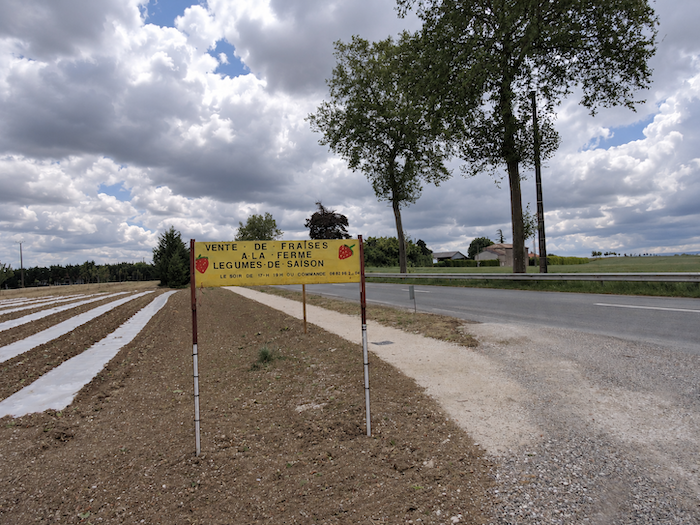
| Farther up, the path crosses a vast market garden, a veritable garden of plenty amid countryside otherwise largely devoted to extensive arable farming. Here, diversity reclaims its place: strawberries, courgettes, artichokes and many other vegetables and soft fruits share the plots. The artichokes, in particular, come as something of a surprise in this corner of Gascony. One would more readily expect to find them in Brittany, their traditional stronghold. But after all, why should the Bretons have a monopoly on this vegetable with such a distinctive silhouette? |
 |
 |
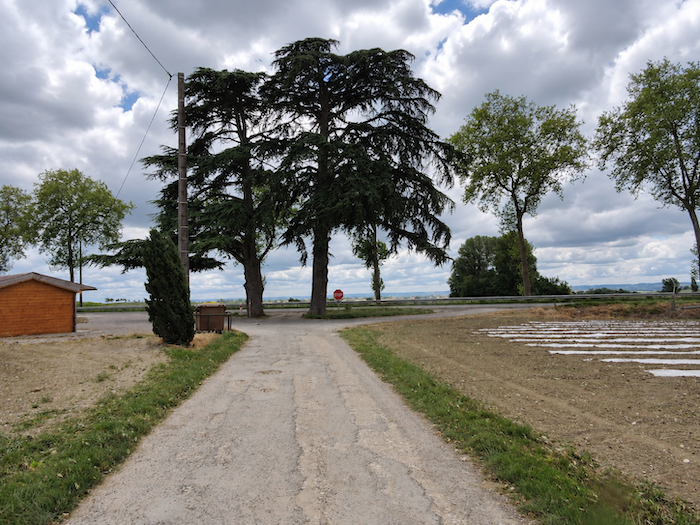
| Beyond the farm, the path reaches the N21 national road, a major thoroughfare coming from Agen and continuing southwards through Lectoure. After the tranquility of the fields and woodland, the return to this busy road marks a rather abrupt change of atmosphere. |
 |
 |
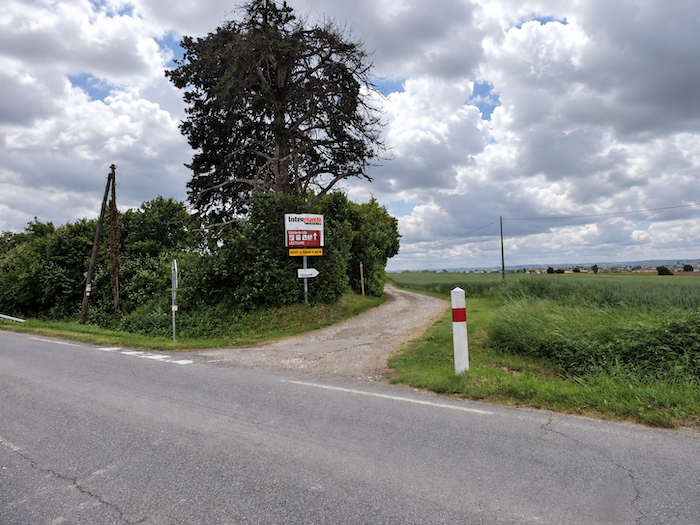
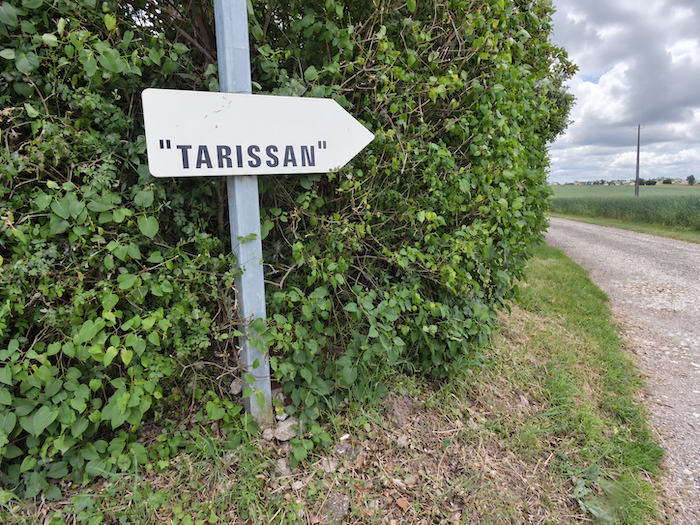
| The GR65 crosses the national road and picks up a broad path on the other side, heading through the countryside towards the locality known as Tarissan. |
 |
 |
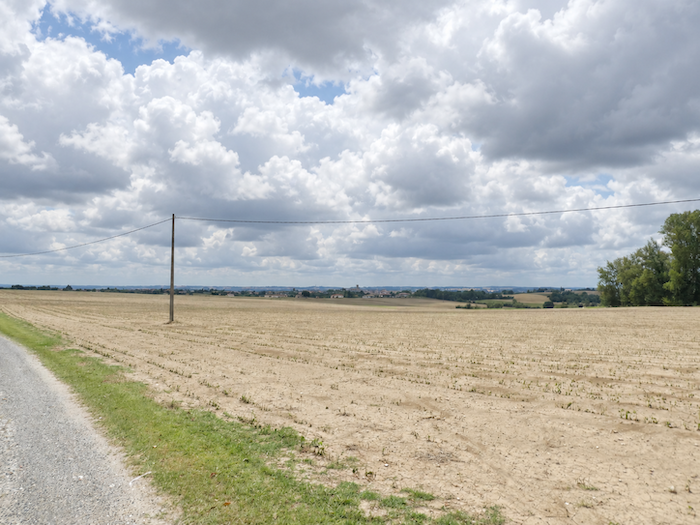
| The GR65 now begins to wander leisurely across a vast plateau, almost level and occasionally sloping very gently downhill, amid an ocean of cereals and sunflowers. In the distance, Lectoure can already be made out, with the bell tower of its cathedral rising above the hills. The town looks almost close enough to touch. But beware of these Gascon mirages! You may remember the interminable approach to Lauzerte, where the last houses seemed to retreat farther away with every step you took. Well, here the Way manages to do even better! You still have some five kilometers to cover before you can finally set foot in the streets of Lectoure. The town is happy enough to show itself, but it is far less willing to let you reach it. |
 |
 |
 |
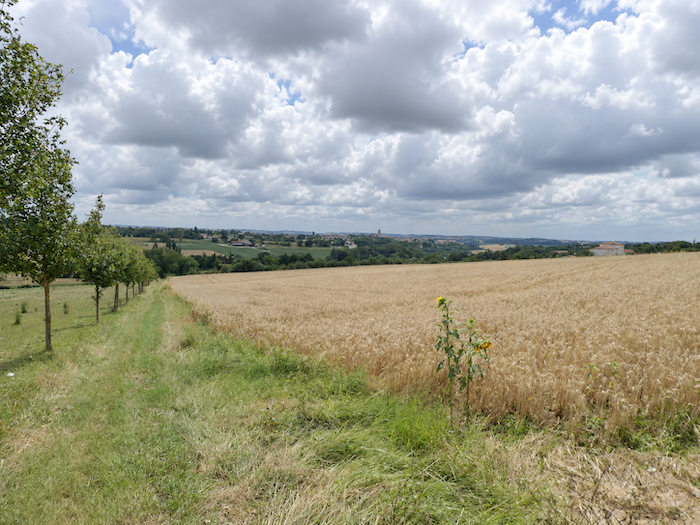 |
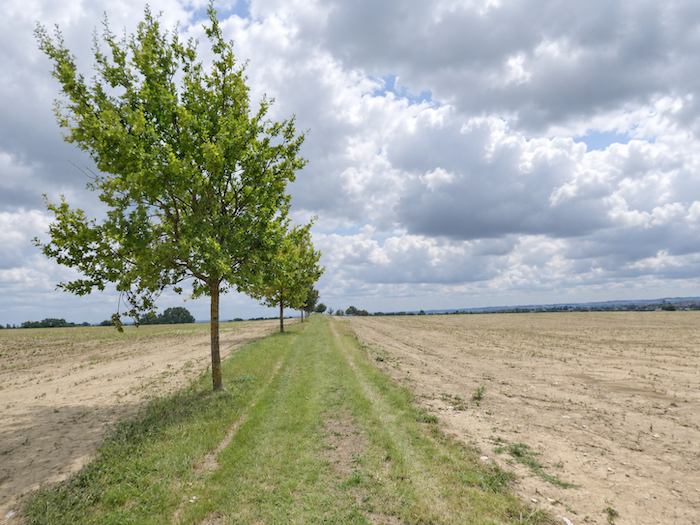
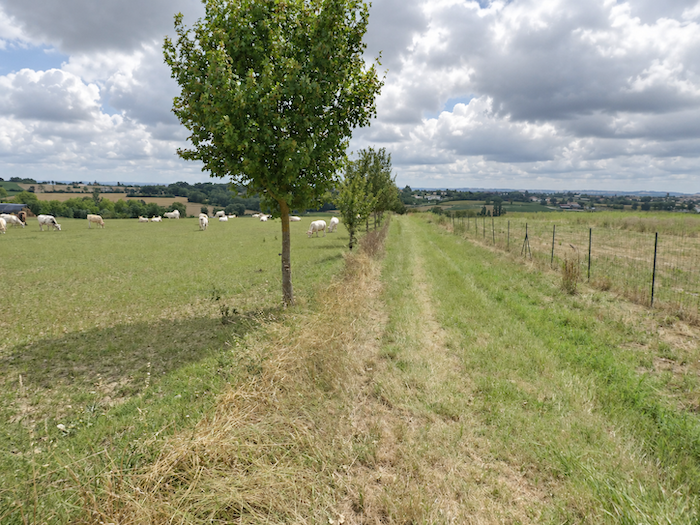
| For now, the walk continues peacefully through the grass, along the edges of fields and meadows, beneath rows of young maple trees planted to accompany walkers and mark their passage. And here are even a few cows! An almost unexpected encounter after so many days spent among vast cultivated fields. It must be said that in this part of the Gers, herds are rather scarce. The land is devoted mainly to cereals and oilseed crops, while pastures occupy only a modest place in the landscape. |
|
|
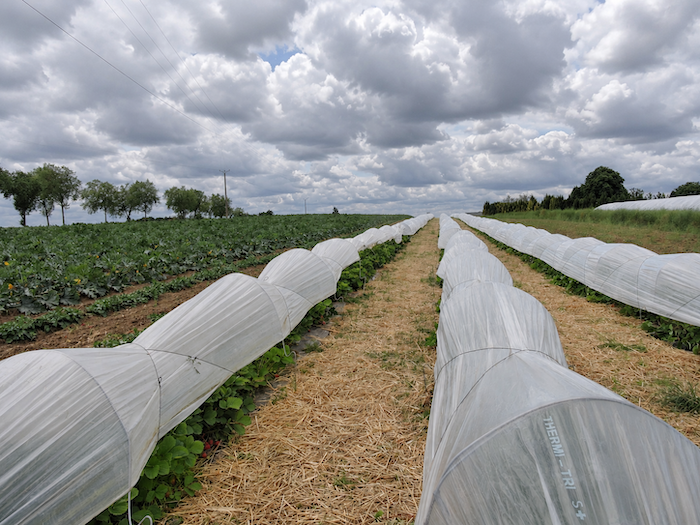
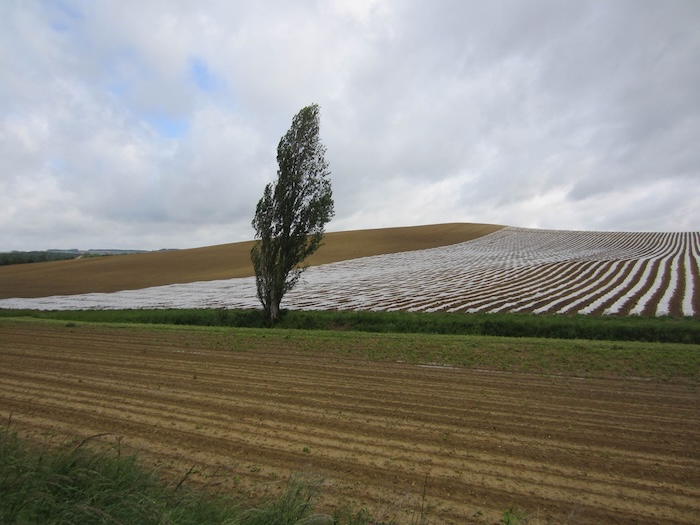
But do not expect to find exactly the same scenery if you return another year. In this countryside governed by the changing rhythms of crop rotation, the fields readily take on new appearances. You might find yourself surrounded by Charentais melon crops, one of the great specialties of the Lectoure area. The sight is rather unusual: beneath their long protective coverings, lined up as far as the eye can see, the plots almost resemble the undulations of a desert, as though small dunes had sprung up in the middle of the Gers countryside. Here, melons are often grown beneath low tunnels, also known locally as “chenilles”, or caterpillars, made from hoops covered with plastic sheeting or fabric. Others grow in the open air, depending on the season and the methods used by the growers.
Section 4: Across the vast fields of Lectoure
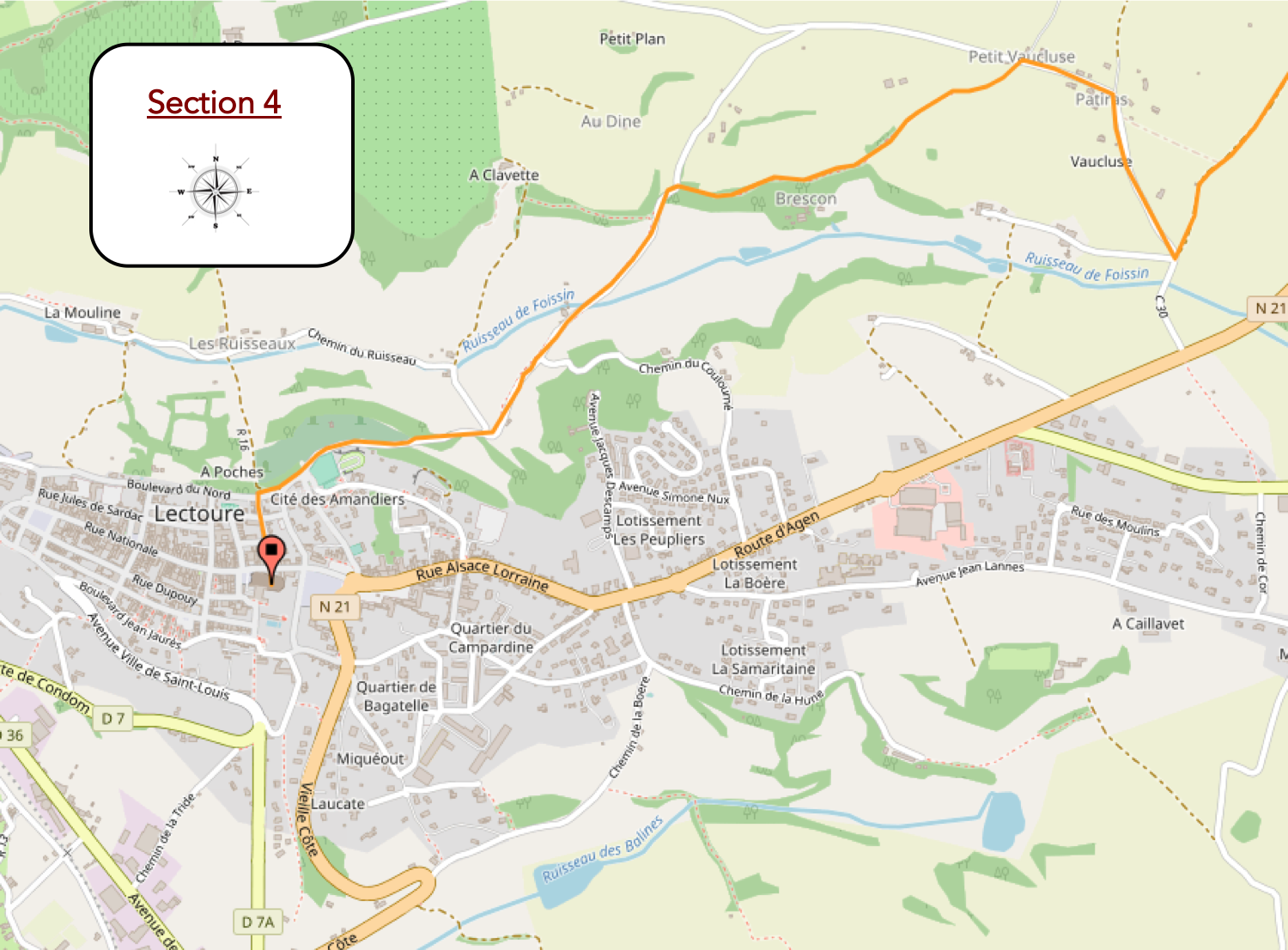
Overview of the route’s challenges: an easy route until the rather steep climb leading up to the citadel.
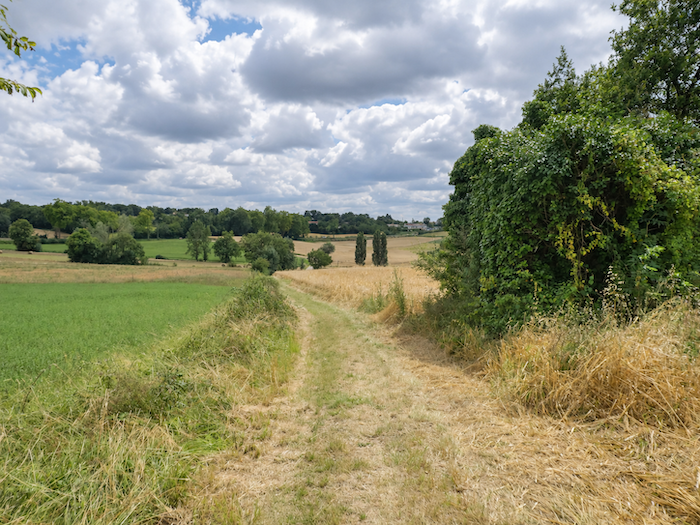
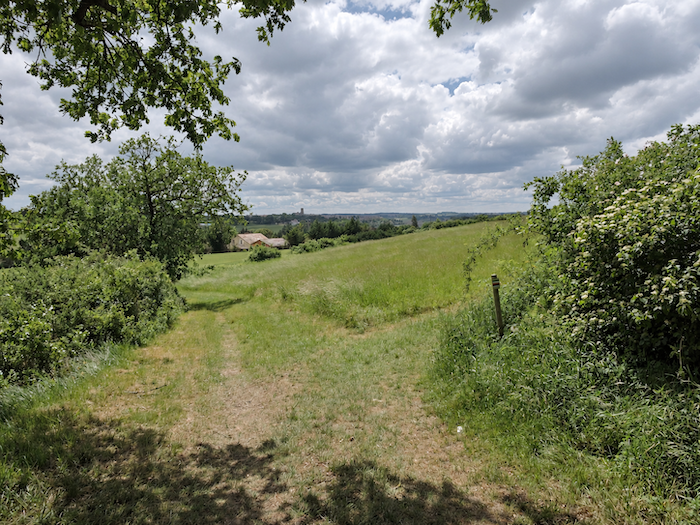
| Shortly afterwards, the path decides to lose some altitude, and not by halves! The descent is steep, winding through wheat fields and plots covered with green manure crops. Another year, sunflowers or soya beans may have taken over these fields, according to the rhythm of crop rotation. Maize, meanwhile, remains relatively scarce in this part of the Gers. But rest assured, or perhaps you should prepare yourselves: it awaits you farther along the Way, and you will have plenty of opportunities to contemplate its endless rows, perhaps even to the point of nausea. All in good time, patience! |
 |
 |
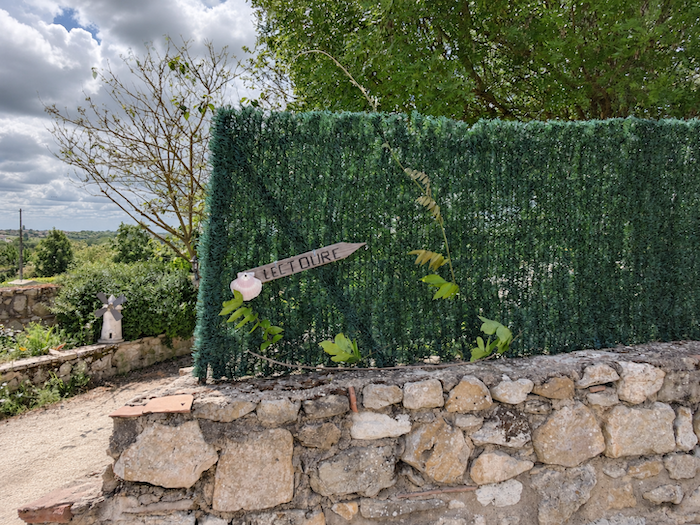
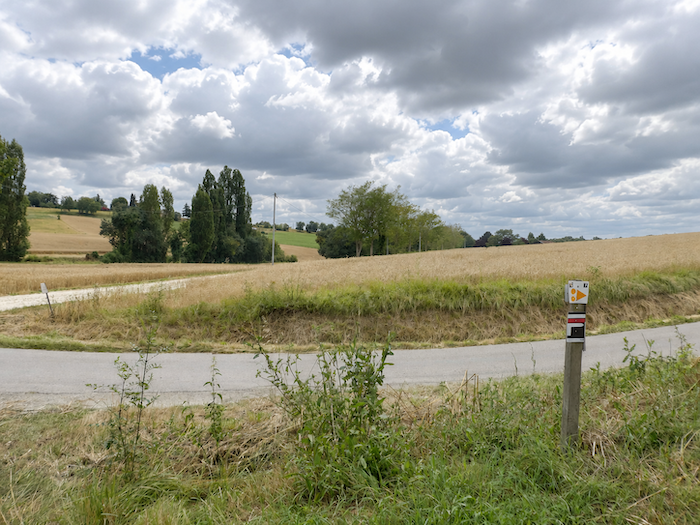
| At the bottom of the dale, the GR65 rejoins a narrow road that immediately begins climbing the opposite hillside. The slope is just as demanding, and cereal fields accompany this new ascent. In this land of hills, every descent seems to be merely a roundabout way of announcing the next climb. |
 |
 |
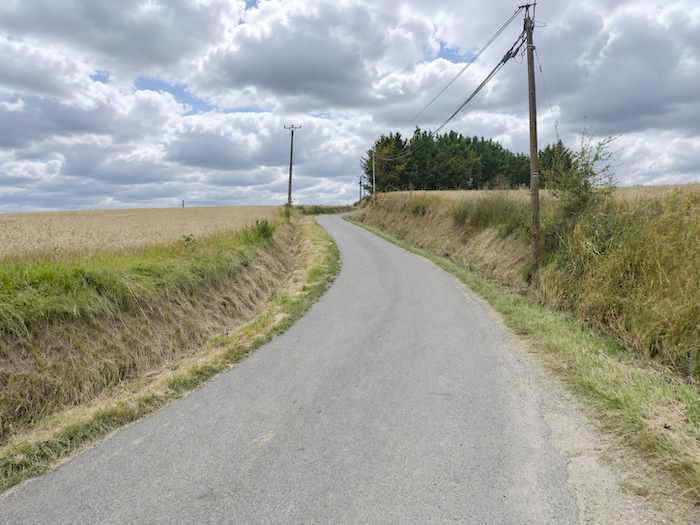
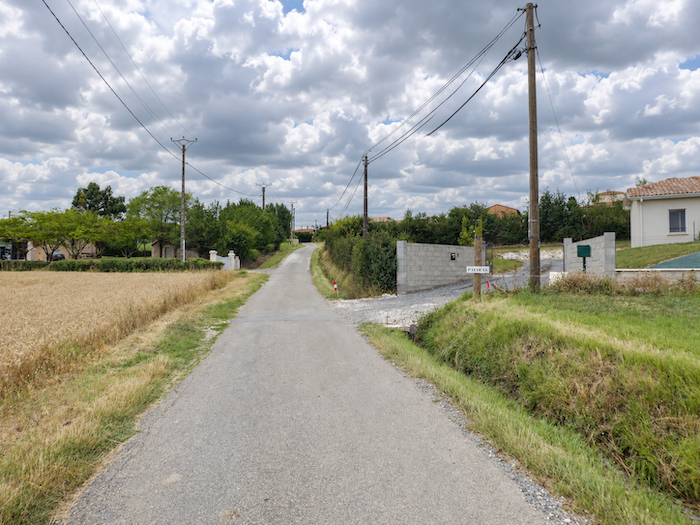
| The road continues its ascent between a few farms and the residential developments of Petit Vaucluse. The vast expanses of farmland gradually give way to the first signs of a more residential landscape, indicating that, appearances notwithstanding, the town is drawing closer. |
 |
 |
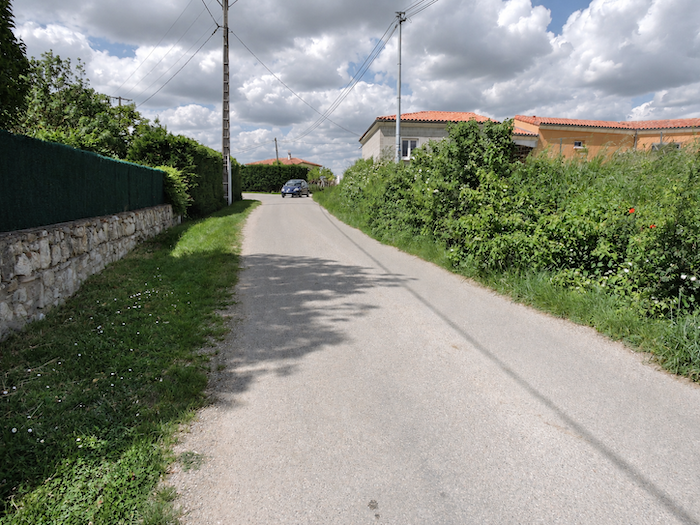
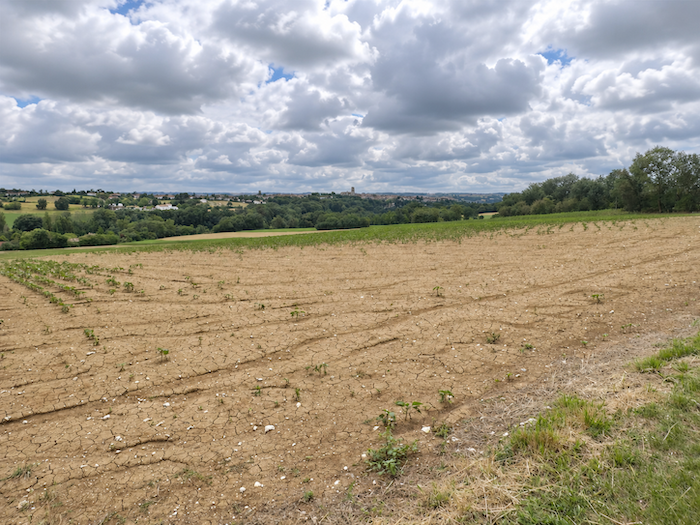
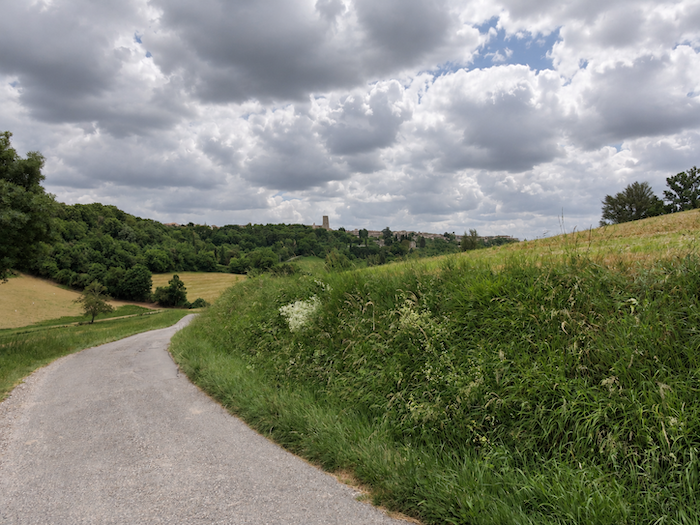
| Lectoure comes into view once more, perched on its heights, with that rather provocative habit hilltop towns have of appearing close at hand when they are still a long way off. The town occupies a plateau overlooking the countryside, and one only has to study the terrain to understand what lies ahead. Between the town and us, another valley still opens up, one that must inevitably be descended before climbing back towards the houses. By now, pilgrims know the familiar refrain: whatever height is gained on one side often has to be surrendered on the other. |
 |
 |
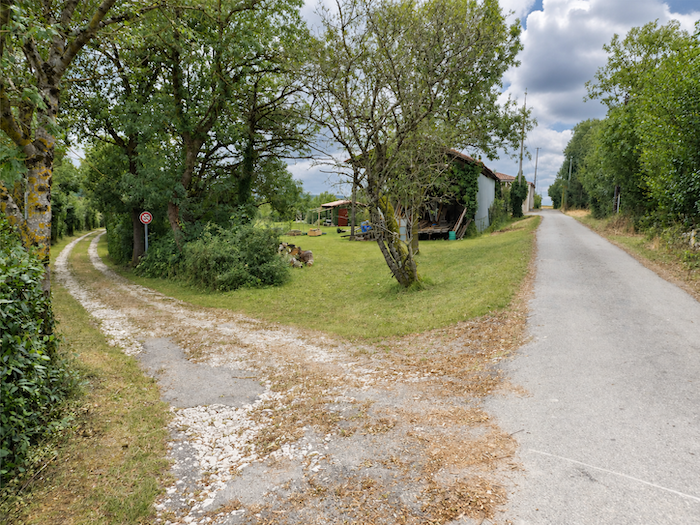
| And that is exactly what happens. Barely beyond the last farms of the hamlet, the GR65 leaves the road for a path that plunges into a woodland of deciduous trees. Oaks and maples, faithful companions throughout these Gers hills, still reign supreme, but this time wild walnut trees have taken the place of chestnuts. |
 |
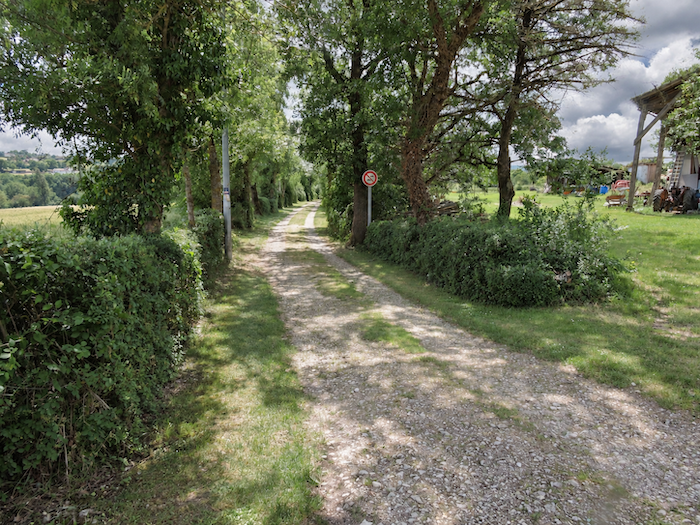 |
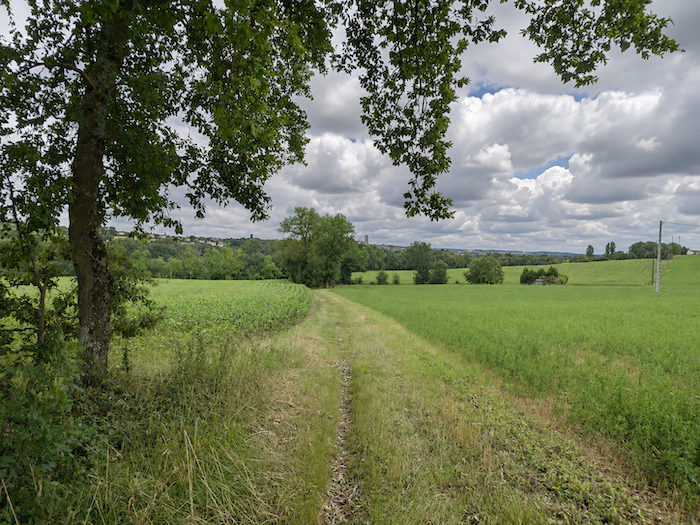
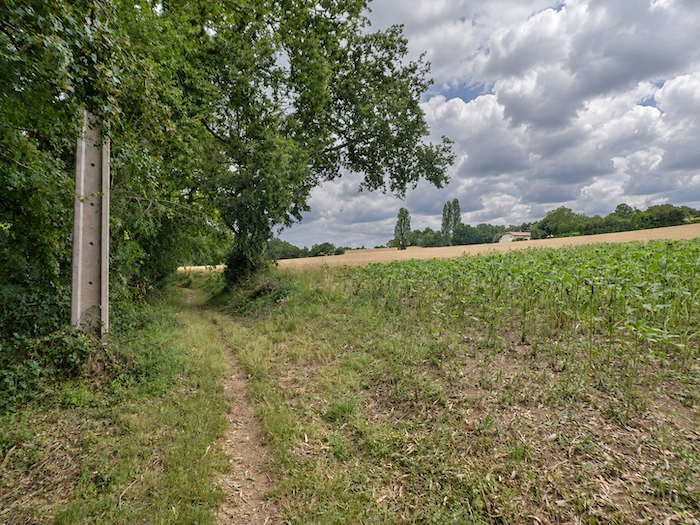
| But do not imagine a deep forest where the trees close their branches overhead. Here, the woodland consists rather of long hedgerows bordering the fields and emphasizing the gentle undulations of the terrain. Cereal crops occupy the higher ground, while sunflowers spread across the lower slopes, as though each crop had chosen its own level in this carefully divided countryside. |
 |
 |
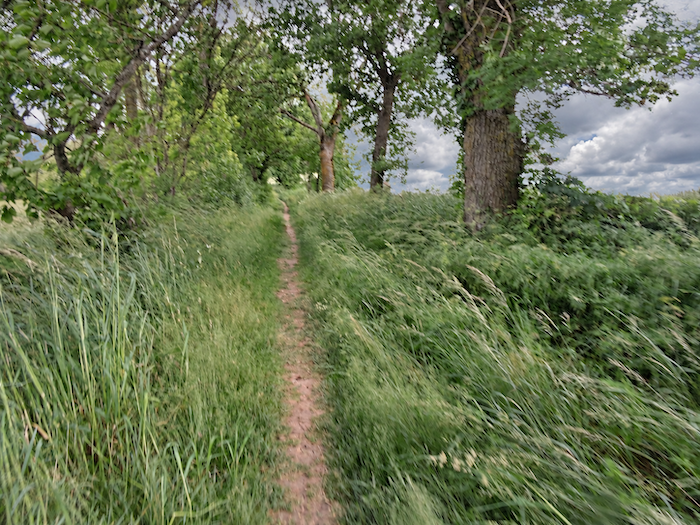
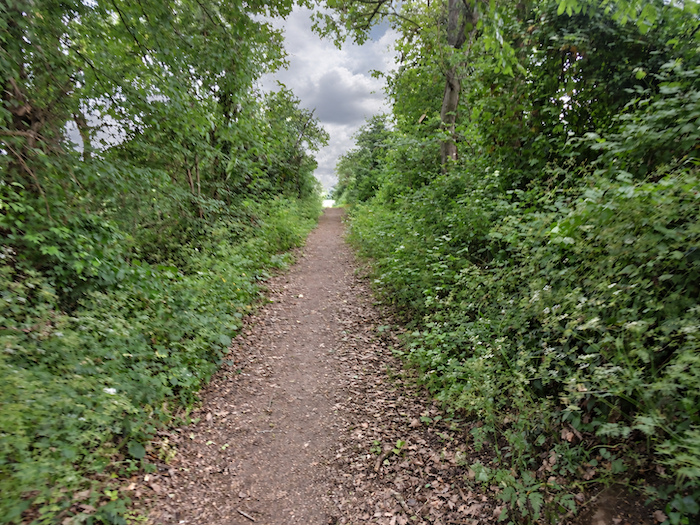
| In places, however, nature reasserts itself and takes on a wilder character. The trail almost disappears beneath the untamed grasses. You then make your way through less disciplined vegetation, where even the Way itself seems uncertain which direction to take. |
 |
 |
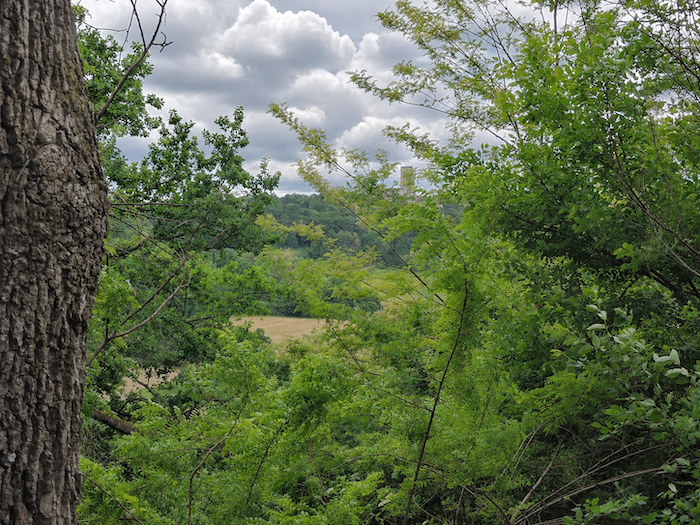
| And now the GR65, ever fond of those little whims whose necessity it alone seems to understand, indulges in yet another detour through the woodland. A brief excursion beneath the trees, a few bends through the greenery, and there it is, back on the road barely a hundred meters farther on. All that for so little! But it seems that, on the Way of St James, the straight line does not always enjoy a particularly good reputation. |
 |
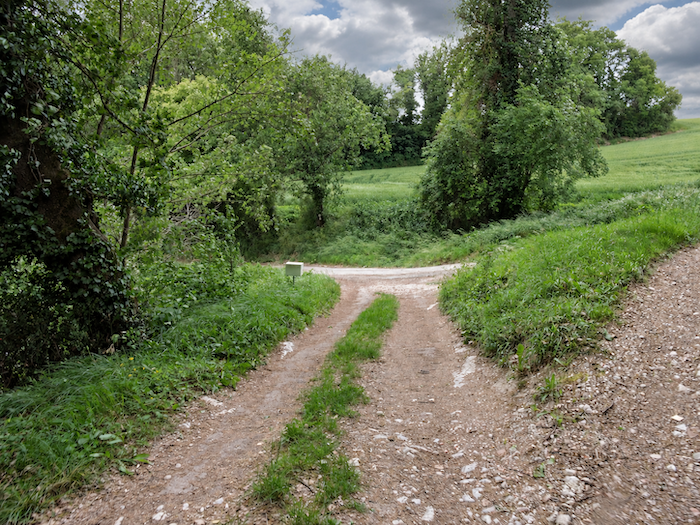 |
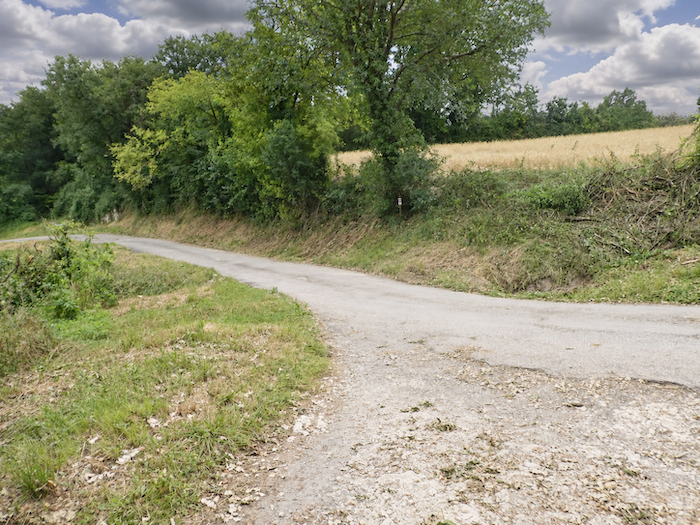
| At the end of this earthy interlude, the GR65 joins a narrow paved road that drops towards the valley floor. Lectoure, meanwhile, continues to play the mysterious stranger, somewhere above the hillside, hidden behind the folds of the terrain. This town has certainly kept us waiting long enough! But let us remain hopeful: after so many descents followed by climbs, surely, we shall eventually manage to get our hands on it. |
 |
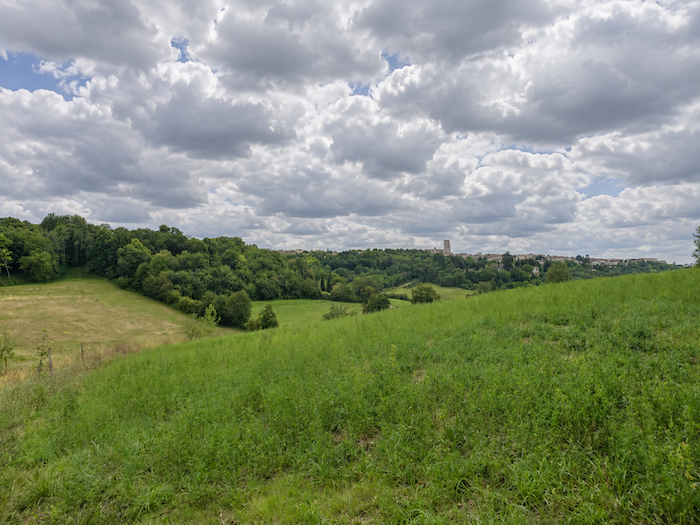 |
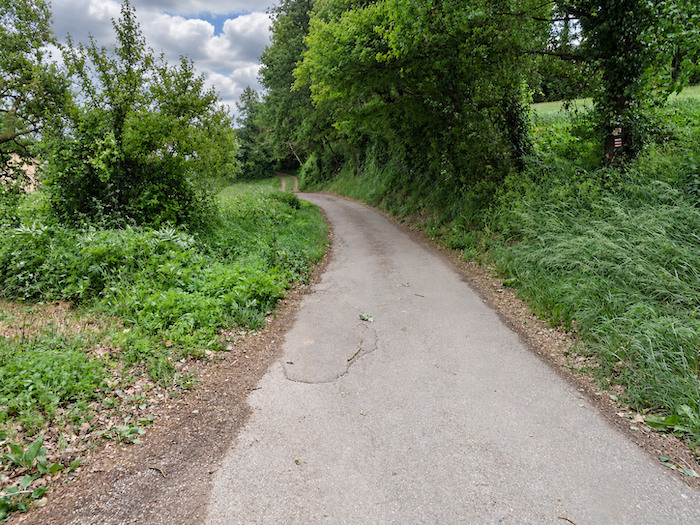
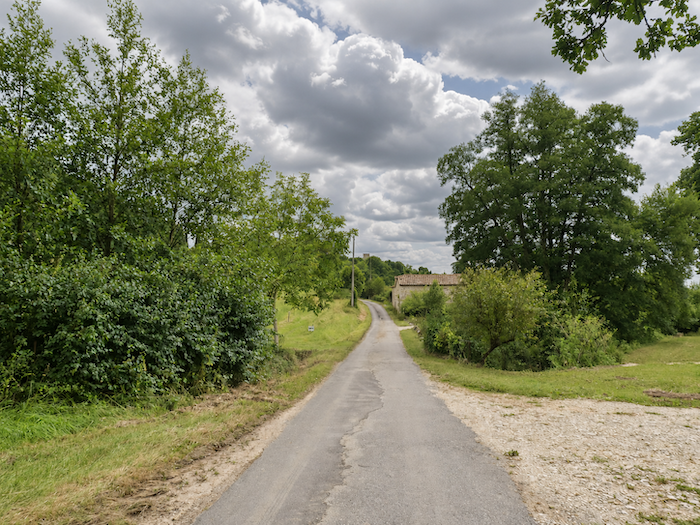
| At the bottom of the dale, the road passes La Mouline de Belin, a magnificent stone manor house where travelers could once find accommodation. The residence has undeniable elegance, with that quiet distinction of fine old properties that seem to have passed through the centuries without losing any of their character. You are now standing at the very foot of Lectoure. Yet however much you raise your eyes and search for its walls, nothing comes into view. They remain hidden by the slope. Never has a town kept its visitors in suspense for so long! |
 |
 |
 |
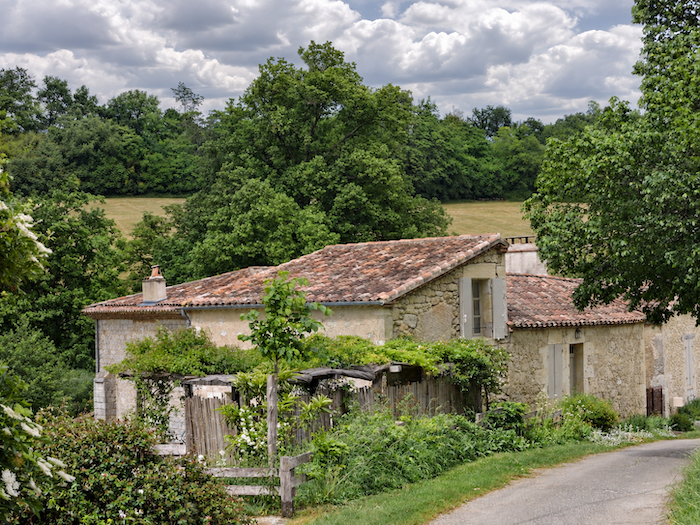 |
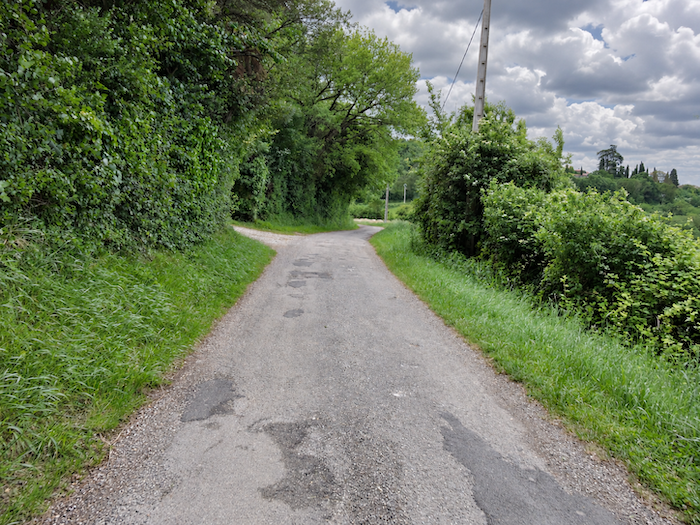
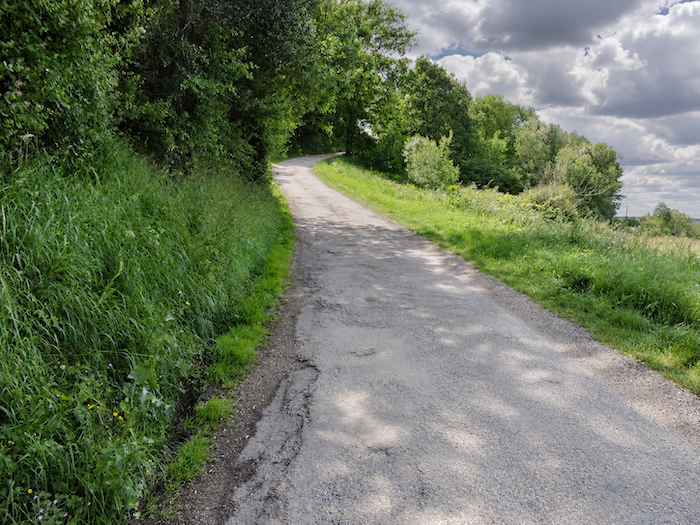
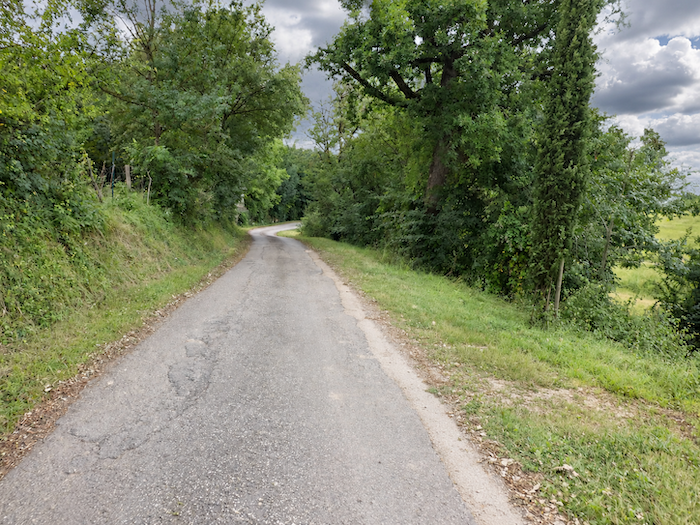
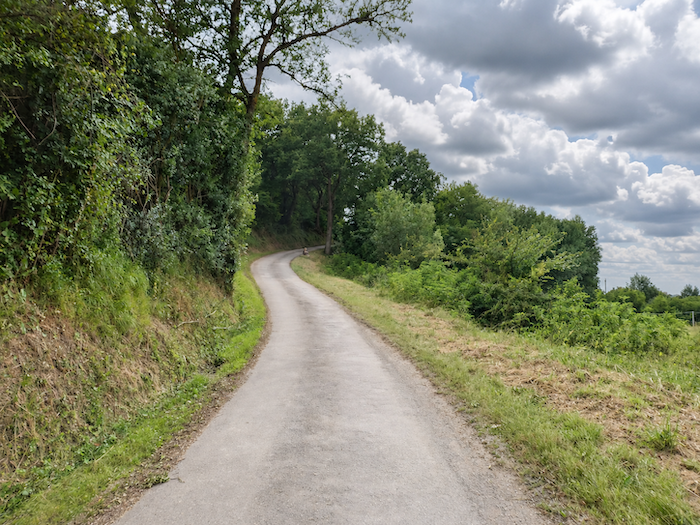
| Here again, those responsible for laying out the GR65 have seen fit to create a path through the grass, just above the beautiful residence, to spare walkers a few meters of asphalt. It is a precaution whose usefulness is difficult to appreciate, given that traffic on this little road is practically nonexistent. You can perfectly well remain on the road without exposing yourself to any particular danger. Even the GR65 itself, seemingly with some reluctance, eventually gives in and almost immediately rejoins the road. But this is where things become more demanding. The road suddenly rears upwards, with a gradient approaching 15%. The climb is tough, fortunately quite short. In Lectoure, people like to say that pilgrims who set out from Auvillar in the morning, after walking more than 32 kilometers, arrive here on their knees. Looking at this final slope, one can readily believe them! |
 |
 |
 |
|
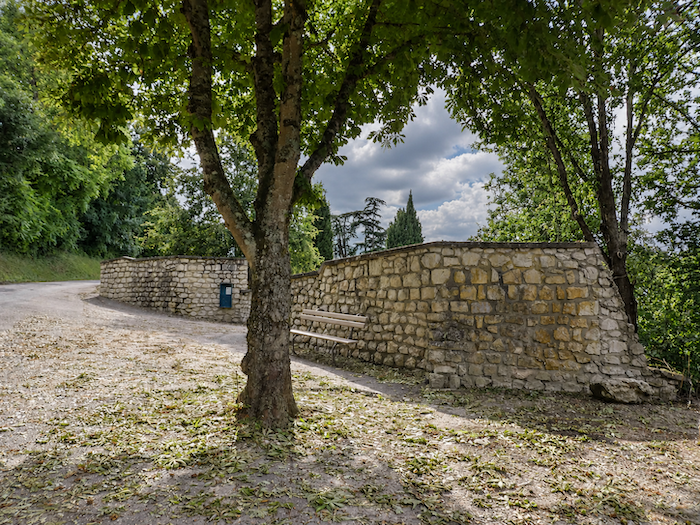
| And then, at the end of this final ordeal, deliverance appears in the most modest form imaginable: a small bench beside the cemetery. It is a welcome place to sit, if only to allow the calf muscles to recover some semblance of tranquility. |
 |
 |
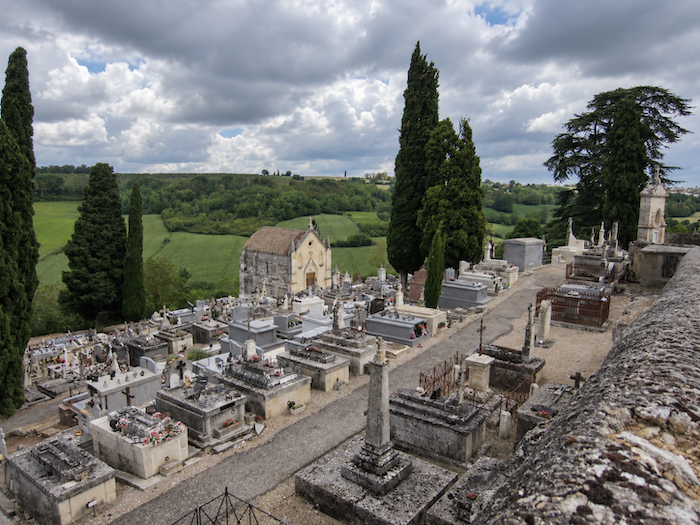
| The cemetery itself deserves far more than a passing glance. Magnificent in its layout and terraced arrangement, it tumbles down the hillside, its graves and funerary monuments following one another along the slope like the tiers of a vast stone amphitheater. |
 |
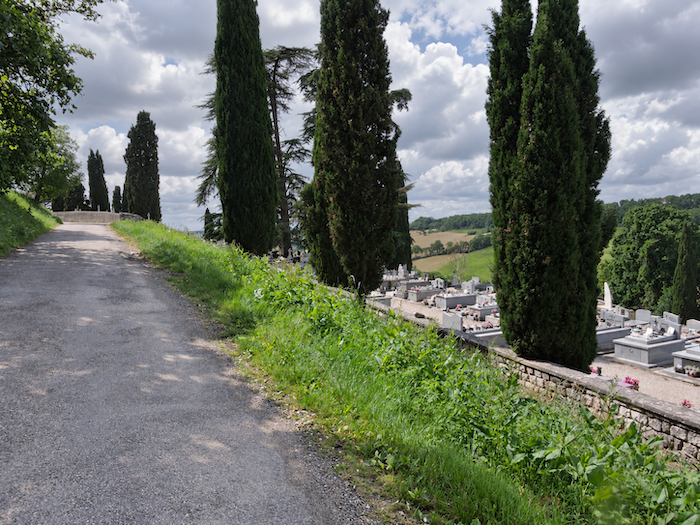 |
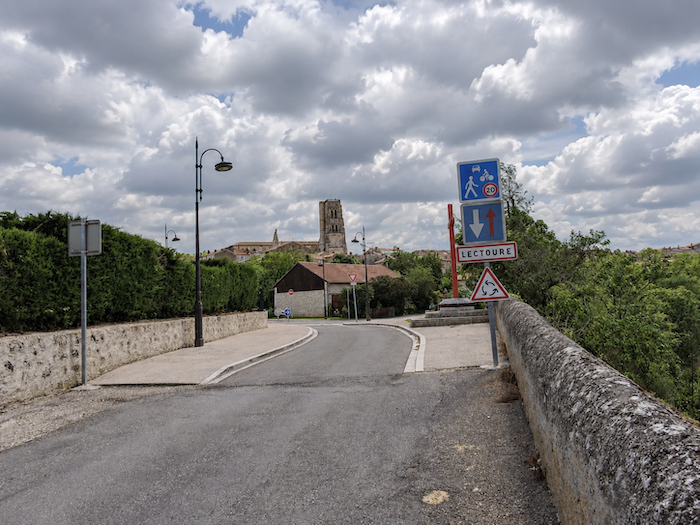
| And this time, there is no mirage, no deceptive promise: Lectoure is finally there, just above the cemetery, sheltered behind its ancient walls. Lectoure is yours at last! |
 |
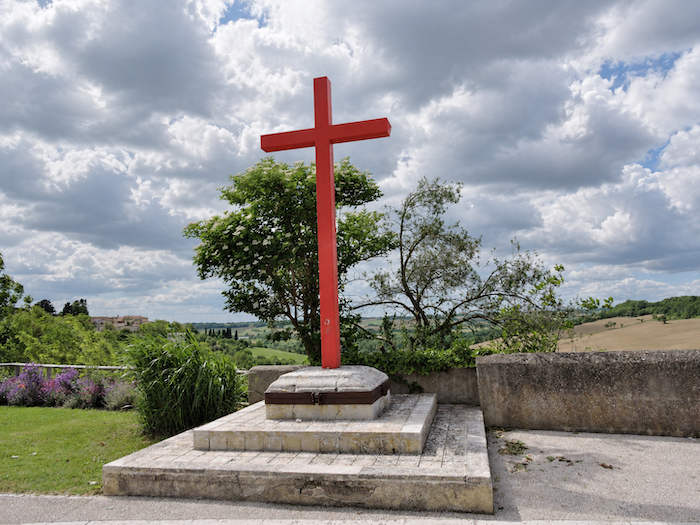 |
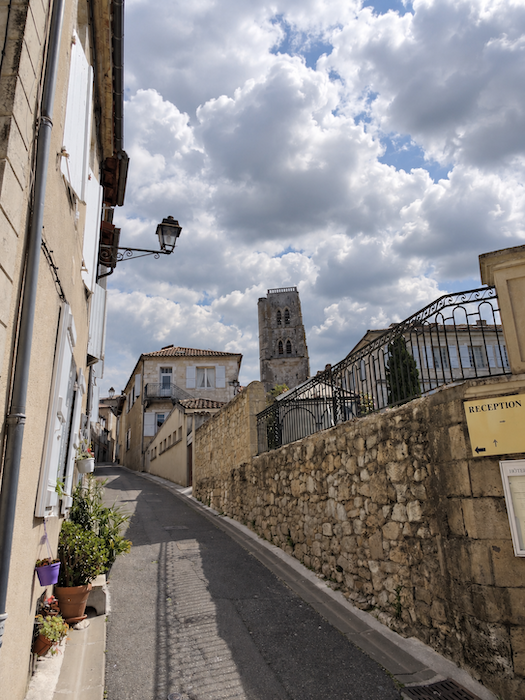
| A narrow street then leads you towards the heart of the old town, just a stone’s throw from the cathedral. After so much wandering through fields and valleys, what a pleasure it is to rediscover ancient stone buildings and the bustle of town streets! |
 |
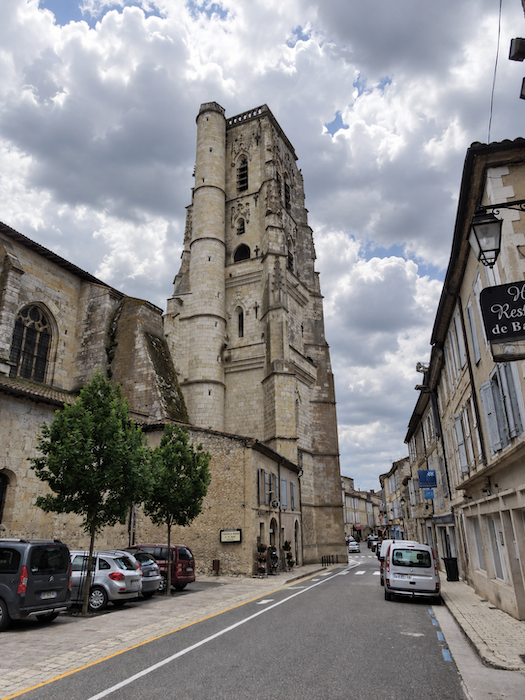 |
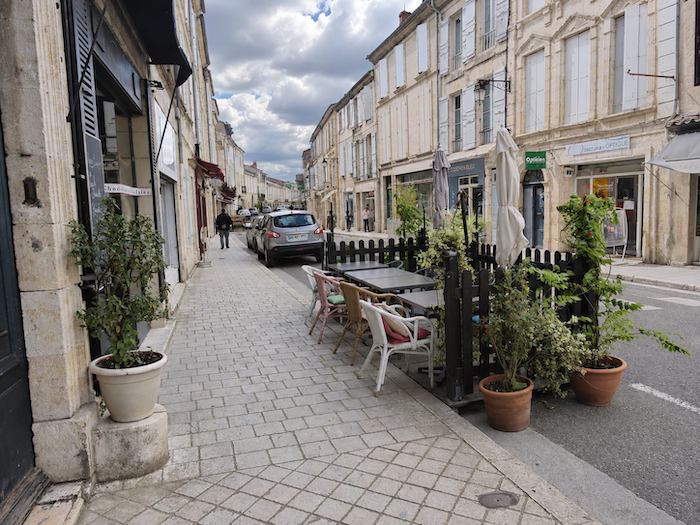
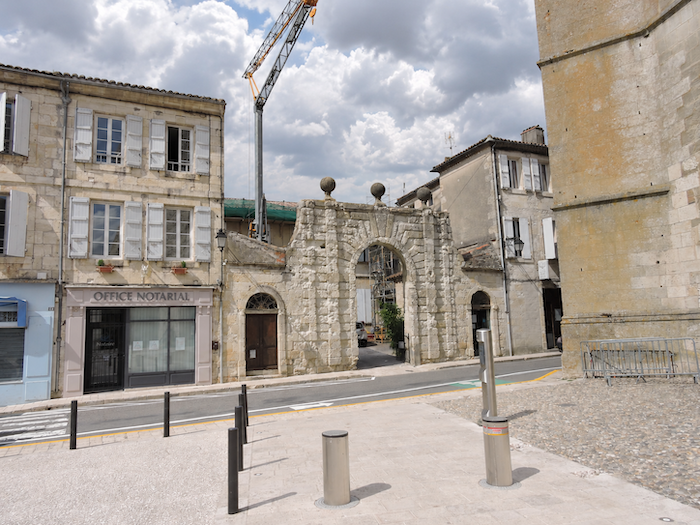
| Perched on its promontory, Lectoure, a small town of some 3,700 inhabitants, certainly lacks neither elegance nor character. The Rue Nationale, once a royal thoroughfare and later an imperial road, runs through it from end to end, like a long backbone around which the old town is organized. Ramparts still encircle the town, although all the gates that once controlled access have disappeared. Within these ancient walls, the lively atmosphere comes as a pleasant surprise. |
 |
 |
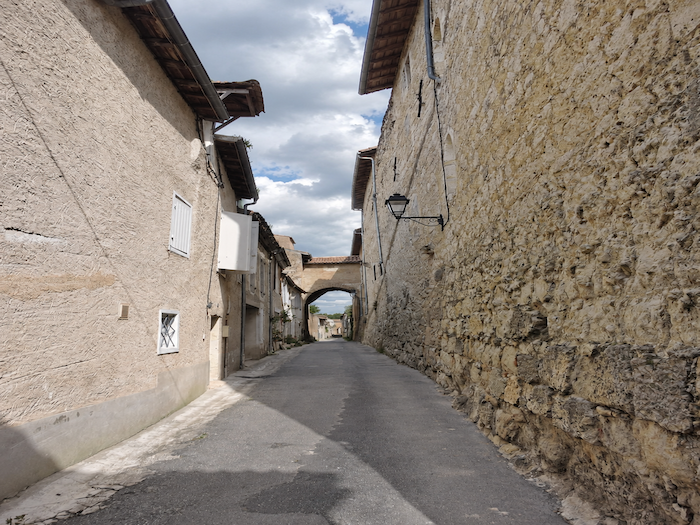
| From the Rue Nationale branches a whole maze of narrow, sometimes dark alleyways, winding between old houses towards the ramparts. |
 |
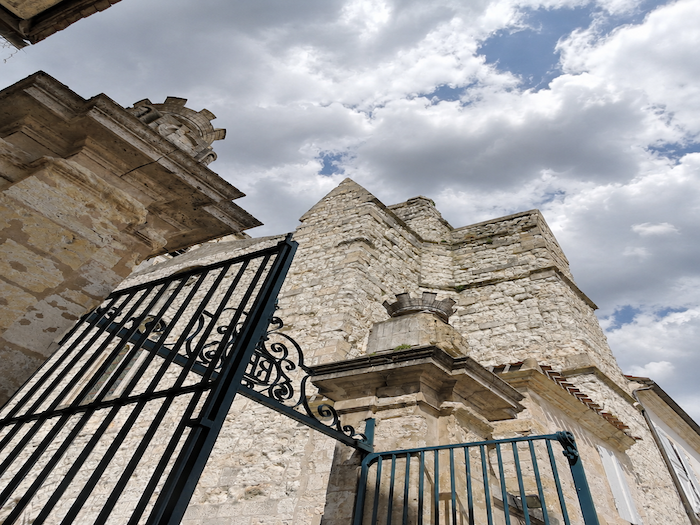 |
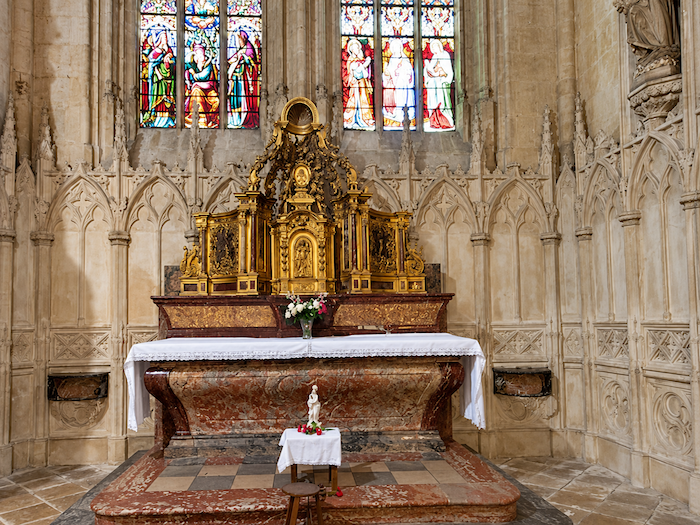
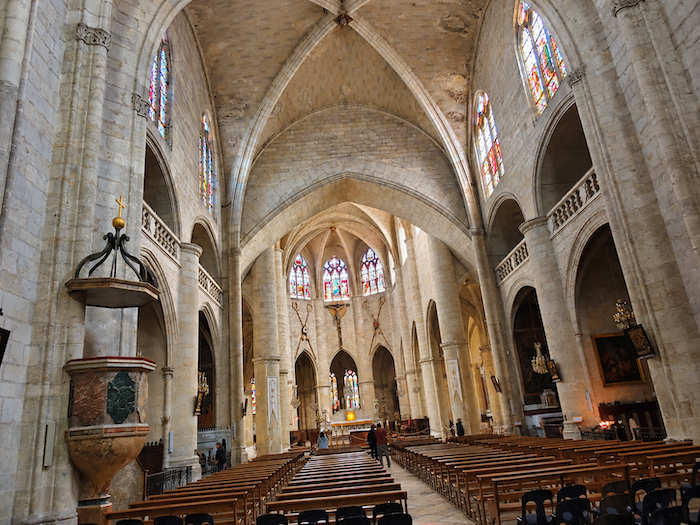
| The Cathedral of Saint-Gervais-et-Saint-Protais bears in its stones the traces of a long and eventful history. From its Romanesque origins, altered over the centuries, it gradually embraced the boldness of Flamboyant Gothic, blending different periods in an architecture where each generation seems to have wanted to leave its mark. Its imposing tower, once crowned by a spire, lost some of its former splendor over the centuries, particularly during the French Revolution. Yet it still rises proudly above the rooftops of Lectoure, even without its former crowning glory. Inside, the cathedral preserves the relics of Saint Clair of Aquitaine, a figure from the early days of Christianity in the region, traditionally associated with the episcopal sees of Albi and Lectoure. |
 |
 |
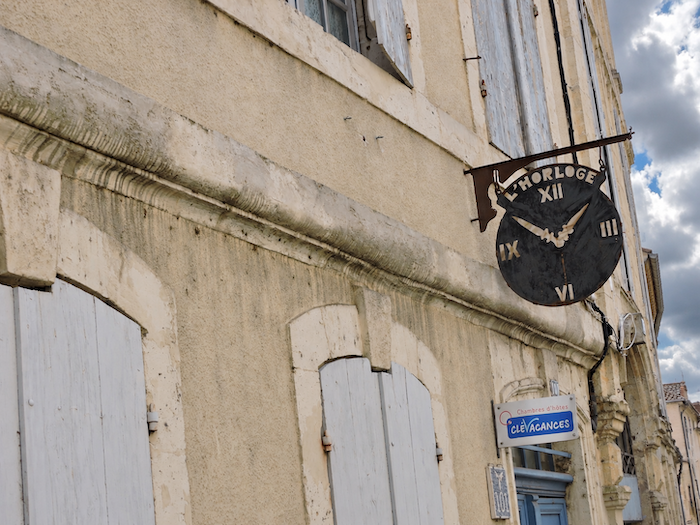
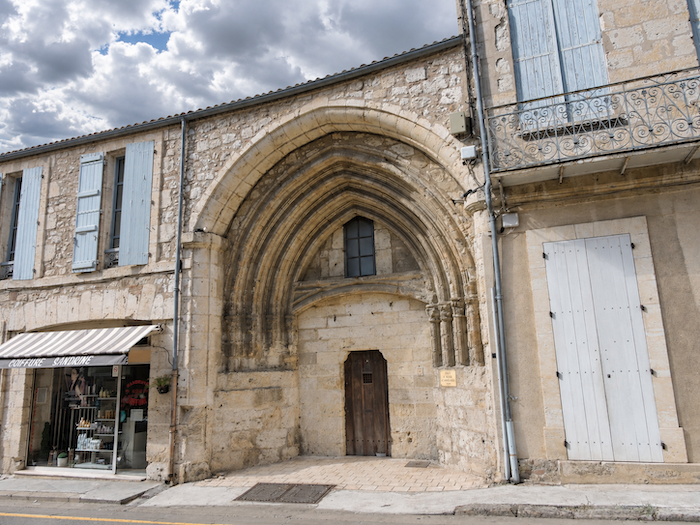
| The houses themselves tell part of this history. Behind their exposed stone façades, often weathered by centuries, lie elegant bourgeois residences and several fine townhouses dating from the 17th and 18th centuries. Ornate doorways, tall windows and noble proportions bear witness to a past when Lectoure had no shortage of prominent citizens and families eager to display their social standing. |
 |
 |
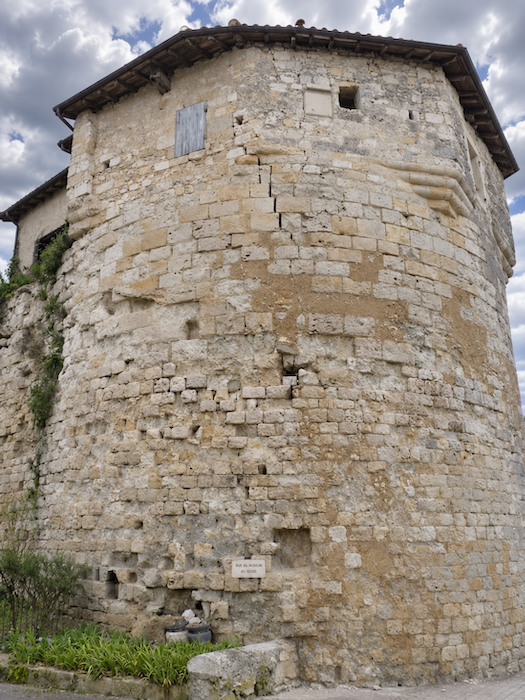
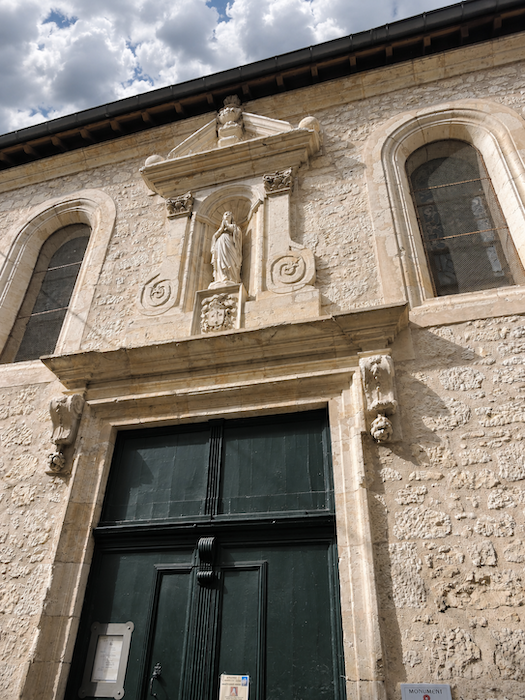
| There is still much to linger over, from the Tour du Bourreau, or Executioner’s Tower, a 14th-century relic and one of the few surviving towers of the former fortified enclosure, to the Carmelite convent, behind whose walls the discreet life of the Carmelite nuns continues. But Lectoure has not yet revealed all its secrets. Other treasures lie hidden below the ramparts, where the old town slopes down towards the countryside. We shall discover them on the next stage. After all, it would be a shame to reveal all at once the charms of a town that has kept us waiting for so long! |
 |
 |
Accommodation on Via Podiensis
- Gîte Domaine de Gachepuy, Marie et Jean-Pierre (pèlerins) Gachepuy; 07 59 59 34 01; Gîte donativo, cuisine
- Gîte Le Temps de l’Escargot, 10 Rue des Glycines, Castet-Arrouy; 06 11 44 80 53; Gîte, dinner, breakfast
- Gîte Communal, Place de la Mairie, Castet-Arrouy; 06 54 92 73 96/05 62 29 28 43; Gîte and tents, dinner, breakfast, cuisine
- Chambre d’hôtes Au Musée d’Albert, 1 Place de l’Église, Castet-Arrouy; 06 22 18 42 76/09 83 35 28 31; Guestroom, breakfast
- Chambre d’hôtes Le Boué, Le Boué; 05 62 68 89 49; Guestroom, dinner, breakfast
- Chambre d’hôtes le Tarissan, Le Tarissan; 06 78 38 60 60; Guestroom, cuisine
- Accueil Presbytère, Rue St Gervais, Lectoure; 06 17 06 09 24; Gîte donativo, dinner, breakfast
- Gîte Le Pas Sage,29 Rue des Frères Danzas, Lectoure; 07 62 20 89 83; Gîte, dinner, breakfast, cuisine
- Gîte L’Etoile Occitane, Isabel (pélerine), 140 Rue Nationale, Lectoure; 05 62 68 82 93/06 7445 11 17; Gîte and Guestroom, breakfast, cuisine
- Gîte La Manufacture Royale de Lectoure, Chemin Claude Ydron, Lectoure; 06 83 51 26 67; Gîte, breakfast, cuisine
- Gîte A2 Pas, 56 Rue Nationale, Lectoure; 06 70 99 37 79; Gîte, breakfast, cuisine
- Chambres d’hôtes Édredon et Coccinelle, 20 Rue du Corhaut, Lectoure; 06 66 10 95 76; Guestroom, dinner, breakfast
- Chambres d’hôtes Le Clos de Lectoure, 87 Rue Nationale, Lectoure; 06 18 32 42 42; Guestroom, breakfast
- Chambres d’hôtes Les Capucins, Françoise (pélerine), 1 Rue des Capucins, Lectoure; 06 27 36 07 21; Guestroom, breakfast
- Chambres d’hôtes St Gervais, 17 Rue St Gervais, Lectoure; 06 61 17 45 01; Guestroom, breakfast
- Hôtel -restaurant de Bastard***, Rue Lagrange, Lectoure; 05 62 68 82 44; Hotel, dinner, breakfast
Year after year, the Camino de Santiago changes and reinvents itself, shaped by the seasons and the footsteps of its pilgrims. Some places to stay close their doors, while others, modest or unexpected, spring up along the way. It would therefore be unrealistic to claim that any list could ever be both permanent and exhaustive. The following selection includes only accommodation located directly on the route or within one kilometer of it. It was updated in 2026 and should therefore remain largely reliable over the next few years. For those wishing to explore further, one guide stands out as an essential reference: Miam Miam Dodo, readily available online. Its greatest strength lies in the fact that it is updated every year. Rather than limiting itself strictly to accommodation along the route, it also lists places to stay further afield, a particularly valuable resource when large numbers of pilgrims make finding a bed at the usual stopping points more uncertain. It also contains a wealth of practical information: welcoming bars, restaurants along the way, and conveniently located bakeries. all welcome stops that punctuate the journey. Alongside these traditional resources, another presence has now become impossible to ignore: Airbnb. The platform has established itself as a major player in the tourism landscape, even in quieter or less prosperous regions. However, as most travelers know, exact addresses are not displayed upfront, which means that some advance planning is required. On the Camino, finding a bed at the last minute can sometimes come down to a fortunate stroke of luck. But luck, by its very nature, is no strategy. Booking ahead is therefore strongly recommended. Finally, when making your arrangements, be sure to ask about dinner and breakfast options. Such details may seem insignificant, but they can make a long day on the Camino considerably more comfortable.
If we take stock of the available accommodation, there are around 40 beds before reaching Lectoure, suggesting that many pilgrims choose to stop earlier along the route. In Lectoure itself, the choice expands to around 150 beds, including a good hotel with 26 rooms. While the Via Podiensis generally sees between 100 and 200 walkers, there tend to be fewer pilgrims after Cahors. Finding accommodation on this stage should therefore not present any major difficulty, although it is always advisable to book ahead.
These routes wind through often sparsely populated areas, where shops and other services are limited. Restaurants are few and far between, as are grocery shops, which are often little more than small local outlets selling bread along with a limited selection of vegetables and dairy products. Food and refreshments are available along the route in Castet-Arrouy, where there is also a water point, but no public toilets. On arrival, Lectoure offers a full range of places to eat, as well as shops and other services. Finally, numerous companies provide luggage-transfer services or transport back to the starting point. Among them, one stands out as a particularly well-established option: La Malle Postale.
Feel free to add comments. This is often how you move up the Google hierarchy, and how more pilgrims will have access to the site.
|
 |
Next stage : Stage 25: From Lectoure to La Romieu |
|
 |
Back to menu |